
ContextQA
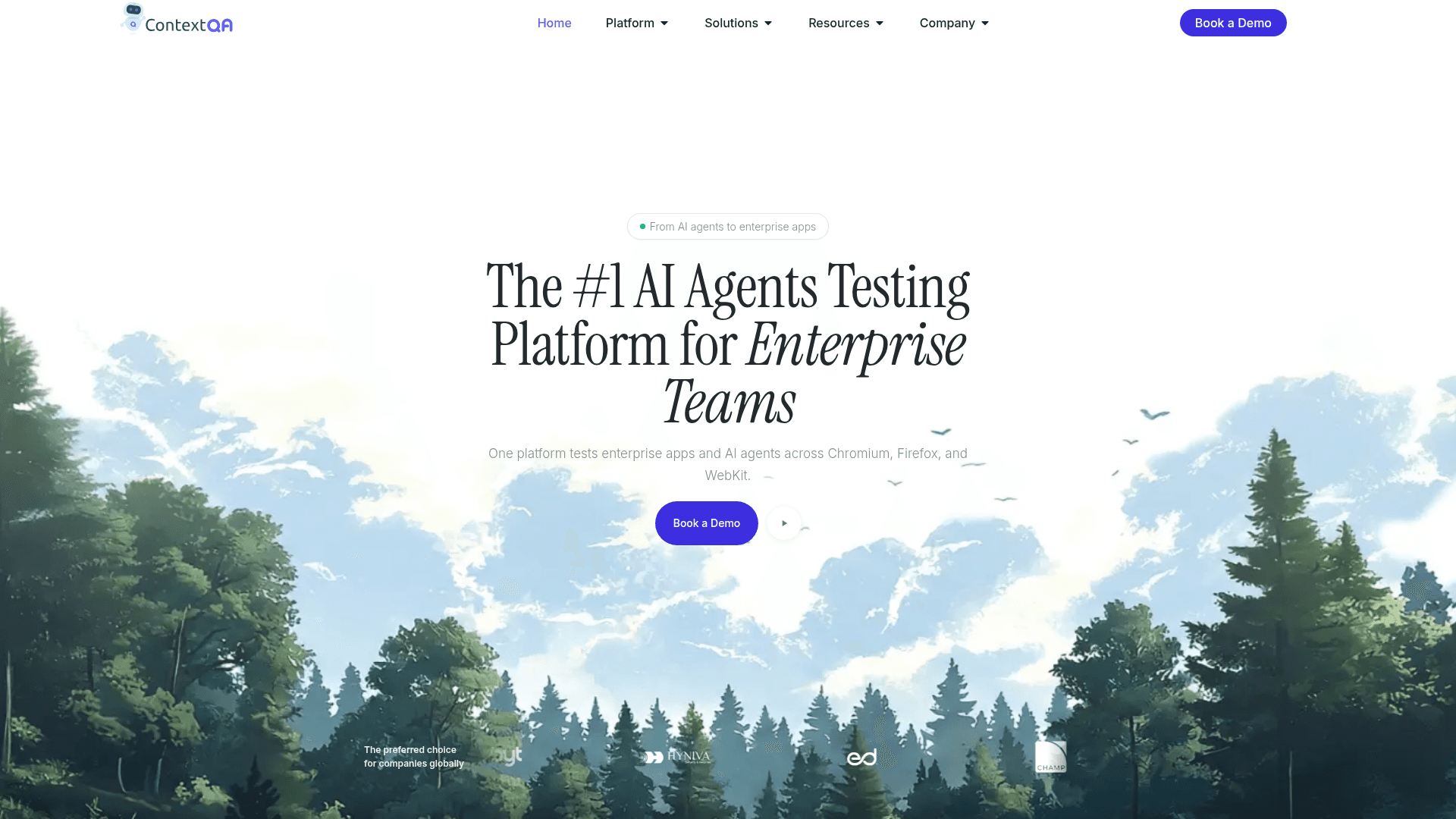
AI-native test automation platform that generates, self-heals, and runs tests across web, mobile, API, and AI agents for enterprise engineering teams.
At a Glance
Engagement
Available On
Alternatives
Listed Jul 2026
About ContextQA
ContextQA is an agentic AI testing platform built for enterprise engineering and QA teams that need to keep pace with fast release cycles. It generates test cases from plain English, user stories, or Jira tickets; auto-heals broken selectors when the DOM shifts; and runs suites in parallel across Chromium, Firefox, WebKit, iOS, and Android. The platform is headquartered in San Francisco, California, and is SOC 2 Type II certified with 99.9% uptime.
What It Is
ContextQA positions itself as an AI-native replacement for the combination of a test execution tool, a test manager, and an AI agent QA layer. Rather than bolting AI onto a record-and-playback core, the platform is built around agentic reasoning from the ground up. It covers web UI, mobile (native iOS and Android), REST and GraphQL APIs, databases, Salesforce, SAP/ERP, and AI agents — all from a single platform with shared reporting, role-based access control, and a unified data model.
Core Capabilities
- AI-generated test cases — Point ContextQA at any application flow and it writes a production-grade suite covering happy paths, edge cases, and failure states without manual scripting.
- Self-healing tests — When the DOM shifts and selectors break, ContextQA patches locators within the same run. The platform states it has executed 18M+ tests and auto-fixed 3M broken ones.
- Root cause analysis — Every failure is traced across visual, DOM, network, code, and data layers, with screenshots and logs surfaced automatically.
- Visual regression — AI-powered visual diff captures baseline screenshots and compares them against future runs, filtering false positives.
- Performance and accessibility testing — Load, stress, WCAG, ADA, and Section 508 compliance checks are built in via the AxeTOS engine.
- MCP server — One plain-English prompt maps to up to 50 testing tools in the automation engine, letting developers run suites from Cursor, Claude Code, or Codex without switching context.
AI Agent Testing
ContextQA includes a dedicated module for testing non-deterministic AI agents as a black box — the same way end users interact with them. It generates adversarial scenarios including hallucination traps, policy violations, and multi-turn edge cases, then scores every response using configurable AI judgment combined with deterministic checks, returning a confidence score rather than a simple pass/fail. The platform states it supports agents running on Salesforce Agentforce, Amazon Bedrock, Azure AI Foundry, Snowflake Cortex, Intercom Fin, and custom-built agents, with no SDK or code instrumentation required on the agent platform side.
Integrations and CI/CD Fit
ContextQA connects to CI/CD pipelines via Jenkins, GitHub Actions, GitLab, Azure DevOps, and CircleCI. Project management and bug-tracking integrations include Jira, TestRail, ServiceNow, and Linear. Communication integrations cover Slack and Microsoft Teams. Device lab integrations include BrowserStack and Sauce Labs. The platform also exposes a REST API and CLI for custom pipeline integration. Tests can be exported as clean Playwright, Selenium, Cypress, or WebDriverIO code at any time, avoiding vendor lock-in.
Deployment and Security
ContextQA runs on cloud infrastructure with 99.9% uptime and is SOC 2 Type II and ISO 27001 certified, with GDPR compliance. On-premises and VPC deployment options are available for organizations with strict data residency or compliance requirements. The platform states that customer data is never used for model training.
Target Audience and Use Cases
The platform targets engineering and QA teams across enterprise software, finance, healthcare, and AI-first startups. It is designed to serve both technical users (automation engineers, SDETs, developers) and non-technical users (manual testers, project managers) through a no-code UI, an MCP interface for plain-English prompts, and a full API/CLI for deeper pipeline integration. The pricing page describes three tiers — Starter, Growth, and Enterprise — sized by testing footprint rather than seat count, with all pricing determined through a sales conversation.
Community Discussions
Be the first to start a conversation about ContextQA
Share your experience with ContextQA, ask questions, or help others learn from your insights.
Pricing
Starter
For teams proving out AI-native testing on a first app or two.
- AI-generated test cases from plain English or Jira
- Web, mobile, and API testing
- Self-healing tests out of the box
- Code export to Playwright, Selenium, Cypress
- CI/CD integration (GitHub, GitLab, Jenkins)
- Community & Slack support
Growth
For teams scaling automation across releases, environments, and pipelines.
- Everything in Starter, plus
- AI root-cause analysis on every failure
- Visual regression & performance testing
- MCP server for Claude Code, Cursor, VS Code
- Continuous testing across pipelines
- Priority support with SLA response times
Enterprise
For regulated, multi-team orgs that need governance, scale, and a dedicated partner.
- Everything in Growth, plus
- Salesforce, SAP & ERP testing
- AI agent & voice agent testing
- SSO, on-prem, and security hardening
- Multi-project & multi-team governance
- Dedicated CSM & 24/7 enterprise SLA
Capabilities
Key Features
- AI-generated test cases from plain English, user stories, or Jira
- Self-healing tests that auto-patch broken selectors
- AI root cause analysis with visual, DOM, network, and code tracing
- Visual regression testing with AI-powered diff
- Performance and load testing
- Accessibility testing (ADA, WCAG, Section 508) via AxeTOS engine
- AI agent testing (black-box, no SDK required)
- Adversarial scenario generation for AI agents (hallucination traps, policy violations)
- AI judgment + deterministic checks with confidence scoring
- Continuous regression testing across model versions
- Web, mobile (iOS/Android), API (REST/GraphQL), and database testing
- Salesforce, SAP, and ERP testing
- Parallel test execution across browsers and devices
- MCP server connecting 50 testing tools to Claude, Cursor, Codex
- CI/CD integration (Jenkins, GitHub Actions, GitLab, Azure DevOps)
- Code export to Playwright, Selenium, Cypress, WebDriverIO
- BDD/Gherkin test generation
- Data-driven parameterized testing
- Scheduled and on-demand test execution
- Real-time dashboards and analytics
- Role-based access control
- On-premises and VPC deployment
- SOC 2 Type II and ISO 27001 compliance
- Email and Slack notifications for test results
- Impact analysis to identify affected tests from code changes