
corparius
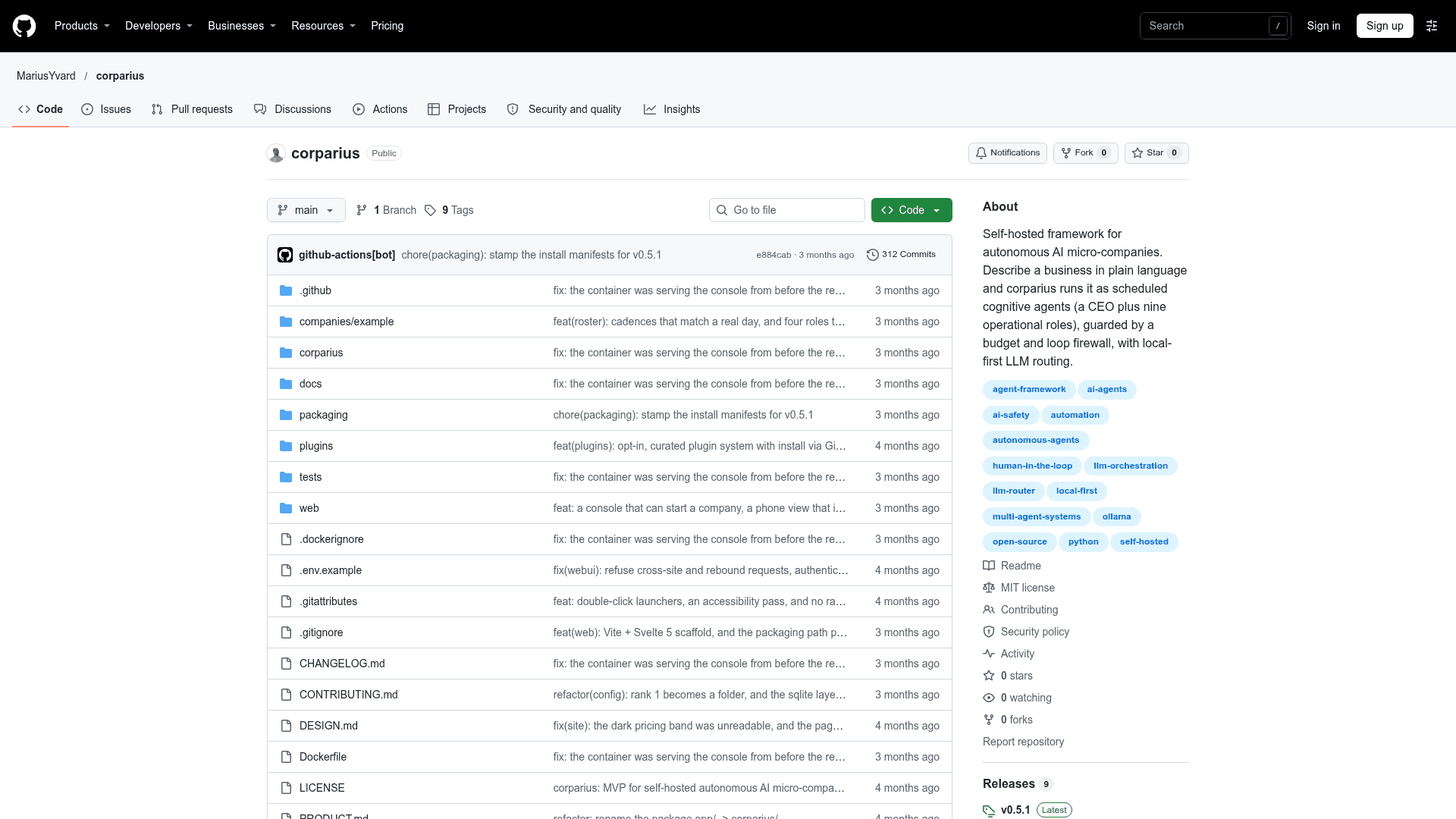
Self-hosted framework that runs autonomous AI micro-companies as ten scheduled agents behind a budget and loop firewall.
At a Glance
Free, MIT-licensed, self-hosted core; no paid tier and no telemetry. Runs offline with a mock LLM; external LLM provider costs (e.g. Anthropic or OpenAI API keys) are separate.
Engagement
Available On
Alternatives
Listed Nov 2026
About corparius
corparius is an MIT-licensed, self-hosted framework from MariusYvard that runs a business described in plain language as ten scheduled agents: a CEO and nine operational roles. The agents pursue one signal, revenue, behind a token budget and a loop firewall. The README describes it as a working MVP that runs end to end offline against a deterministic mock LLM, and the latest listed release is v0.5.1.
What It Is
corparius is an agent orchestration framework for operating a small autonomous company on your own machine. Config, state and models stay local, and cloud LLMs are an opt-in escalation. A scheduler picks the agents due on each tick, routes each turn through a local-first router, records every action and token in a SQLite store, and stops when a guard trips.
Roster, guards and human approval
Each role has a narrow toolset and its own cadence. Ads, outreach, support and finance are held until the company has a published site, a mailbox or a way to be paid. Three automatic guards sit in front of every agent turn: a token budget, a loop guard and a circuit breaker. Tools listed in the HITL setting, by default financial transactions, production code publishing and site deployment, pause the run and file an approval. Approvals can be decided from the console, the CLI or the MCP server.
Console and routing
corparius ui serves a Svelte operator console on localhost, in English and French, with an approval queue, a kanban backlog, per-agent spend, provider keys, mail and Stripe settings, and a chat with the CEO. A versioned JSON API is available, and paired devices get per-device credentials. Routing maps three difficulty tiers to provider targets such as local Ollama, Anthropic, Claude Code, many OpenAI-compatible providers, or a custom gateway, with a fallback chain ending at the local model. corparius preflight verifies with one real call which models an account can reach.
Extending a company
Plugins add providers, tools or templates and are curated and off by default. Skills are SKILL.md prose folders whose bodies enter a prompt only when a named tool is about to run. Documents such as PDF, docx, pptx, xlsx, CSV and Markdown are read with the standard library. Apps expose configured providers behind features like a site FAQ. The project also documents France/EU compliance considerations.
Community Discussions
Be the first to start a conversation about corparius
Share your experience with corparius, ask questions, or help others learn from your insights.
Pricing
Open Source (Self-hosted)
Free, MIT-licensed, self-hosted core; no paid tier and no telemetry. Runs offline with a mock LLM; external LLM provider costs (e.g. Anthropic or OpenAI API keys) are separate.
- MIT License
- Self-hosted
- Runs offline with mock LLM, SQLite, no keys
- Ten scheduled agents (CEO plus nine roles)
- Budget and loop firewall
Capabilities
Key Features
- Ten scheduled agents: a CEO plus nine operational roles
- Token budget, loop guard and circuit breaker
- Human-in-the-loop approval gate for money and production code
- Local-first tiered LLM routing with fallback chain
- Preflight check of which models an account can reach
- Operator console with approval queue, kanban backlog and CEO chat
- Versioned JSON API and per-device pairing credentials
- MCP server support
- Plugins, skills, documents and apps for extending a company
- Sales site generation and deployment
- Runs offline with a mock LLM and SQLite
- Optional encryption of saved secrets at rest
- Backup and restore commands