
CueMap
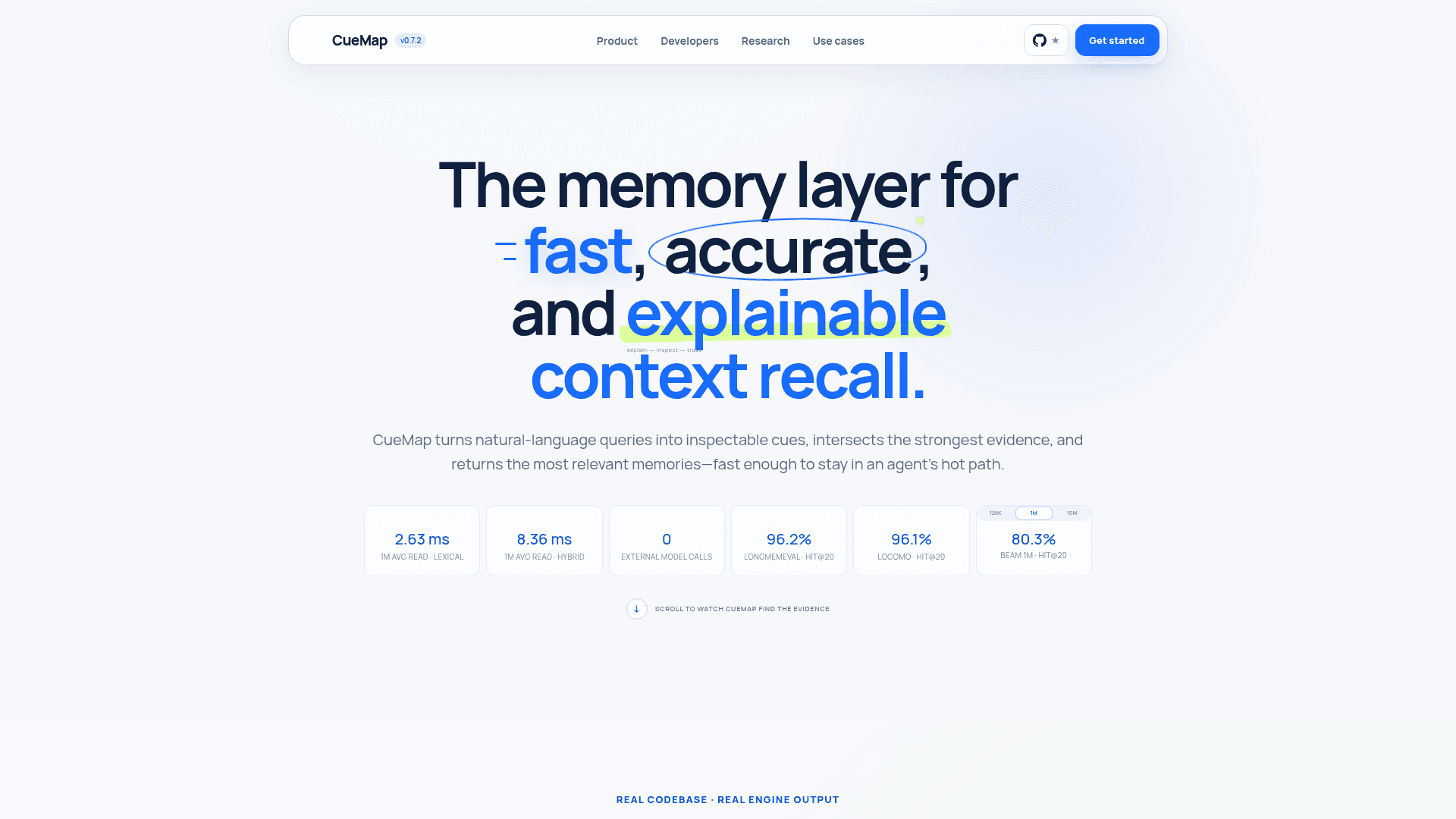
A deterministic, high-performance memory engine built in Rust that gives AI agents fast, accurate, and explainable context recall without external model calls.
At a Glance
Full self-hosted engine under BSL-1.1, converting to Apache 2.0 in 2030. Free for development, testing, and self-hosting.
Engagement
Available On
Alternatives
Listed Aug 2026
About CueMap
CueMap is a high-performance temporal-associative memory store built in Rust, designed to give AI agents durable, inspectable context recall. It turns natural-language queries into deterministic cues, intersects the strongest evidence, and returns source-backed memories—without relying on external model calls or opaque vector search by default. The project is developed by cuemap-dev and is currently at v0.7.2, released in August 2026.
What It Is
CueMap is a memory layer for AI agents and long-running assistants that need to recall information across sessions without hallucinating or losing provenance. Unlike pure vector databases, CueMap's default recall path is deterministic and ontology-free: it extracts normalized lexical cues, structural facets (dates, numbers, entities, source metadata), and recency/salience signals at write time, then resolves queries through the same deterministic normalization at read time. An optional bundled local MiniLM-L3-v2 encoder adds semantic reranking in hybrid mode without opening external network calls.
Architecture and Core Algorithm
CueMap implements what it calls a Continuous Gradient Algorithm with five stages:
- Intersection (Context Filter): triangulates relevant memories by overlapping cues
- Structural Extraction: emits deterministic cues for observable evidence such as dates, numbers, lists, and surface entities
- Recency & Salience: balances fresh data with high-signal events via an adaptive impact scoring module
- Reinforcement: frequently accessed memories gain signal strength, remaining accessible as they age
- Sparse Recall: uses normalized lexical cues, structural facets, recency, salience, and bounded deterministic reranking
The engine is built on Axum for async HTTP, DashMap + aHash for lock-free concurrent access, and Zstd + ChaCha20-Poly1305 for compressed, encrypted-at-rest persistence. Snapshots are stored as zstd-compressed JSON .bin files and restored automatically on startup.
Performance at Scale
The v0.7.2 release benchmarks, run on a MacBook Pro M-series with 64GB RAM against 1M Wikipedia-derived memories, show:
- Lexical recall: 2.63 ms average, 3.72 ms P95
- Hybrid recall (with bundled local encoder): 8.36 ms average, 10.67 ms P95
- Lexical write: 3.33 ms average
- Hybrid write: 11.28 ms average
- Zero external model calls on the hot path
On retrieval benchmarks, the project reports 96.2% Hit@20 on LongMemEval (470 non-abstention questions, hybrid recall), 96.1% Hit@20 on LoCoMo, and 80.3% Hit@20 on BEAM at 1M scale. These are raw retrieval scores before an answer model interprets results.
Integration and Deployment Paths
CueMap offers four access paths that all talk to the same local Rust process:
- CLI:
cuemap addandcuemap recallfrom any terminal - Python SDK:
pip install cuemap - TypeScript SDK:
npm install cuemap - MCP Server:
npx -y cuemap-mcp@0.7.2— connects coding agents (Claude Code, Cursor, VS Code, OpenAI Codex, Google Antigravity, OpenCode) to the local engine - HTTP API: OpenAPI 3.1 contract at
/openapi.yml - Docker:
cuemap/engineimage with bind-mounted data directory
Configuration uses a layered TOML system (CLI args > env vars > server_config.toml > defaults). Cloud backup is supported for AWS S3, Google Cloud Storage, and Azure Blob Storage. Authentication uses API key headers; encryption-at-rest uses ChaCha20-Poly1305 with PBKDF2 key derivation.
Licensing and Source Availability
CueMap is released under the Business Source License 1.1 (BSL-1.1), licensed by CueMap/Kaan Demirel. The BSL allows full use for development, testing, and self-hosting, but prohibits offering the engine as a competing managed database service. The Change Date is 2030-03-02, after which the license converts to Apache 2.0. Commercial licensing for closed-source SaaS or managed-service use is available by contacting the team directly.
Community Discussions
Be the first to start a conversation about CueMap
Share your experience with CueMap, ask questions, or help others learn from your insights.
Pricing
Open Source
Full self-hosted engine under BSL-1.1, converting to Apache 2.0 in 2030. Free for development, testing, and self-hosting.
- Full Rust engine source code
- CLI, Python SDK, TypeScript SDK, MCP server, HTTP API
- Project-isolated multi-tenant memory
- Deterministic lexical and hybrid recall
- Self-learning ingestion agent
Capabilities
Key Features
- Deterministic cue-based recall without external model calls
- Hybrid recall with bundled local MiniLM-L3-v2 semantic reranking
- Lexical recall averaging 2.63 ms at 1M memories
- Project-isolated multi-tenant memory spaces
- MCP server for coding agent integration (Claude Code, Cursor, VS Code, Codex)
- Python and TypeScript SDKs
- HTTP API with OpenAPI 3.1 schema
- Self-learning ingestion agent with filesystem watcher
- Tree-sitter powered code chunking (Rust, Python, TypeScript, Go, Java, PHP)
- Document parsing: PDF, DOCX, XLSX, CSV, JSON, YAML, XML
- Zstd-compressed, ChaCha20-Poly1305 encrypted-at-rest snapshots
- Cloud backup: AWS S3, Google Cloud Storage, Azure Blob Storage
- Periodic and graceful-shutdown snapshot persistence
- API key authentication with multi-key support
- Configurable via TOML with layered CLI/env/config override
- Adaptive salience bias and reinforcement-based access learning
- Manual lexicon wiring and alias management
- Docker support with unprivileged container user
- Bounded reconstruction passes for long-form content
- Match integrity scoring on recall results