
Cynative
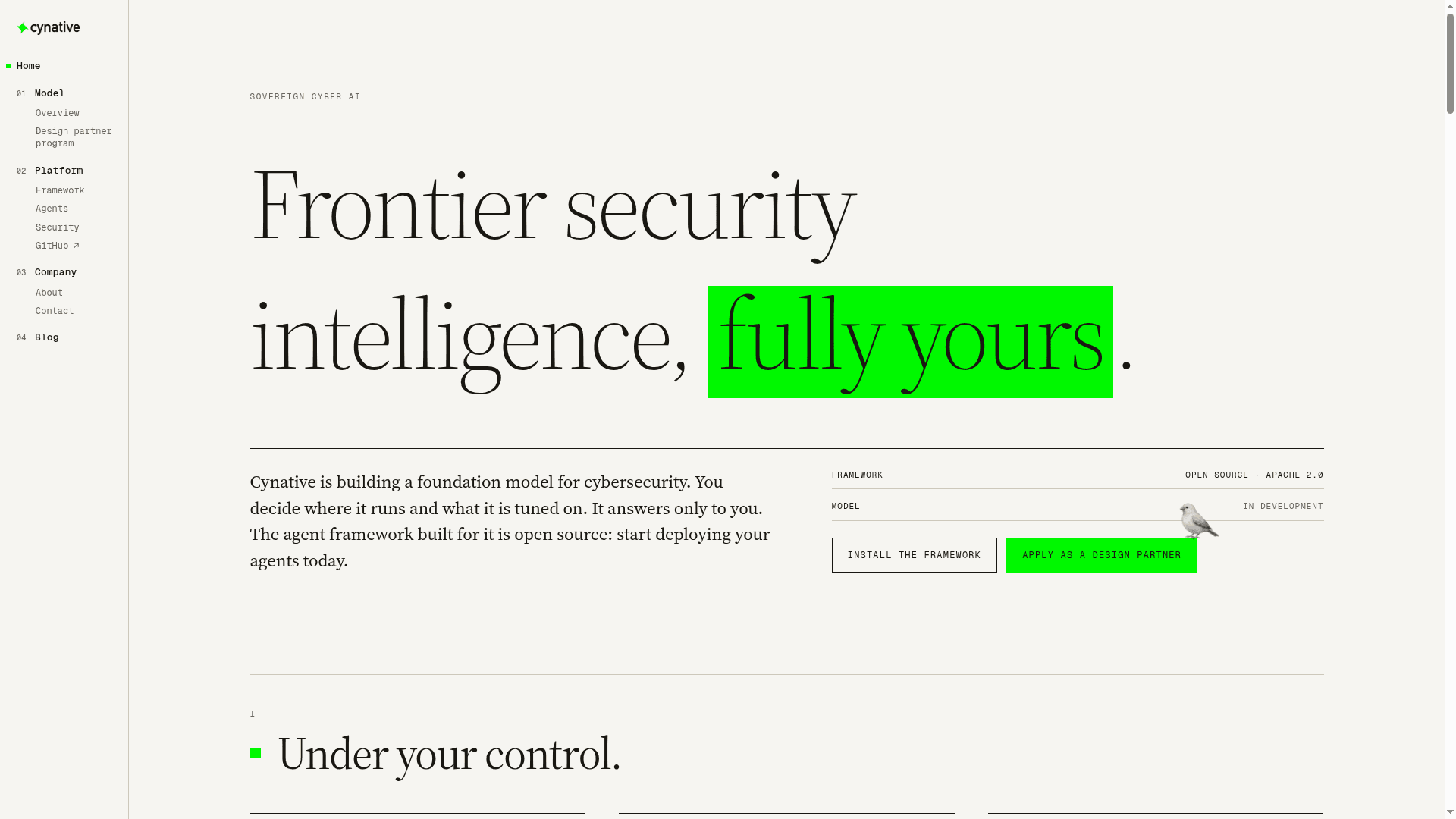
Open-source CLI framework for security agents with live, read-only access to cloud infrastructure across AWS, GCP, Azure, Kubernetes, GitHub, and GitLab.
At a Glance
Fully open-source under Apache-2.0. Free to use, modify, and distribute.
Engagement
Available On
Alternatives
Listed Sep 2026
About Cynative
Cynative is an open-source security agent framework built by a foundation model lab focused on cybersecurity. The framework ships as a single binary CLI tool, licensed under Apache-2.0, and gives security engineers a way to run AI-powered agents against their cloud infrastructure with live, read-only access. The company is also developing a sovereign cybersecurity foundation model — currently in development — designed to run entirely within a team's own perimeter.
What It Is
Cynative is a CLI-based agent harness for security engineers. It connects to AWS, GCP, Azure, Kubernetes, GitHub, and GitLab as one unified system, then uses a frontier LLM of the user's choice to reason across that infrastructure and return verified security findings. The framework ships with 45 built-in agents covering privilege escalation, network exposure, data and storage exposure, credentials and secrets, supply chain and CI, detection and audit coverage, inference exposure, Kubernetes control plane, and hardening and resilience. Users can also write custom agents in a single markdown file using the same format as the built-ins.
How the Read-Only Safety Model Works
Unlike coding agents or MCP servers, Cynative enforces read-only access at three distinct layers before any credential is attached to a request:
- Action gate: Every operation is resolved to its required IAM actions using the cloud providers' own API definitions, then authorized against a read-only policy (
SecurityAuditon AWS,roles/vieweron GCP,Readeron Azure). Anything classified as a write fails closed. - Network pinning: Each request host is pinned to its mapped service and region, and the resolved IP is verified before connecting. The agent can only reach the infrastructure it is configured for.
- Credential scoping (AWS): For assumed-role identities, credentials are re-vended through STS scoped to
SecurityAudit, so AWS IAM enforces the boundary independently of the action gate.
This architecture means the tool is safe to point at production environments. Secrets are redacted from tool output before being sent to the model, and every tool call is recorded to a fail-closed JSONL audit log.
Architecture and Code Execution
For bulk research tasks — checking every public S3 bucket, listing EKS clusters across all regions — Cynative writes and runs JavaScript in an ephemeral sandbox rather than issuing one tool call at a time. The sandbox exposes the agent's tools as async JavaScript functions, allowing the model to loop, filter, and fan out calls concurrently using a built-in mapConcurrent helper. Only what the script logs returns to the model, keeping token usage efficient. The sandbox has no network or host access of its own; it can only call the tools Cynative exposes.
LLM Provider Flexibility and Sovereign Deployment
Cynative connects to LLMs through the embedded Bifrost SDK and supports a wide range of providers out of the box, including OpenAI, Anthropic, Azure OpenAI, Amazon Bedrock, Google Vertex/Gemini, Cohere, Mistral, Groq, Ollama, and vLLM. This means teams can point the framework at a model already running inside their cloud account — so the model, the agent, and the data all share one account and nothing leaves the environment.
The company's longer-term product is a dedicated cybersecurity foundation model, currently in development, intended to run inside a team's own perimeter and be tunable on that team's own data. A design partner program is open for teams that want to shape what the model does.
Founders and Background
Both founders, Shaked Zin (CEO) and Yuri Shapira (CTO), came to Cynative from Palo Alto Networks, where they led engineering after it acquired their previous company, PureSec, which the About page describes as having pioneered cloud-native runtime and IAM security.
Update: v1.11.3
The latest release is v1.11.3, published on September 10, 2026. The repository was last updated on September 11, 2026, indicating active development. The project notes it deliberately collects no telemetry — the team states they do not know how many teams run it, by design.
Community Discussions
Be the first to start a conversation about Cynative
Share your experience with Cynative, ask questions, or help others learn from your insights.
Pricing
Open Source
Fully open-source under Apache-2.0. Free to use, modify, and distribute.
- 45 built-in security agents
- AWS, GCP, Azure, Kubernetes, GitHub, GitLab connectors
- Custom agent authoring
- Read-only by construction with three-layer enforcement
- JavaScript sandbox for concurrent research
Capabilities
Key Features
- 45 built-in security agents for AWS, GCP, Azure, GitHub, and Kubernetes
- Custom agent authoring in a single markdown file
- Live, read-only access to cloud infrastructure
- Three-layer read-only enforcement: action gate, network pinning, credential scoping
- JavaScript sandbox for concurrent, bulk infrastructure research
- Evidence-backed, verified findings
- Support for OpenAI, Anthropic, Bedrock, Vertex, Ollama, and more LLM providers
- Fail-closed JSONL audit log for every tool call
- Secrets redacted from model input
- Interactive and non-interactive (pipe/script) modes
- Privilege escalation detection across AWS, Azure, GCP
- Network exposure analysis
- Supply chain and CI security agents
- Detection and audit coverage gap analysis
- Inference exposure agents for Bedrock, Azure OpenAI, Vertex AI
- Kubernetes control plane security agents
- STS credential scoping for AWS assumed-role identities
- No telemetry by design