
daidocs
Open plain-text file format and engine for AI memory: converts conversations into .dai files on your disk, readable by Claude, GPT, Gemini, Cursor, and local models via MCP.
At a Glance
Complete local product, v4.4n engine Apache 2.0, self-hosted with your own API key or Claude subscription. Dashboard included. Three keyless conversions to try.
Engagement
Available On
Alternatives
Listed Sep 2026
About daidocs
daidocs is an open-source AI memory system built by Kerneta (a trading name of Siro Robotics Ltd, registered in England and Wales) that stores LLM conversation history as plain-text .dai files on your own machine. The project launched its V4.4n32 release on 18 September 2026 under the Apache 2.0 licence, with the complete engine, MCP server, and benchmark artifacts published in the same repository.
What It Is
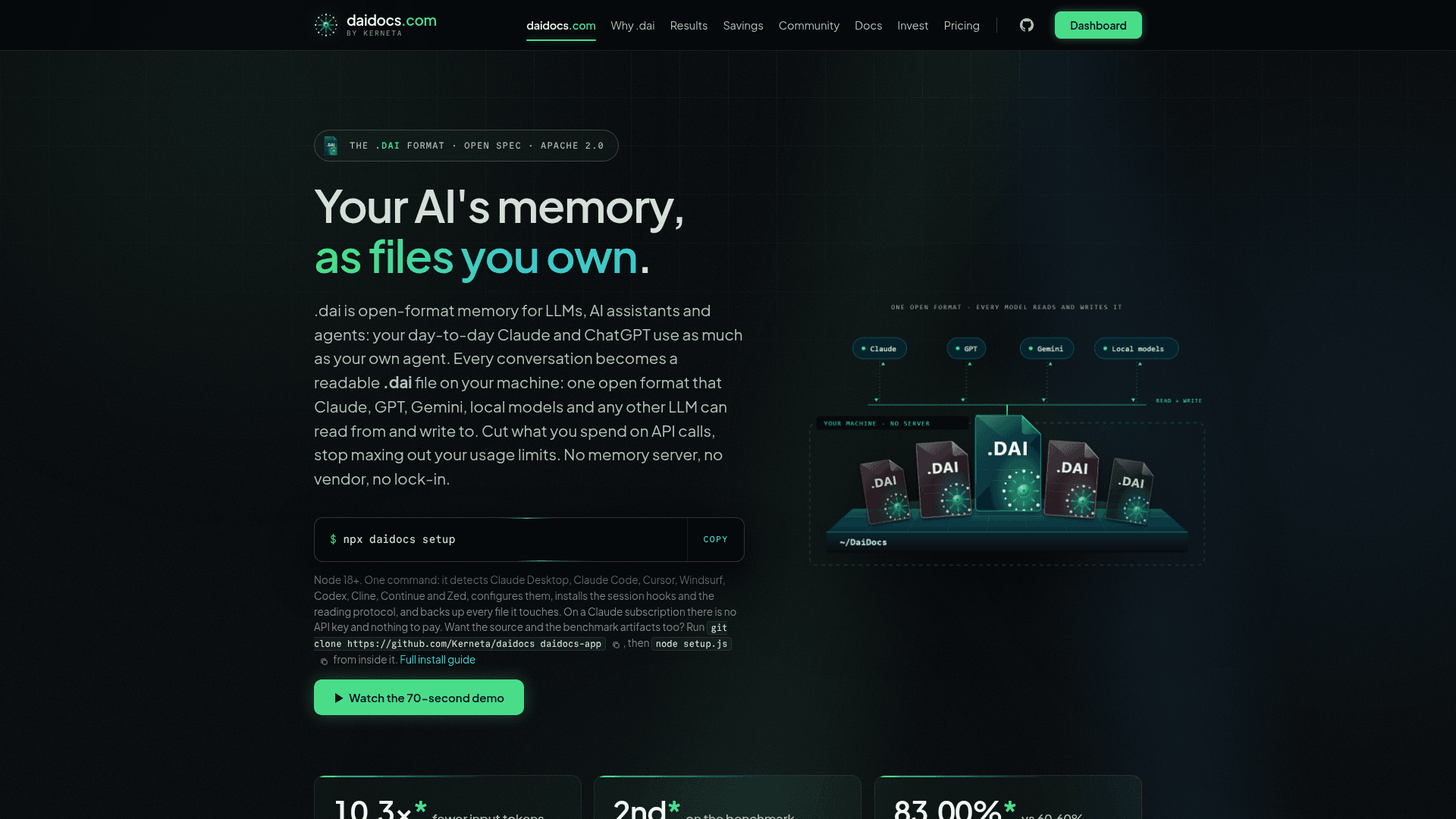
.dai is a file format — not a memory service — designed to make AI assistant memory portable, inspectable, and vendor-independent. Each conversation becomes a single plain-text file with three zones: a YAML header (identity and metadata), a fenced JSON block (machine-parseable facts, events, and entities), and the cleaned original content. A small derived index sits beside the files for fast retrieval. Because the store is a folder of text files, it works with grep, git, any editor, and any model that speaks MCP — Claude Desktop, Claude Code, Cursor, Windsurf, Codex, Cline, Continue, Zed, the OpenAI Agents SDK, and local models.
How the Memory Architecture Works
The system separates two model roles: an observer that converts a conversation into a .dai file once, and an actor that answers questions from the store. Conversion is a single model call per conversation; recall is index lookup and file reads with no model call at all. The retrieval layer reads a question-specific slice of the store in three zooms — manifest first, then a file's Understanding block, then specific content segments only if needed — rather than loading the whole history. According to Kerneta's published benchmark run on LongMemEval-S (500 questions, GPT-4o answering), the engine reads a mean of 10,065 tokens per question against histories averaging 103,601 tokens, approximately 10.3× fewer input tokens than pasting the full history.
Benchmark Position and Accuracy Claims
Kerneta publishes the following figures, all attributed to LongMemEval-S with GPT-4o answering and the benchmark authors' own evaluate_qa.py scorer:
- 83.00% (415/500) with GPT-4o as the answering model — second among memory systems whose configuration is reproducible by someone outside the vendor
- 92.00% (460/500) with Claude Fable 5 as the answering model
- 60.60% (303/500) for the same GPT-4o model with no memory system (full history pasted), the benchmark authors' own baseline
- The system ahead on the same protocol is Mastra Observational Memory at 84.80%, which Kerneta states reads approximately 30,000 tokens per question versus their 10,065
The replication protocol is published in docs/REPLICATION.md in the repository, and per-question judge verdicts are included in benchmark/.
Deployment Model and Surfaces
The complete local product runs free and self-hosted. npx daidocs setup detects and configures Claude Desktop, Claude Code, Cursor, Windsurf, Codex, Cline, Continue, and Zed in one command, installs session hooks, and backs up every file it touches. On a Claude subscription, no API key is required — the assistant in the session writes each memory itself. A Python reader (pip install daidocs) provides pure-Python access to the store without Node. Hosted surfaces — the claude.ai web connector, mobile (iOS/Android), team vaults with SSO, and org-wide provisioning — are described as in waitlist and not yet available.
Update: V4.4n32 Launch Release
The repository went public on 13 September 2026, with the V4.4n32 launch release published on 18 September 2026. This is the initial public release of the engine, format specification, MCP server, benchmark adapter, and all run artifacts. The GitHub README notes the repository was published only after a full key rotation and history scrub. The format version is 4.4, and the engine designation is v4.4n (the "n" variant that produced the published 83.00% figure). Earlier engine versions appear only as aggregate totals in the version ladder on the results page.
Open-Source Model and Funding
The format specification, the v4.4n engine, and the MCP server are all Apache 2.0, including a patent grant. Kerneta states the local product will never be crippled to upsell a hosted tier — cloud plans sell hosting, sync, and team features, not gated engine capabilities. The project is self-funded with no external investment at the time of launch, according to the pricing page. Supporter badges (one-off payments that convert to indexing credit) are the primary early funding mechanism alongside pay-as-you-go hosted conversion.
Community Discussions
Be the first to start a conversation about daidocs
Share your experience with daidocs, ask questions, or help others learn from your insights.
Pricing
Free
Complete local product, v4.4n engine Apache 2.0, self-hosted with your own API key or Claude subscription. Dashboard included. Three keyless conversions to try.
- v4.4n engine, Apache 2.0, full local product
- Self-host with your own API key, Claude subscription, or local model
- Free dashboard at dashboard.daidocs.com with your own key
- Three keyless conversions to try without an API key
- Memory stored locally as plain text files
Pay as you go
Hosted conversion run by Kerneta using a higher-accuracy model. Pay only for conversions from prepaid credit topped up any time. No subscription.
- Pay only for conversions you run from prepaid credit
- Higher-accuracy model chosen by Kerneta for conversion
- Nothing to cancel, nothing charged while idle
- Recall is never metered
- Visible meter in dashboard
Gold Supporter
One-off supporter badge: name added to SUPPORTERS.dai in the repository git history, plus indexing credit.
- Name or handle added to SUPPORTERS.dai in the repository
- Listed on the pricing page
- Named however you want, or anonymously
- Greppable in the repository
- $25 of indexing credit on your account
Ruby Supporter
One-off supporter badge with everything in Gold plus a vote on roadmap and early access to roadmap.
- Everything in the Gold badge
- Named in the release notes of the next spec version
- Vote on what is benchmarked next and which connector is built first
- Roadmap access before it is public
- $125 of indexing credit on your account
Enterprise and startups
Bespoke setup, data residency terms, named contact, volume conversion pricing, and help migrating existing archives.
- Bespoke setup by Kerneta team
- Help moving an existing archive in
- Your own observer model, including one running locally
- Data residency and retention terms in writing
- Named contact
- Volume conversion pricing
Capabilities
Key Features
- Open plain-text .dai file format for AI memory
- MCP server with save_memory, recall_memory, list_memories, read_memory, declare_project, brief_parent tools
- One-command setup detecting Claude Desktop, Claude Code, Cursor, Windsurf, Codex, Cline, Continue, and Zed
- Session hooks for automatic memory saving every 4,000 tokens in Claude Code
- Three-zone file format: YAML header, JSON Understanding block, and verbatim Content
- Shared index (manifest.jsonl, facts.jsonl, events.jsonl, profile.jsonl) for fast retrieval without model calls
- Three-zoom reading protocol: manifest → Understanding block → specific Content segments
- Python reader (pip install daidocs) with pure-Python Store API
- Local-first: memory stored as plain text files on user's own disk
- Portable across Claude, GPT, Gemini, Cursor, and local models from one store
- Dashboard memory map (npm run dashboard) as a self-contained offline HTML page
- Folder-level project memory with seven folder types: normal, locked, frozen, connected, shared, confidential, temporary
- Benchmark replication artifacts: per-question judge verdicts and sha256 manifest
- Idempotent setup with automatic backup of every touched config file
- API key stored only in OS user environment, never in files
- Convert existing Claude Code session history with node daidocs.js convert
- Unconverted sessions stored in _unconverted/ and readable before conversion
- Byte-exact originals preserved in _raw/, never deleted
- Support for Anthropic API native memory tool (memory_20250818) backed by .dai store
- Observer/actor model separation: convert once with a capable model, answer with any model