Darts
Python library for user-friendly forecasting and anomaly detection on time series, from classical models to deep neural networks.
At a Glance
Darts is a Python library for forecasting and anomaly detection on time series, released under the Apache License 2.0 at no charge.
Engagement
Available On
Alternatives
Listed Nov 2026
About Darts
Darts is an open-source Python library from Unit8 for forecasting and anomaly detection on time series. It provides classical statistical models, machine-learning regressors, deep neural networks and foundation models behind one scikit-learn-style fit() and predict() interface. The latest listed release is 0.47.0, and the code is published under the Apache 2.0 license.
What It Is
Darts is a time series toolkit installed with pip install darts in a Python 3.10+/3.11+ environment. Users wrap data in a TimeSeries object, which can be created from and exported to pandas, polars, numpy, pyarrow, xarray and other backends. They then fit a model and generate forecasts, including probabilistic ones.
Forecasting Workflow
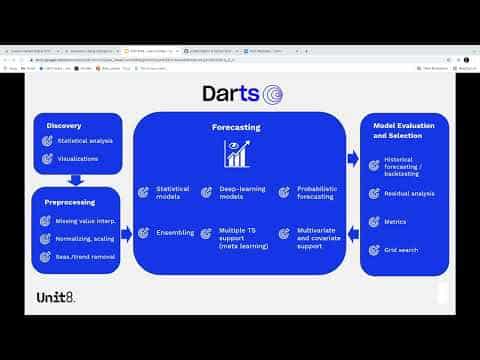
Models range from baselines and ARIMA, Prophet, exponential smoothing and Theta to N-BEATS, TFT, TiDE and TSMixer. Wrappers cover scikit-learn-compatible regressors and classifiers, Nixtla's StatsForecast and NeuralForecast, and zero-training foundation models such as Chronos-2, TimesFM, TiRex and PatchTST-FM. Darts supports:
- univariate and multivariate series
- past, future and static covariates
- training global models on multiple series
- sample weights
- conformal prediction for calibrated quantile intervals
- hierarchical reconciliation
- backtesting with moving historical windows
- ensembles, metrics, data transformers and SHAP-based explainability
Anomaly Detection
The darts.ad module combines scorers, detectors and aggregators. Users can wrap any forecasting or filtering model to compare predictions with actuals, or apply PyOD detectors to time series through PyODScorer. Examples include a k-means scorer with a quantile detector that yields binary anomaly labels. Filtering models include Kalman, Gaussian process and moving-average filters.
Ecosystem and Documentation
Deep learning models are built on PyTorch Lightning, which supports GPU/TPU training and custom callbacks. MLflow integration tracks and persists forecasting experiments. Documentation includes a quickstart, user guide, API reference, example notebooks and release notes.
Community Discussions
Be the first to start a conversation about Darts
Share your experience with Darts, ask questions, or help others learn from your insights.
Pricing
Open Source (Apache 2.0)
Darts is a Python library for forecasting and anomaly detection on time series, released under the Apache License 2.0 at no charge.
- Apache License 2.0
- Forecasting models from ARIMA to deep neural networks
- Anomaly detection
- Backtesting and model ensembling
- Univariate and multivariate time series
Capabilities
Key Features
- Forecasting models from ARIMA to deep neural networks behind a fit()/predict() API
- Foundation models requiring no training
- Anomaly detection with scorers, detectors and aggregators
- PyOD integration
- Multivariate and probabilistic forecasting
- Conformal prediction
- Past, future and static covariates
- Global models trained on multiple series
- Hierarchical reconciliation
- Backtesting
- SHAP explainability
- Data processing transformers and metrics
- Filtering models (Kalman, Gaussian process, moving average)
- Built-in datasets
- MLflow integration
- PyTorch Lightning support
- Multiple data backends (pandas, polars, numpy, pyarrow, xarray)
Integrations
Demo Video