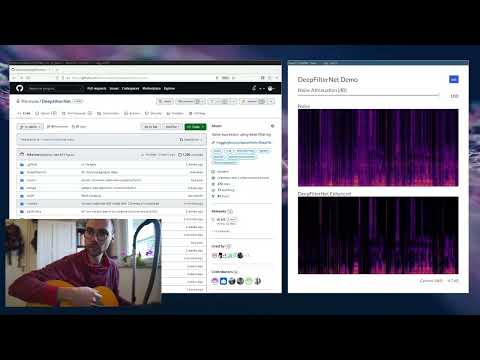
DeepFilterNet
Open-source low-complexity speech enhancement framework for full-band 48kHz audio that suppresses noise using deep filtering.
At a Glance
DeepFilterNet core code and model weights, dual-licensed under MIT or Apache-2.0 at the user's option.
Engagement
Available On
Listed Nov 2026
About DeepFilterNet
DeepFilterNet is an open-source speech enhancement framework maintained by Rikorose on GitHub. It suppresses noise in full-band (48kHz) speech audio using deep filtering, and ships as a Rust command-line binary, a Python package, and a LADSPA plugin. The latest listed release is v0.5.6.
What It Is
DeepFilterNet is a noise suppression and speech enhancement toolkit built around a deep filtering approach. It includes pretrained models (DeepFilterNet, DeepFilterNet2 and DeepFilterNet3 are referenced) plus training and evaluation code. The repository is organized into a Rust library (libDF) for data loading and augmentation, Python code for training, evaluation and visualization, Python wrappers, and a LADSPA plugin.
How You Use It
There are several ways to run it:
- deep-filter binary: a pre-compiled Rust binary with no Python dependencies that denoises noisy .wav files. Currently only 48kHz wav files are supported.
- Python package:
pip install deepfilternetprovides thedeepFiltercommand and anenhance/init_dfAPI for use in scripts. This path also supports the PyTorch backend, for example for GPU processing. - Real-time plugin: a LADSPA plugin integrates with PipeWire's filter-chain as a virtual noise-suppression microphone.
Training Your Own Models
The training entry point is df/train.py. It takes HDF5 datasets of speech, noise and room impulse responses, created with a provided preparation script, together with a dataset configuration JSON that defines train, validation and test sets and optional sampling factors.
Research Background
The project is tied to several published papers covering the original DeepFilterNet, DeepFilterNet2 for embedded devices, perceptually motivated real-time enhancement, and multi-frame filtering for hearing aids. The README provides citation guidance and links to audio samples and a Hugging Face demo, which is currently paused.
Licensing
The README states that code and model weights are dual-licensed under MIT or Apache 2.0, at the user's option.
Community Discussions
Be the first to start a conversation about DeepFilterNet
Share your experience with DeepFilterNet, ask questions, or help others learn from your insights.
Pricing
Open Source
DeepFilterNet core code and model weights, dual-licensed under MIT or Apache-2.0 at the user's option.
- All code and model weights in the repository dual-licensed under MIT or Apache-2.0
- Pre-compiled deep-filter binary (no Python dependencies)
- LADSPA plugin for PipeWire real-time noise suppression
- Python package via PyPI (deepfilternet)
Capabilities
Key Features
- Full-band 48kHz speech enhancement
- Noise suppression using deep filtering
- Pre-compiled deep-filter binary for wav files
- Python package with CLI and API
- LADSPA plugin with PipeWire integration for real-time mic noise reduction
- Pretrained DeepFilterNet, DeepFilterNet2 and DeepFilterNet3 models
- Training pipeline with HDF5 datasets
- Optional postfilter and delay compensation
- PyTorch backend with GPU processing support
Integrations
Demo Video