
Deepnote
A collaborative, AI-powered data notebook platform for data analysts, scientists, and engineers to explore data, build dashboards, and automate insights in the cloud.
At a Glance
A free version for aspiring data analysts and scientists.
Engagement
Available On
Alternatives
Listed Jul 2026
About Deepnote
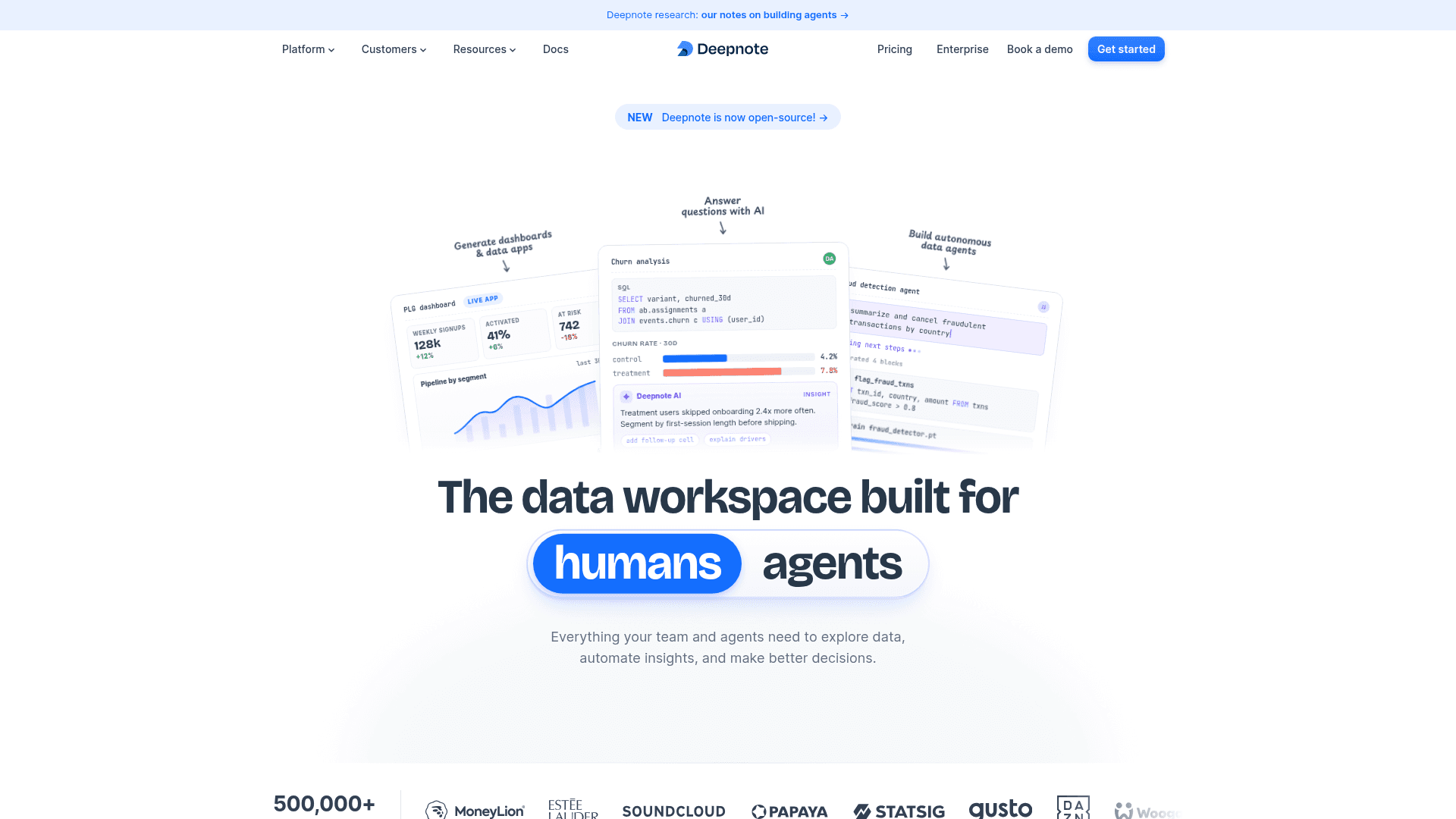
Deepnote is a cloud-based data workspace that combines notebooks, SQL, AI assistance, and collaboration tools into a single platform. The homepage states it is used by 500,000+ data professionals and is now open-source under the Apache 2.0 license. It positions itself as a modern alternative to Jupyter, Google Colab, and Databricks, with built-in multiplayer editing, AI code generation, and one-click data app publishing.
What It Is
Deepnote is a collaborative notebook environment designed for data analytics, data engineering, and machine learning workflows. It supports Python, SQL, and R in a single IDE, lets teams build interactive dashboards and data apps without leaving the notebook, and connects to 60+ data sources including Snowflake, BigQuery, Redshift, and Databricks. The platform runs entirely in the cloud, eliminating local environment setup, and offers scheduling, GPU compute, and notebook-as-API deployment out of the box.
Open-Source Transition
The homepage prominently announces "Deepnote is now open-source!" under the Apache 2.0 license. A quote from the CEO of AlphaSignal on the homepage describes it as "Jupyter, but with SQL, AI, and multiplayer mode, among other handy features." This transition signals a significant product-direction shift, making the core notebook format publicly available while the hosted platform retains commercial tiers.
AI Capabilities Built Into the Workflow
Deepnote AI is woven throughout the product rather than bolted on as a sidebar:
- Auto AI: describe what you want to analyze and Deepnote queries, analyzes, and interprets data automatically
- Code generation, explanation, refactoring, and debugging aware of your code context and data stack
- AI code completion in Python and SQL
- Autonomous data agents: the platform supports building agents that can query, train models, deploy endpoints, and visualize results across multiple notebook cells
- MCP and Google A2A integration for connecting agents to external tools
- Enterprise plans support bring-your-own-LLM and access to GPT-5 and Sonnet 4.6
Collaboration and Deployment Architecture
Deepnote runs notebooks in the cloud with real-time multiplayer editing, inline commenting, and version history. Teams can share work via link or email invite, organize projects in folders, and publish notebooks as white-labeled data apps or dashboards. Compute options range from basic 2 vCPU / 5 GB RAM machines to high-memory (128 GB RAM, 16 vCPU) and GPU (12 GB K80) instances. The platform also supports:
- Scheduled notebook runs (hourly, daily, weekly, monthly)
- Notebook API deployment for model serving
- Spark and Snowpark for terabyte-scale workloads
- VS Code and Cursor integrations for local-to-cloud workflows
Security and Enterprise Readiness
Deepnote is SOC 2 Type II certified and HIPAA and GDPR compliant. Enterprise features include SSO via SAML or OIDC, SCIM directory sync, role-based access control, permission groups, audit logs, federated warehouse authentication, static IPs, SSH tunnels, and private Docker image support. Deployment options span multi-tenant, single-tenant (managed by Deepnote or self-hosted), and on-premise behind a customer's firewall. The enterprise page notes Deepnote was listed as a Sample Vendor in the Gartner® Hype Cycle™ for Analytics and Business Intelligence for 2024.
Audience and Adoption Signals
The platform targets data analysts, data scientists, data engineers, and ML engineers, and the homepage claims use at 96 of the top 100 universities. Vendor-published testimonials on the homepage include users from SoundCloud, Gusto, Statsig, and Floryn. The explore gallery covers use cases from NPS analysis and A/B testing to protein visualization, LLM applications, and fraud detection agents, reflecting a broad practitioner audience across fintech, biotech, gaming, and enterprise segments.
Community Discussions
Be the first to start a conversation about Deepnote
Share your experience with Deepnote, ask questions, or help others learn from your insights.
Pricing
Free
A free version for aspiring data analysts and scientists.
- Up to 3 editors
- Up to 5 projects
- Limited Deepnote AI (10 completions/month, 5 calls/month per AI feature)
- Unlimited Basic machines (5 GB RAM, 2 vCPU)
- 7 day revision history
Team
For data teams needing a powerful platform for seamless collaboration.
- Unlimited viewers & notebooks
- Unlimited editors
- Unlimited projects
- GPT-5 and Sonnet 4.6 access
- Premium integrations (BigQuery, Snowflake, Redshift, etc.)
- Background execution
- Scheduled notebooks
- 30 day revision history
- $39 worth of AI credits every month
- $280 worth of CPU every month
- $50 worth of GPU every month
- More powerful machines (Plus: 16 GB RAM, 4 vCPU)
- Discounted additional compute
- Access controls
- Shared datasets
- Sync notebooks with git
- Folders
- Notebook API
- White-labeled notebooks
- Static IPs
- Pay-as-you-go machines
- Performance machines (64 GB RAM, 16 vCPU)
- High memory machines (128 GB RAM, 16 vCPU)
- GPU machines (60 GB RAM, 12 GB K80 GPU)
- Build docker images
- 14-day free trial
Enterprise
For organizations with greater machine and security needs.
- Custom contract & invoice
- Priority support
- Dedicated success manager
- Unlimited AI
- Permission groups
- SSO & directory sync
- Private docker images
- Bring your own LLM
- Audit logs
- Federated Authentication
- Single-tenancy
- Volume machine discounts
- HIPAA Compliance
- SSH Tunnels
- Custom machines
- Unlimited revision history
- Unified billing across multiple workspaces
- Private cloud (on-premise) option
Capabilities
Key Features
- AI code generation and completion
- Auto AI for natural-language data analysis
- Python, SQL, and R support in one IDE
- Real-time multiplayer collaboration
- Interactive data apps and dashboards
- Scheduled notebook runs
- Notebook API deployment
- GPU and high-memory compute options
- Spark and Snowpark integration
- 60+ data source integrations
- Version history and revision tracking
- Role-based access control
- SSO via SAML or OIDC
- SCIM directory sync
- Audit logs
- SOC 2 Type II and HIPAA compliance
- Autonomous data agent support
- MCP and Google A2A integration
- Bring your own LLM (Enterprise)
- VS Code and Cursor integration
- dbt and LookML semantic layer
- ETL/ELT pipeline support
- Data catalog
- White-labeled notebooks
- Import/export as .ipynb