
Derive
An open-source, self-hostable workspace for publishing, reviewing, and versioning AI-generated artifacts with permanent URLs, comments, and MCP agent integration.
At a Glance
For individuals, independent projects, and small teams.
Engagement
Available On
Alternatives
Listed Aug 2026
About Derive
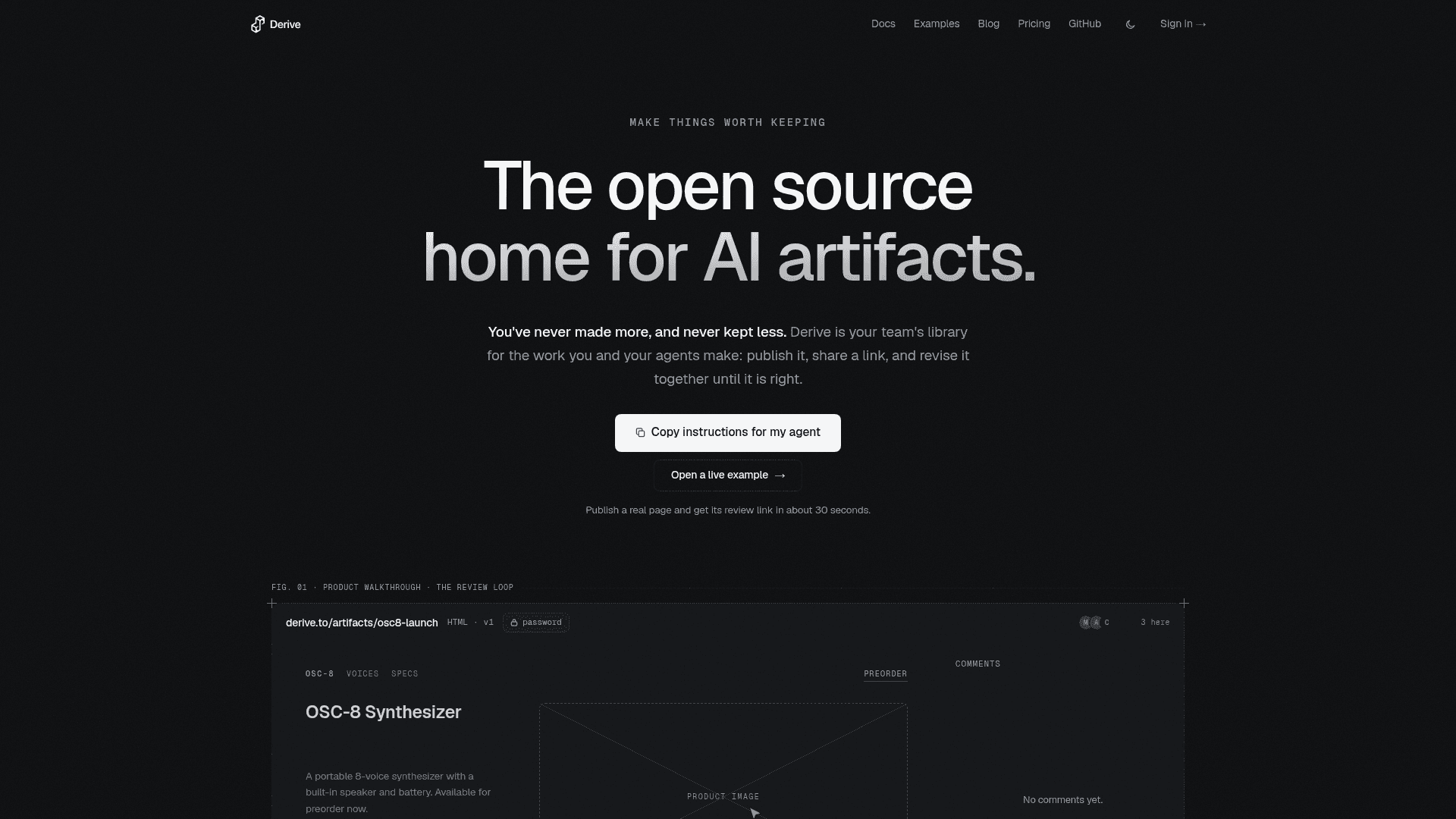
Derive is a team library for AI-generated artifacts — HTML pages, Markdown documents, decks, and built sites — giving each piece of work a permanent URL, full version history, and a built-in review loop. Built by Derive Labs and licensed under the Functional Source License (FSL-1.1-ALv2), it is self-hostable as a single container and also available as a hosted service. The project reached its first tagged release, v0.2.0, in August 2026.
What It Is
Derive solves the problem of AI-generated work disappearing into chat threads, Slack pastes, and expired context windows. When an agent produces a page or document, Derive gives it a durable URL that resolves to every version ever published. Teams can comment on the exact text, request formal approvals, and @mention people or agents to act on feedback — all without the work ever leaving a single, searchable library. The product is described as "agent-native": it ships an MCP server so compatible clients like Claude Code, Codex, and Cursor can publish, read, and revise artifacts directly.
How the Publish-Review Loop Works
The core workflow has four steps the homepage labels Publish, Share, Collaborate, and Own:
- Publish: A CLI command (
derive publish), HTTP API call, or MCP tool takes any HTML file, Markdown document, or multi-file build and creates a versioned artifact at a permanent URL. Every revision is a new version at the same link; no draft is ever discarded by default. - Share: Artifacts can be scoped to the workspace, shared with anyone via link, or password-protected for external clients. Viewers never need an account; commenting and editing require sign-in.
- Collaborate: Comments pin to exact lines of text. @mentions work for both people and agents. A draft stays a draft until a named person formally approves a version, making approval status unambiguous.
- Own: Artifacts, versions, and comments export in open formats. The product runs as a single Docker container on SQLite and local disk by default, or on Postgres and S3/R2 at scale.
Agent and MCP Integration
Derive has an MCP server built in. One command connects compatible clients:
claude mcp add --transport http derive https://derive.to/mcpfor Claude Codenpx skills add derive-to/derive --skill derivefor any agent that reads skills- A Cursor deep-link badge is provided in the README for one-click setup
The MCP server exposes tools for publishing, catching up on feedback, commenting, and reading any artifact or version. Agents are granted a role (viewer, commenter, or editor) and act within that scope. The homepage notes that agents do not consume billing seats — only human editors who publish work are counted.
Architecture and Self-Hosting
The repository is a TypeScript monorepo with a clear package split:
apps/api— HTTP API, sandboxed artifact serving, viewerapps/web— web UI built with TanStack Start in SPA modepackages/core— domain logic: ports, publish pipeline, Markdown rendering, viewer shellpackages/db— MetaStore supporting SQLite, Postgres, and Cloudflare D1packages/storage— BlobStore supporting local filesystem, S3, and R2packages/cli—derive initandderive publishcommandspackages/mcp— local stdio MCP server plus the agent skill guide
Every artifact is served on an opaque origin under a strict sandbox CSP, ships Open Graph and Twitter meta tags, and streams live updates over Server-Sent Events.
Update: Derive 0.2.0 — First Tagged Release
The GitHub repository shows the project was created in June 2026 and reached its first tagged release, v0.2.0, on August 12, 2026. The repository was last pushed on August 28, 2026, indicating active early development. The roadmap is itself a live Derive artifact at derive.to/roadmap, kept as a versioned document. The license is FSL-1.1-ALv2, which the project describes as converting automatically to Apache-2.0 two years after each release ships.
Community Discussions
Be the first to start a conversation about Derive
Share your experience with Derive, ask questions, or help others learn from your insights.
Pricing
Free
For individuals, independent projects, and small teams.
- Up to 3 editors per workspace
- Unlimited viewers and commenters
- Full review loop: comments, review rounds, send-backs
- CLI, API, and MCP for agents
- Permanent URLs with full version history
Team
For teams whose agents ship work that needs review.
- Everything in Free
- Unlimited editors
- Custom domain
- White-label shared pages
- Password-protected links
- Brandprint: house style available to each connected agent
- 50 GB pooled storage, then ~$1 per extra 10 GB/month
- Full analytics history
Business
For organizations that need control and accountability.
- Everything in Team
- 250 GB pooled storage, then ~$1 per extra 10 GB/month
- SSO with identity provider (OIDC)
- Audit log
- Multiple custom domains
- Guest editor management
- Uptime SLA
- Priority support
Enterprise
For isolation, residency, and procurement requirements.
- Everything in Business
- Dedicated single-tenant instance
- Data residency: your region, your cloud or ours
- Migration and onboarding help
- Support contract
- Support contracts for self-hosted deployments: SLA, LTS releases, upgrade and migration help
Capabilities
Key Features
- Permanent versioned URLs for every artifact
- Full version history with no drafts discarded
- Inline comments pinned to exact text
- Formal approval and review rounds
- @mentions for people and agents
- MCP server for agent integration (Claude Code, Codex, Cursor)
- CLI publishing (derive publish)
- HTTP API for anonymous draft publishing
- Password-protected sharing links
- Custom domain support
- Sandboxed artifact viewer on opaque origin
- Live collaboration via Server-Sent Events
- Workspace library with live previews
- Collections and pinned artifacts
- Reusable Agents with instructions, skills, and run history
- Checkpoints for ongoing work
- Self-hostable as a single Docker container
- SQLite + local disk or Postgres + S3/R2 storage backends
- Open Graph and Twitter meta tags on every artifact
- Export in open formats (artifacts, versions, comments)
- Access controls: private, workspace, or public with optional password
- Audit log (Business plan)
- SSO via OIDC (Business plan)
- Brandprint: house style available to connected agents (Team plan)