
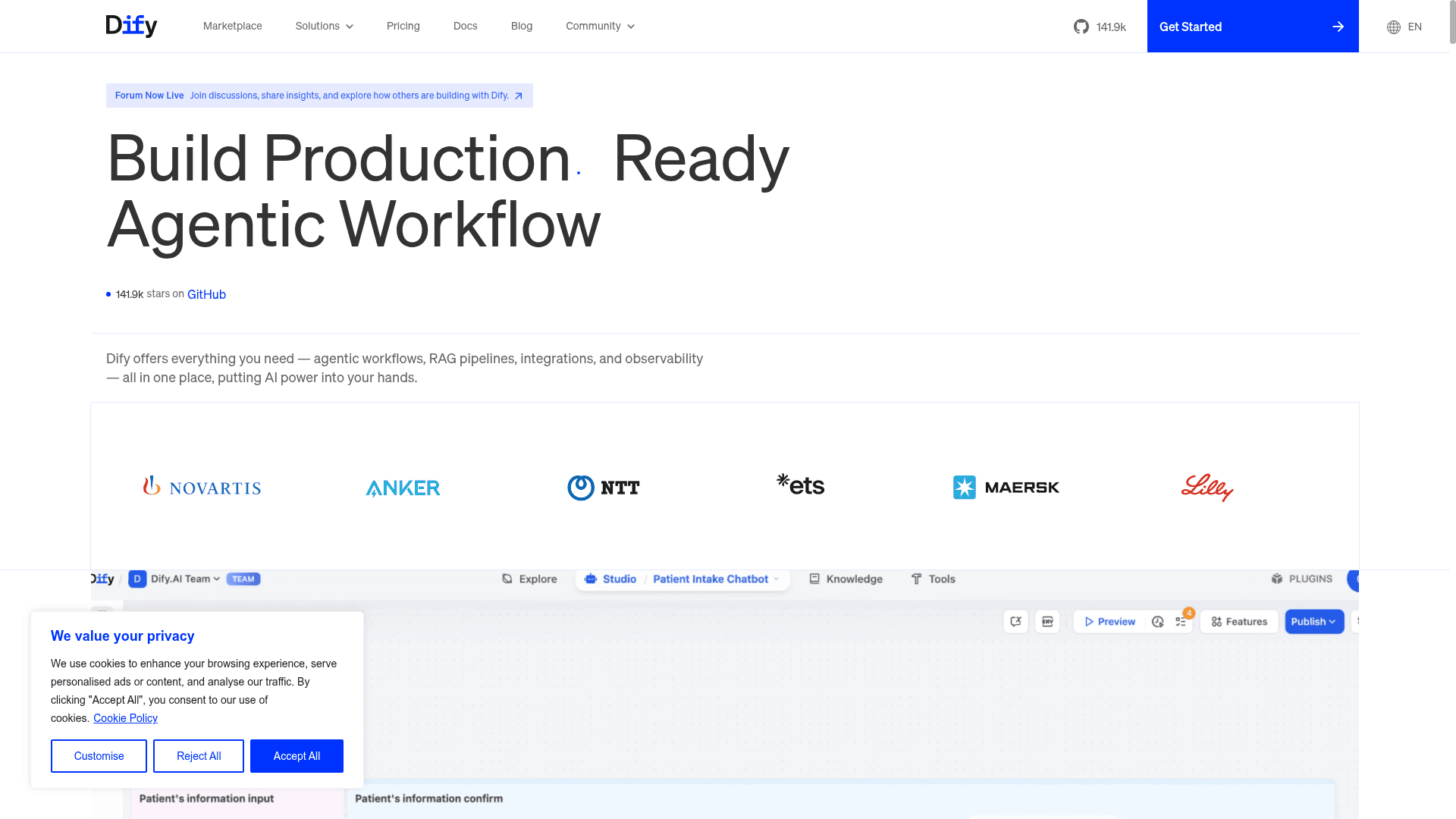
Open-source LLM app development platform for building production-ready AI agents, agentic workflows, RAG pipelines, and more with an intuitive visual interface.
At a Glance
About Dify
Dify is an open-source LLM application development platform built by LangGenius, Inc. It combines agentic workflows, RAG pipelines, model management, observability, and a plugin marketplace into a single interface, letting teams go from prototype to production without heavy infrastructure work. The platform is available as a managed cloud service or as a self-hosted deployment via Docker Compose, Kubernetes, or major cloud providers.
What It Is
Dify sits in the LLMOps and agentic workflow category — a visual, low-code/no-code environment where developers and non-technical users alike can design, test, and deploy AI applications. Its core job is to abstract away the complexity of chaining LLMs, retrieval systems, tools, and agents into a drag-and-drop canvas, then expose the result as a web app, API, or MCP server. The GitHub repository (langgenius/dify) lists over 141,900 stars and 22,300 forks as of May 2026, with 800+ contributors, signaling broad community adoption.
Core Capabilities
- Visual Workflow Builder — a canvas-based editor for constructing multi-step AI pipelines with branching logic, parallel execution, and conditional nodes.
- RAG Pipeline — document ingestion, chunking, embedding, and retrieval with out-of-box support for PDFs, PPTs, and other common formats; external Knowledge API also supported.
- Agent Framework — define agents using LLM Function Calling or ReAct patterns; 50+ built-in tools including Google Search, DALL·E, Stable Diffusion, and WolframAlpha.
- Comprehensive Model Support — integrates with hundreds of proprietary and open-source LLMs from dozens of providers (GPT, Mistral, Llama3, Azure OpenAI, Hugging Face, Replicate, and any OpenAI API-compatible endpoint), including local models via Ollama.
- Prompt IDE — side-by-side model comparison, prompt crafting, and text-to-speech additions for chat apps.
- LLMOps & Observability — application logs, performance analytics, annotation-based dataset improvement, and integrations with Langfuse, Langsmith, and Arize Phoenix.
- Backend-as-a-Service — every Dify capability is exposed via API, enabling embedding into existing business logic.
- MCP Integration — native Model Context Protocol support; apps can be published as universal MCP servers.
Deployment Model
Dify supports three primary deployment paths:
- Dify Cloud — fully managed SaaS at cloud.dify.ai; zero setup required.
- Self-hosted Community Edition — Docker Compose startup with minimum 2 CPU cores and 4 GiB RAM; Kubernetes Helm charts and Terraform modules are community-maintained for AWS, Azure, Google Cloud, and Alibaba Cloud.
- Enterprise Edition — on-premises, VPC, or public cloud with high availability, SSO, multi-tenant management, role-based access control, end-to-end encrypted transmission, and dedicated support. Available via contact sales.
Open-Source Lineage and License
The repository is licensed under a modified Apache 2.0 license (the "Dify Open Source License"). The core platform source code is publicly available, but the license adds conditions: operating a multi-tenant SaaS service using Dify source code requires a commercial license from LangGenius, and the frontend LOGO and copyright must not be removed without authorization. The latest release as of May 2026 is v1.14.2, described as covering security fixes, agent groundwork, workflow reliability, and deployment updates.
Update: v1.14.2 (May 2026)
The most recent tagged release, v1.14.2, was published on May 19, 2026. The release notes describe security fixes, foundational agent improvements, workflow reliability enhancements, and deployment-related updates. The repository shows active commit activity with the main branch receiving pushes as recently as May 19, 2026, indicating a fast-moving release cadence. The project roadmap is publicly tracked at roadmap.dify.ai.
Enterprise Adoption Signals
The Dify homepage and enterprise page publish vendor-attributed testimonials from Volvo Cars (Head of AI & Data APAC), Ricoh (Division General Manager), and an unnamed assessment products company. The vendor states the platform serves teams across support, HR, legal, marketing, sales, development, and finance use cases, and claims over one million applications are running on Dify across departments and industries worldwide — figures that are vendor-published and not independently verified.
Community Discussions
Be the first to start a conversation about Dify
Share your experience with Dify, ask questions, or help others learn from your insights.
Pricing
Sandbox
Try core features for free with limited credits and resources.
- 200 message credits
- 1 Team Workspace
- 1 Team Member
- 5 Apps
- 50 Knowledge Documents
Professional
For independent developers and small teams ready to build production AI applications.
- 5,000 message credits/month
- 1 Team Workspace
- 3 Team Members
- 50 Apps
- 500 Knowledge Documents
- 5GB Knowledge Data Storage
- 100 Knowledge Request Rate Limit/min
- Priority Document Processing
- 20,000 Trigger Events/month
- Unlimited Triggers/workflow
- Faster Workflow Execution
- 2,000 Annotation Quota Limits
- Unlimited Log History
- No Dify API Rate Limit
- Support OpenAI/Anthropic/Llama2/Azure OpenAI/Hugging Face/Replicate
- Priority Email Support
Team
For medium-sized teams requiring collaboration and higher throughput.
- 10,000 message credits/month
- 1 Team Workspace
- 50 Team Members
- 200 Apps
- 1,000 Knowledge Documents
- 20GB Knowledge Data Storage
- 1,000 Knowledge Request Rate Limit/min
- Top Priority Document Processing
- Unlimited Trigger Events
- Unlimited Triggers/workflow
- Priority Workflow Execution
- 5,000 Annotation Quota Limits
- Unlimited Log History
- No Dify API Rate Limit
- Support OpenAI/Anthropic/Llama2/Azure OpenAI/Hugging Face/Replicate
- Priority Email Support
Enterprise
Enterprise-grade AI infrastructure with on-premises deployment, SSO, multi-tenant management, and dedicated support.
- Unlimited Team Members
- Unlimited Apps
- High Availability infrastructure
- On-premises, public cloud, or VPC deployment
- SSO management
- Multi-tenant support
- Two-step verification
- End-to-end encrypted transmission
- Strict data access control
- Dedicated support and training
- Best practices guidance
- SOC Type II Report
Capabilities
Key Features
- Visual workflow builder with drag-and-drop canvas
- RAG pipeline with document ingestion and retrieval
- Agent framework with LLM Function Calling and ReAct
- 50+ built-in tools (Google Search, DALL·E, Stable Diffusion, WolframAlpha)
- Comprehensive model support (GPT, Mistral, Llama3, Azure OpenAI, Hugging Face, Replicate, Ollama)
- Prompt IDE with side-by-side model comparison
- LLMOps observability with Langfuse, Langsmith, Arize Phoenix integrations
- Backend-as-a-Service API for all capabilities
- Native MCP integration and publish as MCP server
- Plugin marketplace for extending capabilities
- Self-hosted deployment via Docker Compose or Kubernetes
- Enterprise SSO, role-based access control, multi-tenant management
- App version control
- Knowledge base with external Knowledge API support
- Annotation-based dataset improvement