
EverOS
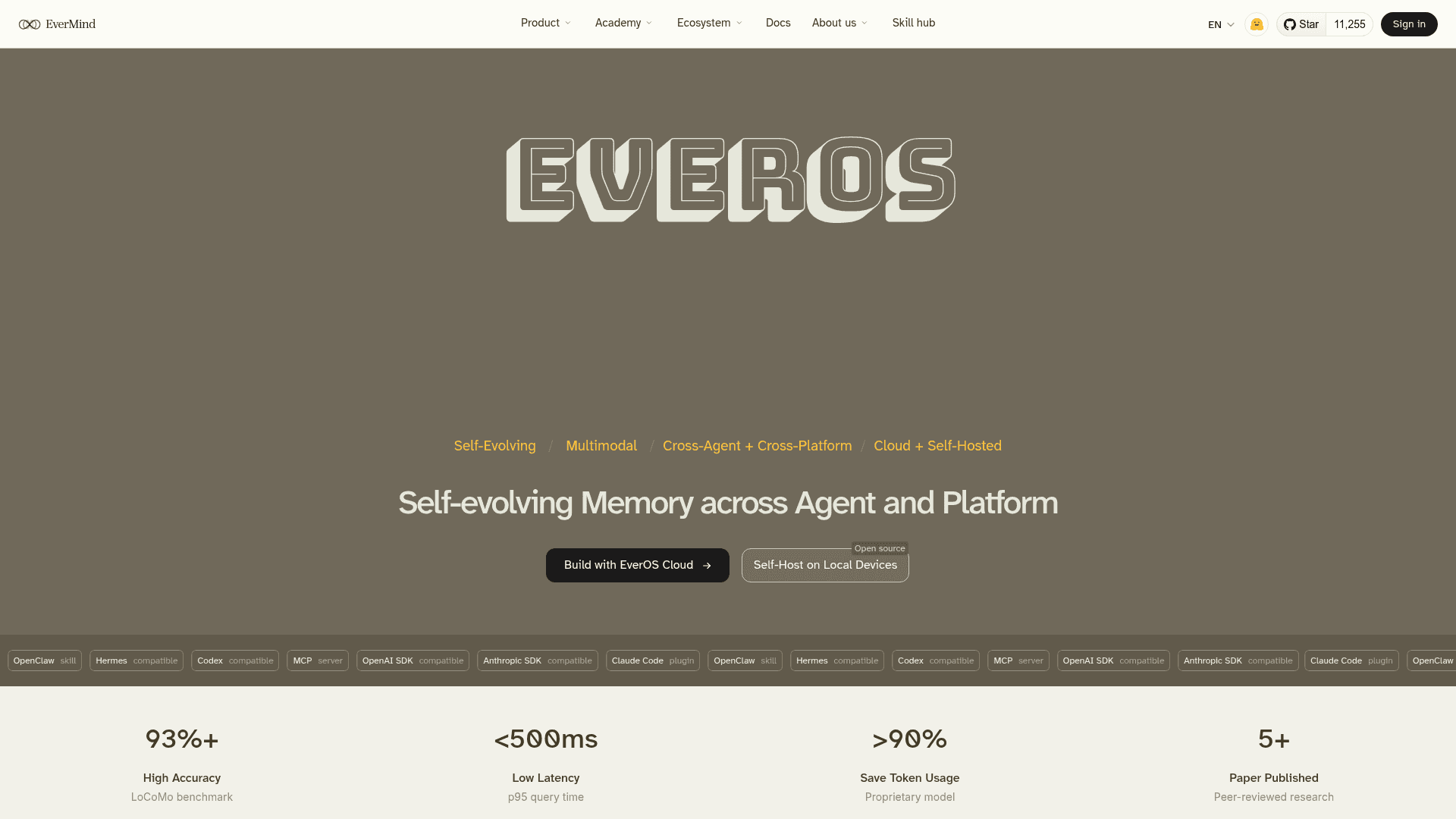
EverOS is a self-evolving, multimodal memory operating system for AI agents that provides persistent, cross-platform memory with 93%+ retrieval accuracy and under 500ms latency.
At a Glance
About EverOS
EverOS is an open-source memory operating system built by EverMind AI that gives AI agents persistent, self-evolving memory across sessions, platforms, and agent teams. It is available both as a managed cloud service and as a self-hosted Python library licensed under Apache 2.0. The project has accumulated over 11,000 GitHub stars and reached version 1.1.1 as of July 2026.
What It Is
EverOS is a local-first, Markdown-native memory runtime for AI agents. Rather than relying on context windows or traditional RAG pipelines, it provides a structured memory layer that stores conversations, files, and agent trajectories as readable Markdown files, then syncs local SQLite and LanceDB indexes for fast retrieval. The system classifies memories into four types — Episodic, Semantic, Procedural (Skills), and Profile — and retrieves them using a hybrid mRAG method that combines dense vector search with sparse keyword matching. The result, according to EverMind's published benchmarks, is 93.05% accuracy on the LoCoMo benchmark, under 500ms p95 retrieval latency, and approximately 10× lower token cost compared to loading a full context window.
Self-Evolving Skills: The Core Differentiator
The feature EverMind describes as unique to EverOS is its Self-Evolving Skills mechanism. Every task an agent completes is recorded as a Case (an execution trajectory). When the same pattern succeeds repeatedly, EverOS distills those Cases into reusable Skills through an offline consolidation process called Distillation. These Skills are then shared across the entire agent team without manual curation or hardcoding. This procedural memory layer means agents improve over time rather than starting from scratch on every task.
Architecture and Stack
EverOS uses a three-part local stack:
- Markdown files as the canonical source of truth — readable, editable, diffable, and Git-versionable
- SQLite for structured metadata and indexing
- LanceDB for vector-based semantic retrieval
Memory is scoped orthogonally by user_id, agent_id, app_id, project_id, and session_id, enabling multi-agent and multi-user environments without data leakage. The API is OpenAI-protocol compatible, so it works with OpenAI, OpenRouter, vLLM, Ollama, and DeepInfra backends by changing a single environment variable.
Ecosystem and Integrations
EverOS drops into existing agent stacks without requiring infrastructure changes. The project page lists compatibility with:
- Claude Code (as a plugin)
- OpenClaw (as a skill)
- Hermes and Codex (compatible)
- MCP (as a server)
- OpenAI SDK and Anthropic SDK (compatible)
The broader EverMind open-source ecosystem includes Raven (a self-improving agent harness), EverAlgo (the stateless algorithm engine), HyperMem (hypergraph memory for long-term conversations), and evaluation suites EverMemBench and EvoAgentBench. Multimodal ingestion supports PDFs, images, Word documents, spreadsheets, presentations, emails, HTML pages, and URLs through a single API call.
Deployment Model: Cloud and Self-Hosted
EverOS offers two deployment paths with the same SDK and retrieval engine:
- EverOS Cloud: A fully managed service with automatic scaling, described as production-ready from day one with no infrastructure to manage.
- Self-hosted: The full open-source stack runs on any infrastructure. Data never leaves the user's environment, and every layer is inspectable. All memories export as clean Markdown, making migration between cloud and self-hosted a matter of switching endpoints, not code.
Update: EverOS v1.1.1
The latest release is EverOS 1.1.1, published on July 7, 2026. The repository was last pushed to on July 14, 2026, and last updated on July 18, 2026, indicating active development. The project was created in October 2025 and has grown to over 11,000 stars and 860 forks. EverMind has also published at least five peer-reviewed papers backing the memory architecture, including EverMemOS (arxiv:2601.02163) and HyperMem (arxiv:2604.08256).
Community Discussions
Be the first to start a conversation about EverOS
Share your experience with EverOS, ask questions, or help others learn from your insights.
Pricing
Community (Self-Hosted)
Open-source self-hosted deployment, forever free. Run the full memory stack on your own infrastructure.
- Unlimited Memory Spaces
- Unlimited MCU - your compute, your scale
- Full source code - every layer inspectable
- Apache 2.0 - fork, modify, ship
- Community support via Discord & GitHub
Free
Cloud-hosted free tier with limited memory spaces and monthly usage.
- 3 Memory Spaces
- 50,000 MCU / month
- 100,000 Retrieval API Calls / month
- Community support
Pro
Cloud plan for builders who need more memory spaces, higher usage, and self-evolving skills. Free during beta.
- 8 Memory Spaces
- 250,000 MCU / month
- 500,000 Retrieval API Calls / month
- Top-up packs available
- Self-Evolving Skills enabled
- Priority email support
Enterprise
Custom cloud plan with dedicated support and private deployment options.
- Custom Memory Spaces
- Custom MCU quota
- Custom Retrieval API Calls
- Dedicated account manager
- Private deployment option
Capabilities
Key Features
- Self-evolving Skills via Case distillation
- Persistent cross-session memory
- Multimodal ingestion (PDF, images, docs, spreadsheets, slides, URLs)
- Hybrid mRAG retrieval (dense + sparse)
- Four memory types: Episodic, Semantic, Procedural, Profile
- Markdown-native storage (readable, Git-versionable)
- Local three-part stack: Markdown + SQLite + LanceDB
- Orthogonal scoping by user, agent, app, project, session
- OpenAI-protocol compatible API
- Cloud and self-hosted deployment with same SDK
- Memory Bank interface for inspecting and editing memories
- 93%+ retrieval accuracy on LoCoMo benchmark
- <500ms p95 retrieval latency
- ~10x lower token cost vs full context window
- MCP server support
- Claude Code plugin
- Apache 2.0 open-source license