
fak — the Fused Agent Kernel
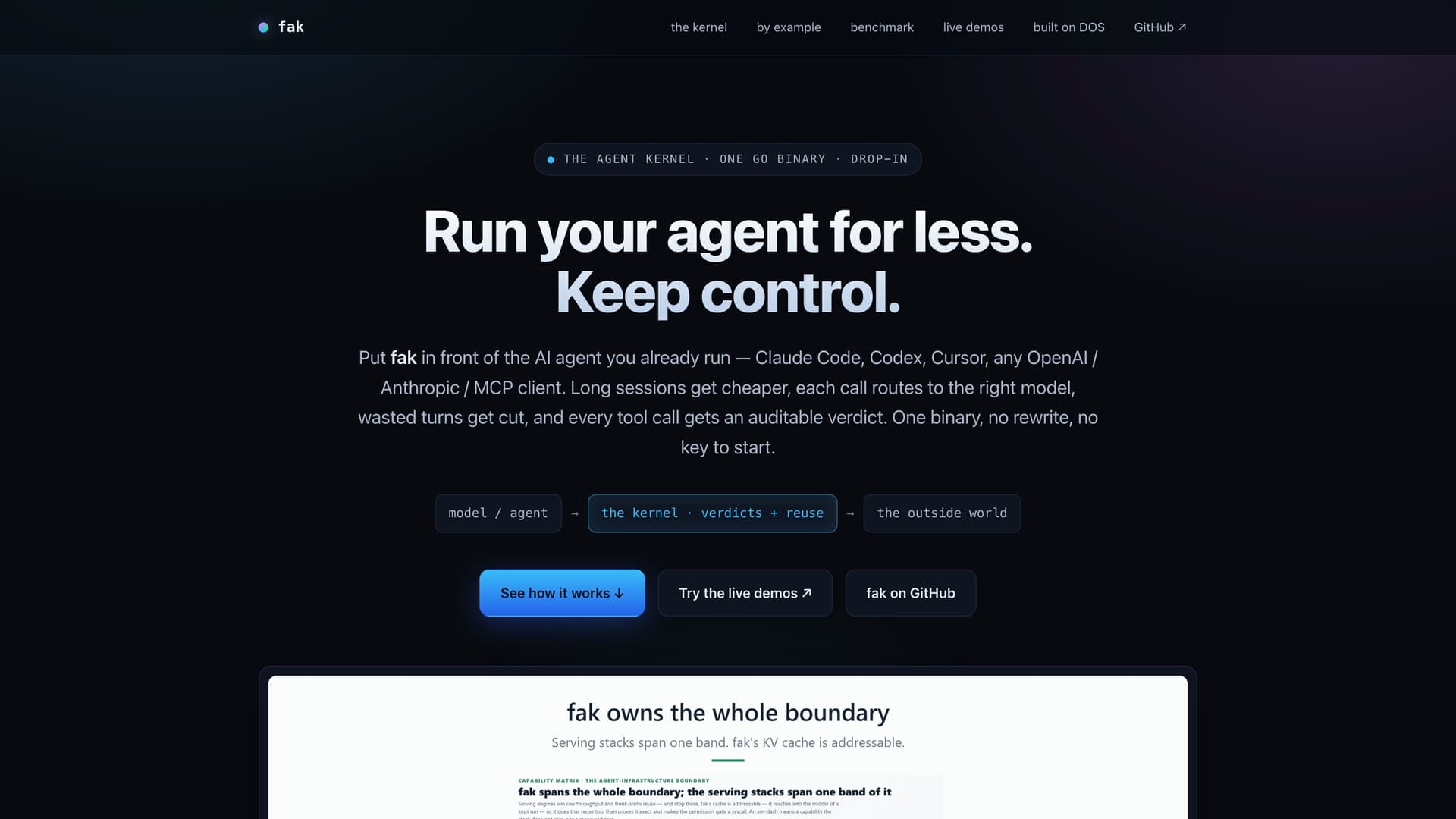
A single Go binary that turns any tool-using AI agent (Claude Code, Codex, Cursor, OpenAI/Anthropic/MCP clients) into a managed agent with cache-stable model traffic, nanosecond tool-call policy, and context compaction.
At a Glance
About fak — the Fused Agent Kernel
fak (Fused Agent Kernel) is an open-source Go binary that sits between an AI agent and the tools it calls, acting as a management plane for model traffic, context lifetime, and capability policy. Released under Apache-2.0 by Netra Systems, Inc., it is designed to drop in front of existing agents — Claude Code, Codex, Cursor, or any OpenAI/Anthropic/MCP client — without requiring a rewrite or API key to evaluate. The project is pre-1.0 and actively developed, with every capability claim tagged as [SHIPPED], [SIMULATED], or [STUB] in a public claims ledger.
What It Is
fak is an agent kernel: an in-process gate that intercepts every tool call an agent makes and treats it like a syscall. The model proposes; the kernel disposes. From the operations seat it is a control plane with audit and policy enforcement. From the performance seat it is a coordination layer that eliminates repeated work across context, cache, and model traffic. The project's own framing is that those two functions turn out to be the same gate — the tool-call boundary.
The kernel runs in two modes: fak guard launches beside a single local agent session as its supervisor, and fak serve runs as a shared OpenAI-, Anthropic-, or MCP-compatible endpoint that multiple clients can point at. Both modes run the same kernel; the difference is scope.
How the Kernel Gate Works
Every tool call passes through a five-gate flow inside the kernel before it reaches the outside world:
- Policy verdict — each proposed call receives ALLOW, DENY, TRANSFORM, or REQUIRE_WITNESS against a reviewable capability floor. The project states this check runs at ~362 ns in-process with no policy model or network hop, and defaults to
default-denyfor unknown tools. - Addressable KV cache — the kernel can reach into the middle of a kept run, evict a single poisoned or expired span, and leave the model's scratchpad bit-for-bit identical to a run that never saw it (the project labels this
max|Δ| = 0). - Shared-prefix reuse — the system-prompt-plus-tools block is prefilled once for a whole agent fleet and reused across sessions. The project's benchmark authority documents claim approximately 4.1× fewer prefill tokens versus a tuned warm-cache stack on a 5-agent × 50-turn workload.
- Context compaction — sessions compact their own history (up to ~107K tokens per trim) and can resume after a crash instead of dying at the context limit.
- In-kernel GGUF serving — the kernel can load GGUF weights itself and serve OpenAI, Anthropic, and MCP clients directly, with SSD expert-weight offload for mixture-of-experts models so the full model does not have to sit in RAM.
Deployment Model
fak is a single static binary with no runtime dependencies. Installation is a one-line curl or go install for Go 1.26+ users. It is offline-capable: fak agent --offline runs a deterministic mock planner that verifies the managed-agent path and policy boundary without an API key, model download, or GPU. The project also ships a Colab quickstart notebook for browser-based evaluation.
For production use, fak guard wraps an existing agent CLI (e.g., fak guard -- claude) and fak serve exposes a gateway endpoint that existing OpenAI or Anthropic clients point at unchanged. A fak node install command registers an always-on MCP service.
Tradeoffs to Know
The project's README is explicit about what fak is not:
- It is not a faster model server — vLLM, SGLang, and llama.cpp win raw throughput; fak runs in front of them.
- The security floor is structural, not detection-based — it removes the tools and results a prompt injection would need rather than claiming to detect a successful injection.
- Tool-calling turns are adjudicated whole-turn, not token-streamed — prose deltas still stream, but tool-call bytes do not, so full-turn latency applies when wiring an interactive harness to the gateway.
- The reuse win is self-host only; frontier-scale fleet numbers are design targets, not measurements.
- Power and energy numbers are simulated.
Update: v0.43.0 (July 2026)
The README was verified against VERSION 0.43.0 on 2026-07-29. The latest GitHub release tag is v0.41.0 (published 2026-07-14). The repository was last pushed on 2026-07-29, indicating active development. The project's CLAIMS.md and BENCHMARK-AUTHORITY.md are maintained as living documents that trace every benchmark number to a commit and artifact, and label what is simulated versus measured.
Community Discussions
Be the first to start a conversation about fak — the Fused Agent Kernel
Share your experience with fak — the Fused Agent Kernel, ask questions, or help others learn from your insights.
Pricing
Open Source
Fully free and open-source under Apache-2.0. Download and self-host the single static binary.
- Single static binary install
- fak guard and fak serve modes
- Default-deny tool-call policy
- Addressable KV cache
- Context compaction and crash resume
Capabilities
Key Features
- Drop-in agent kernel — no rewrite required
- fak guard: local launcher and supervisor for existing agents
- fak serve: shared OpenAI/Anthropic/MCP-compatible endpoint
- Default-deny tool-call policy with ALLOW/DENY/TRANSFORM/REQUIRE_WITNESS verdicts
- Nanosecond in-process policy checks (~362 ns, no network hop)
- Addressable KV cache with mid-run span eviction (max|Δ|=0)
- Shared-prefix reuse across agent fleets
- Context compaction up to ~107K tokens per trim
- Crash resume for long-running sessions
- In-kernel GGUF weight loading with SSD expert offload for MoE models
- Offline mode for keyless, GPU-free evaluation
- Audit journal for every tool-call verdict
- Quarantine for poisoned tool results
- Code linting at the kernel boundary (Go, JSON, Python, CUDA)
- OpenAI, Anthropic, and MCP client compatibility
- Single static binary, no runtime dependencies
- Apache-2.0 open-source license
- Public claims ledger with SHIPPED/SIMULATED/STUB tags