
Firebolt
Postgres-compatible analytical database that runs as a single binary or scales to hundreds of nodes, with open source Core and a managed service.
At a Glance
Free, self-hosted edition of Firebolt with no usage limits.
Engagement
Available On
Alternatives
Listed Oct 2026
About Firebolt
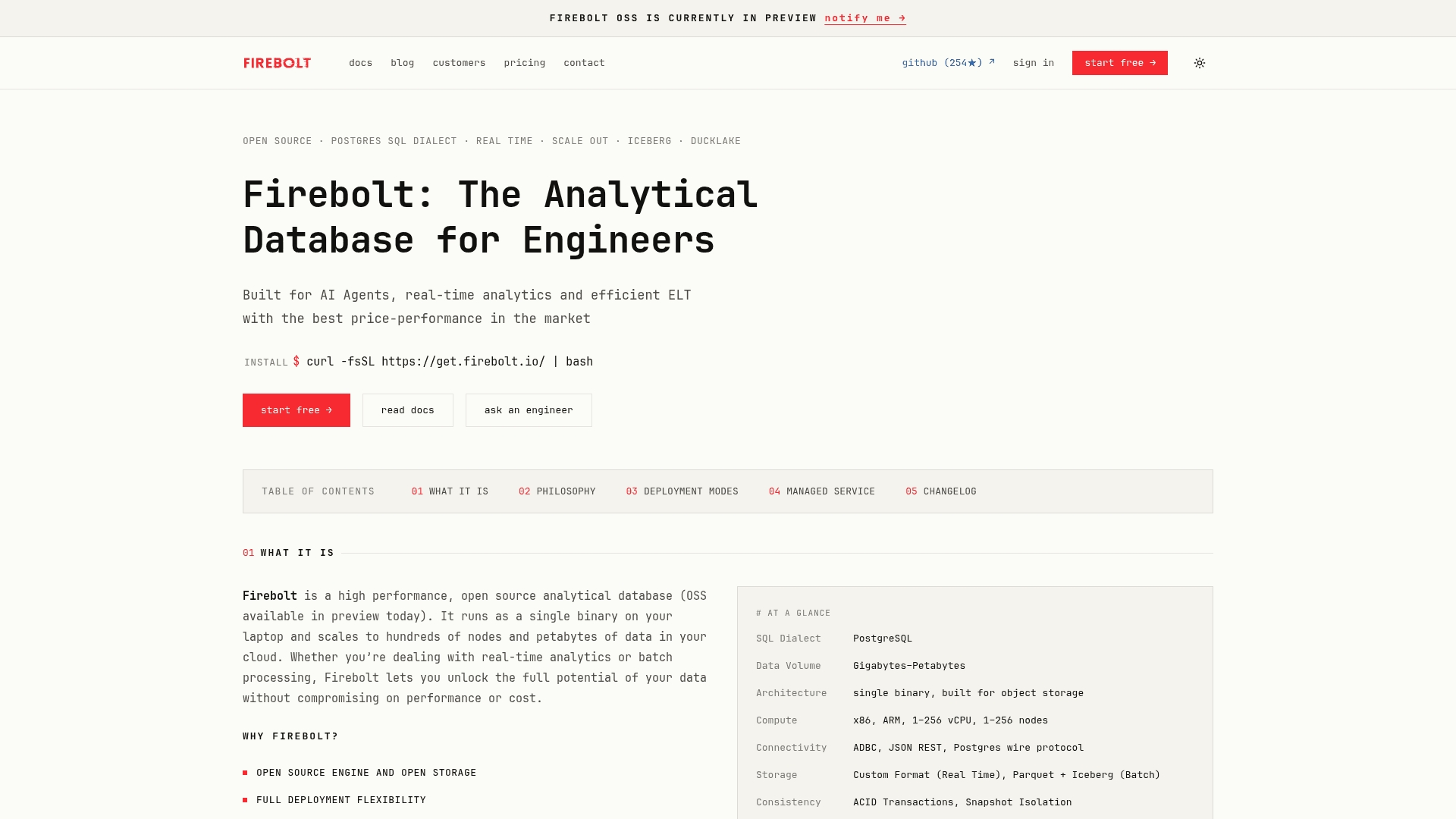
Firebolt is an analytical database from Firebolt Analytics Inc, aimed at engineers building real-time analytics, ELT, and AI-agent workloads. It uses a Postgres-compatible SQL dialect and can run as a single binary on a laptop or as a cluster of up to hundreds of nodes. The open source edition, Firebolt Core, is described as being in preview, and a managed service is also offered.
What It Is
Firebolt is a distributed analytical query engine built around object storage. Queries are written in a PostgreSQL-compatible SQL dialect with analytical extensions such as array lambda functions, native JSON types, cross-database queries, and geospatial functions. Data can be stored in Firebolt's own format for real-time workloads, or read in place from Parquet and Apache Iceberg for batch use, with DuckLake reading marked experimental. It provides ACID transactions with snapshot isolation.
Deployment Modes
The same engine runs in several ways: a single binary with zero dependencies (SQLite for metadata at laptop scale), a Docker image, a Helm chart, a Kubernetes operator for self-managed clusters, and a fully managed service on AWS. Self-managed deployments are documented as GA on AWS and GCP and in preview on Azure. Firebolt Core is the free self-hosted edition, started with a one-line install script or Docker, and queried via HTTP, a CLI, or a web UI container.
Performance and Indexing
The FAQ describes sparse primary indexes, aggregating indexes, data skipping and full-text indexes, vectorized multi-threaded execution, and tiered caching (FireCache) as the means of keeping latency low. Engines can scale up, scale out, and add clusters automatically for concurrency.
AI and Integrations
SQL functions such as AI_QUERY and AI_EMBED_TEXT call LLMs through Amazon Bedrock, and HNSW indexes with VECTOR_SEARCH provide vector similarity search. A Firebolt MCP Server connects clients such as Claude, Cursor, and GitHub Copilot Chat to Firebolt data, and an in-product Firebolt Agent (preview) helps generate and fix SQL. Ingestion supports COPY FROM, table-valued readers, Kafka streams, and Postgres/MongoDB change data capture (private preview). Drivers exist for several languages, plus dbt, Airflow, Tableau, and Postgres wire protocol connectivity (preview).
Community Discussions
Be the first to start a conversation about Firebolt
Share your experience with Firebolt, ask questions, or help others learn from your insights.
Pricing
Firebolt Core
Free, self-hosted edition of Firebolt with no usage limits.
- Free to use, forever
- No usage limits
- Self-hosted anywhere
- Single Docker image
- License is not identified as OSI-approved (GitHub shows 'Other (NOASSERTION)')
Managed Engine S
Managed service engine, billed per second (US East rate shown hourly).
- 1 node, 8 vCPU, 64 GB memory, 1,875 GB disk
- $1.84 / hour (US East, storage-optimized)
- Storage $0.0264 / GB-month on object storage (pass-through)
- $200 free credits
- Per second billing, scale to zero
Managed Engine M
Managed service engine, billed per second (US East rate shown hourly).
- 1 node, 16 vCPU, 128 GB memory, 3,750 GB disk
- $3.68 / hour (US East, storage-optimized)
Managed Engine L
Managed service engine, billed per second (US East rate shown hourly).
- 1 node, 32 vCPU, 256 GB memory, 7,500 GB disk
- $7.36 / hour (US East, storage-optimized)
Managed Engine XL
Managed service engine, billed per second (US East rate shown hourly).
- 1 node, 64 vCPU, 512 GB memory, 15,000 GB disk
- $14.72 / hour (US East, storage-optimized)
Managed Engine 2XL
Managed service engine, billed per second (US East rate shown hourly).
- 2 nodes, 128 vCPU, 1,024 GB memory, 30,000 GB disk
- $29.44 / hour (US East, storage-optimized)
Capabilities
Key Features
- Postgres-compatible SQL dialect
- Single binary to multi-node cluster deployment
- Apache Iceberg and Parquet support
- DuckLake reading (experimental)
- HNSW vector search indexes
- LLM calls from SQL (AI_QUERY, AI_EMBED_TEXT)
- MCP server for LLM clients
- Aggregating, sparse primary, and full-text indexes
- Result and subresult caching (FireCache)
- ACID transactions with snapshot isolation
- Autoscaling engines with workload isolation
- Kafka streaming ingestion
- RBAC, SSO, and network policies
- Native JSON and geospatial types
- Helm chart and Kubernetes operator