
Fractal
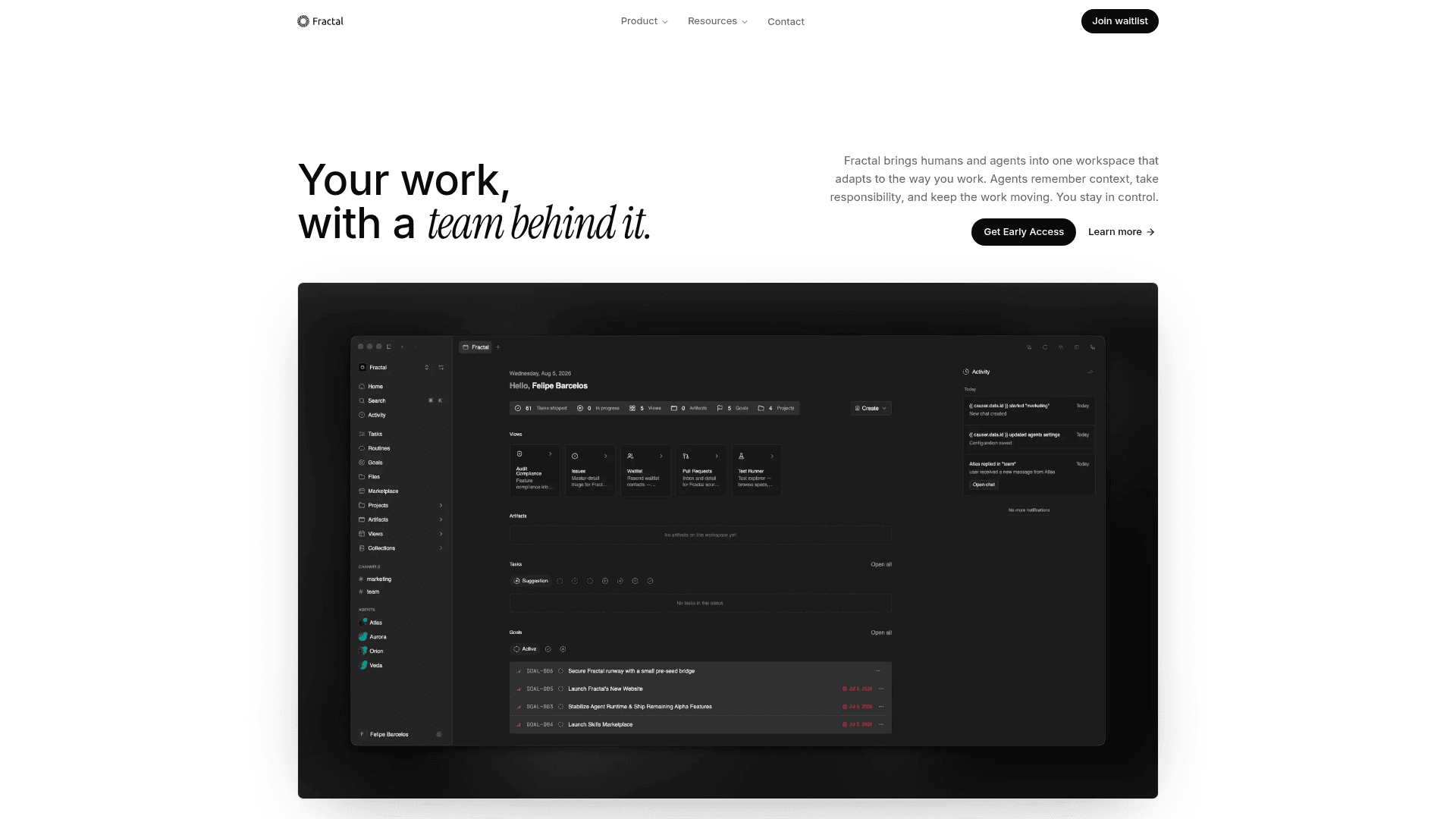
Fractal is a collaborative workspace that brings humans and AI agents together, with persistent memory, task management, routines, and a marketplace of integrations.
At a Glance
About Fractal
Fractal is an adaptive workspace built by Nubler Digital LTDA, founded by Felipe Barcelos, that combines human collaboration with AI agent orchestration in a single environment. The product is currently in early access, with a waitlist and active changelog showing regular alpha releases. It positions itself as "the operating system for work" — a living workspace where agents remember context, take ownership of tasks, and keep work moving while humans stay in control.
What It Is
Fractal is a human-agent collaboration platform that replaces the traditional "chat box waiting for prompts" model with a persistent, adaptive workspace. Rather than starting every AI session from scratch, Fractal maintains memory across sessions, assigns agents to specific roles and responsibilities, and surfaces work through customizable views. The core idea is that agents become useful teammates — not just reactive tools — by holding context, executing tasks in isolated environments, and handing off work cleanly to humans for review.
Core Architecture
Fractal is organized around six interconnected pillars:
- Memory — Conversations, decisions, and preferences persist across sessions so agents never need to be re-briefed on established context.
- Tasks — Work items are assigned to agents with a defined lifecycle: Suggestion → Planning → Execution → Review. Agents operate in isolated worktrees for safe execution.
- Chat — Humans and agents share a single conversation thread, enabling clean handoffs and visible progress without switching tools.
- Routines — Agents can be given standing responsibilities triggered by schedules or workspace events (e.g.,
task.status_changed, nightly audits). - Surfaces — The workspace adapts its views and UI around the domain — CRM boards, editorial calendars, operational dashboards — shaped by the work itself.
- Marketplace — Pre-built plugins and MCP-ready integrations (GitHub, Linear, Notion, Slack, Discord, Stripe) extend agent capabilities without custom development.
The Orchestrator Model
At the center of Fractal is a persistent Orchestrator agent that converts plain language into structured work, surfaces relevant memory and prior decisions, creates tasks and routines, and coordinates specialist agents under human supervision. The Orchestrator is designed to be auditable and non-intrusive — agents ask when judgment matters and report back when work is complete. Each agent is scoped to only the capabilities and data it needs, keeping workspaces isolated and secure.
Target Audience
Fractal's about page describes a broad set of intended users:
- Founders managing roadmap, operations, and go-to-market
- Operators coordinating client workflows and deliverables
- Agencies running multi-client boards with shared context
- Developers handling implementation, review, testing, and releases
- Marketers managing campaigns, content, and reporting
- Educators organizing classes, lesson plans, and grading
Update: Alpha Releases (August 2026)
The changelog shows active development with multiple alpha releases in August 2026, including "More Reliable Agent Workspaces" (alpha-0.1.406, Aug 24), "More Focused Shared Conversations" (alpha-0.1.405, Aug 17), and "A More Connected Fractal" (alpha-0.1.403, Aug 16). The product is in early access with a waitlist; prospective users can join via the homepage or contact the team for enterprise demos and walkthroughs.
Community Discussions
Be the first to start a conversation about Fractal
Share your experience with Fractal, ask questions, or help others learn from your insights.
Pricing
Early Access Waitlist
Join the waitlist to get early access to Fractal's human-agent workspace.
- Memory across sessions
- Task management
- Agent orchestration
- Chat with agents
- Routines
Capabilities
Key Features
- Persistent memory across sessions
- AI agent orchestration
- Task lifecycle management (Suggestion → Planning → Execution → Review)
- Shared human-agent chat threads
- Scheduled and event-triggered routines
- Adaptive workspace surfaces and views
- Marketplace of MCP-ready plugins
- Isolated agent worktrees for safe execution
- Role-based agent scoping
- Proactive task creation by agents
- Full run history for routines
- Human-in-the-loop review and approval