EveryDev.ai
Subscribe
Home
Tools

5,089+ AI tools

  • New
  • Trending
  • Featured
  • Rate tools
  • Compare
  • Arena
Categories
  • Agents2594
  • Coding1910
  • Infrastructure898
  • Projects718
  • Research640
  • MCP611
  • Marketing497
  • Analytics495
  • Design422
  • Testing406
  • Data378
  • Security328
  • Integration259
  • Communication250
  • Prompts246
  • Extensions219
  • Commerce171
  • Voice170
  • DevOps168
  • Web123
  • Learning114
  • Finance35
AI Tools by Topic
  • AI Coding Assistants
  • Agent Frameworks
  • MCP Servers
  • AI Prompt Tools
  • Vibe Coding Tools
  • AI Design Tools
  • AI Database Tools
  • AI Website Builders
  • AI Testing Tools
  • LLM Evaluations
Follow Us
  • X / Twitter
  • LinkedIn
  • Reddit
  • Discord
  • Threads
  • Bluesky
  • Mastodon
  • YouTube
  • GitHub
  • Instagram
Get Started
  • Users
  • Rate Tools
  • About
  • Editorial Standards
  • Corrections & Disclosures
  • Community Guidelines
  • Advertise
  • Contact Us
  • Newsletter
  • Submit a Tool
  • Start a Discussion
  • Write A Blog
  • Share A Build
  • Terms of Service
  • Privacy Policy
Explore with AI
  • ChatGPT
  • Gemini
  • Claude
  • Grok
  • Perplexity
Agent Experience
  • llms.txt
Theme
With AI, Everyone is a Dev. EveryDev.ai ©
    1. Home
    2. Tools
    3. FrontierMemory
    FrontierMemory icon

    FrontierMemory

    Performance Metrics

    A benchmark that measures the quality of agent-generated memory by how much it helps agents solve downstream coding and knowledge-work tasks.

    Visit Website

    At a Glance

    Pricing
    Open Source

    Apache-2.0 licensed FrontierMemory benchmark code, self-hosted. Benchmark tasks are adapted from other benchmarks under their own licenses; the corpus is a gated Hugging Face dataset.

    Engagement

    Available On

    Linux
    Web
    API
    CLI

    Resources

    WebsiteDocsGitHubllms.txt

    Topics

    Performance MetricsLLM EvaluationsAgent Memory

    Alternatives

    BridgeBenchOmnisBenchLLM Stats
    Developer
    Letta, Inc.Letta builds the open platform for stateful AI agents—combin…

    Listed Oct 2026

    About FrontierMemory

    FrontierMemory is a benchmark from Letta for evaluating continual learning through memory. Agents read past trajectories and write a memory folder, and that memory is scored by how much it helps a fresh agent solve downstream tasks. The project is open source under Apache-2.0 and includes a command-line tool, a public leaderboard for models and harnesses, and a submission process.

    What It Is

    FrontierMemory is an evaluation framework for memory generation. The site says existing memory benchmarks mostly measure recall of past facts, while FrontierMemory measures memory quality by downstream task success. The README describes 15 memory-dependent tasks adapted from public coding and knowledge-work benchmarks, which test whether agents learn task contracts, user preferences, and environment rules from trajectories. The site names HarborIndex, DeepSWE, and SkillsBench among the task sources.

    How a Run Works

    A run has two stages. In memory generation, a memory agent reads a fixed corpus of 674 agent trajectories, each ending in a PASS or FAIL verifier result, and writes a memory folder. Generation is limited to six hours, and the agent has no web access beyond its model API. In the task stage, a task agent attempts the 15 target tasks with that memory, alongside a no-memory control. The score is the strict pass rate on each task's verifier.

    The frontier-memory CLI, built on Harbor, covers the workflow:

    • fetch-corpus downloads the gated corpus.
    • generate-memory runs a memory harness.
    • run-tasks evaluates task agents, with or without memory.
    • score and bundle package results for submission.

    Execution is supported on Docker or Modal. Python 3.12+ is required.

    Leaderboard and Submissions

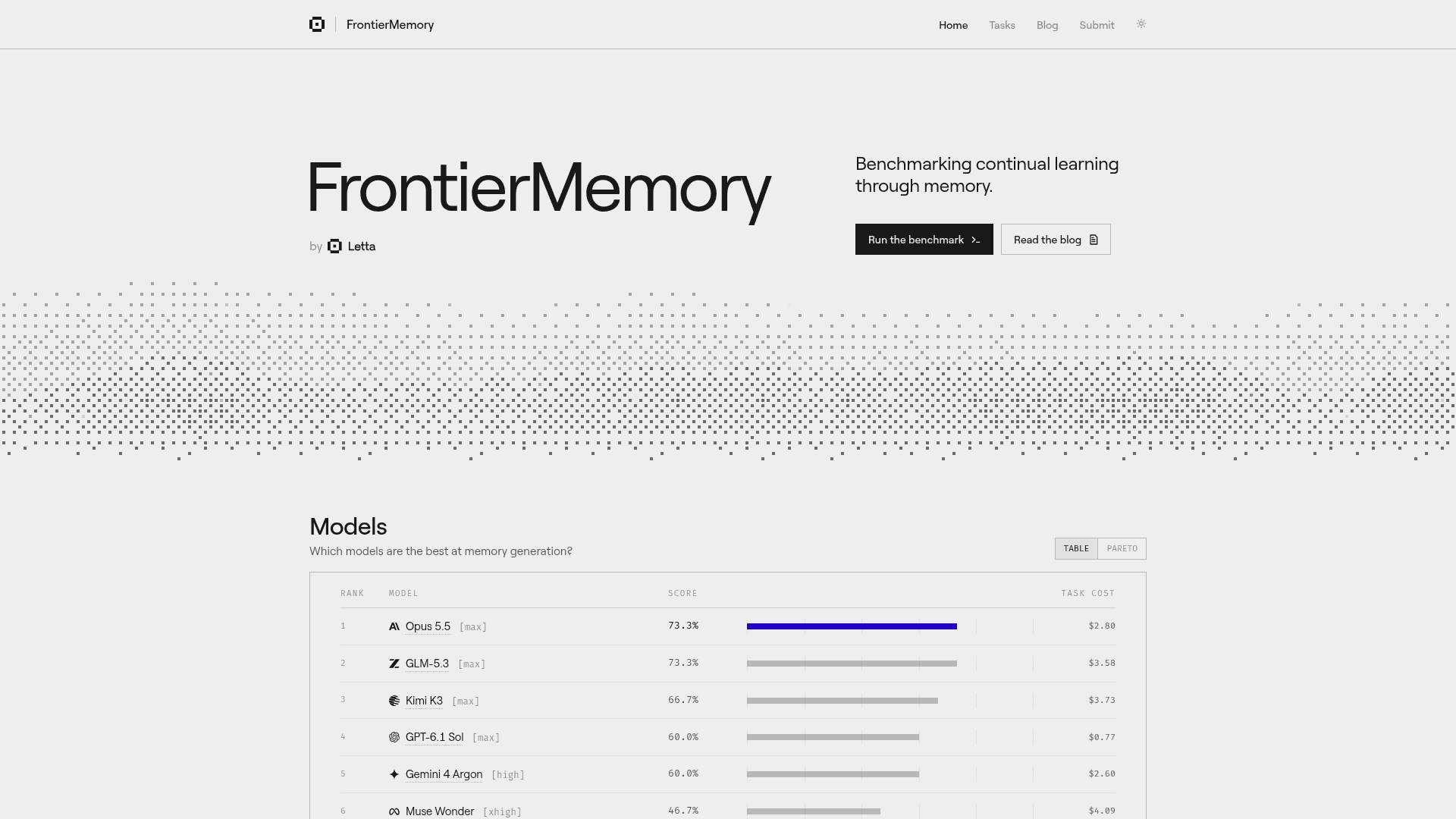
    The leaderboard ranks models and harnesses by score and task cost, including Letta Dream, OpenAI Agents SDK, Prime Agent, Hermes Agent, and Claude Managed Agents. Official runs use Letta Dream for memory generation and Letta Code for task evaluation by default. Developers can submit a model by email, or a memory-generation harness through an adapter pull request. Submissions need three independent runs, which Letta verifies before posting an official score. Task-only submissions are not accepted.
    FrontierMemory - 1

    Community Discussions

    Be the first to start a conversation about FrontierMemory

    Share your experience with FrontierMemory, ask questions, or help others learn from your insights.

    Pricing

    OPEN SOURCE

    Open Source

    Apache-2.0 licensed FrontierMemory benchmark code, self-hosted. Benchmark tasks are adapted from other benchmarks under their own licenses; the corpus is a gated Hugging Face dataset.

    • Code under Apache-2.0
    • frontier-memory CLI
    • Tasks adapted from other benchmarks, each under its own license (see THIRD_PARTY_NOTICES.md)
    • Corpus is a gated Hugging Face dataset requiring acceptance of its terms
    • Model API, Docker/Modal and LLM judge costs are external

    Capabilities

    Key Features

    • Memory-quality benchmark scored by downstream task solve rate
    • 15 memory-dependent tasks adapted from public benchmarks
    • Fixed corpus of 674 agent trajectories with PASS/FAIL results
    • Public leaderboards for models and memory harnesses with cost data
    • frontier-memory CLI for generating memory, running tasks, scoring and bundling
    • No-memory control runs
    • Custom memory-generation harness adapters via Harbor
    • Runs on Docker or Modal with network restrictions

    Integrations

    Harbor
    Modal
    Docker
    Hugging Face
    Letta Dream
    Letta Code
    Codex
    Claude Code
    Hermes Agent
    OpenAI Agents SDK
    OpenClaw
    API Available
    View Docs

    Ratings & Reviews

    No ratings yet

    Be the first to rate FrontierMemory and help others make informed decisions.

    Rate other tools you’ve used

    Developer

    Letta, Inc.

    Letta builds the open platform for stateful AI agents—combining research-driven memory management (MemGPT) with practical tooling like ADE, SDKs, and a managed cloud.

    Read more about Letta, Inc.
    3 tools in directory

    Similar Tools

    BridgeBench icon

    BridgeBench

    BridgeBench ranks AI coding models across UI generation, security, refactoring, hallucination, debugging, and speed benchmarks.

    OmnisBench icon

    OmnisBench

    An open, reproducible benchmark for LLM routing efficiency that measures how close a routing policy gets to the ideal quality-per-dollar frontier using fresh, uncontaminated tasks.

    LLM Stats icon

    LLM Stats

    Public leaderboards and benchmark site that publishes verifiable evaluations, scores, and performance metrics for large language models and AI providers.

    Browse all tools

    Related Topics

    Performance Metrics

    Specialized tools for measuring, evaluating, and optimizing AI model performance across accuracy, speed, resource utilization, and other critical parameters.

    88 tools

    LLM Evaluations

    Platforms and frameworks for evaluating, testing, and benchmarking LLM systems and AI applications. These tools provide evaluators and evaluation models to score AI outputs, measure hallucinations, assess RAG quality, detect failures, and optimize model performance. Features include automated testing with LLM-as-a-judge metrics, component-level evaluation with tracing, regression testing in CI/CD pipelines, custom evaluator creation, dataset curation, and real-time monitoring of production systems. Teams use these solutions to validate prompt effectiveness, compare models side-by-side, ensure answer correctness and relevance, identify bias and toxicity, prevent PII leakage, and continuously improve AI product quality through experiments, benchmarks, and performance analytics.

    201 tools

    Agent Memory

    Memory layers, frameworks, and services that enable AI agents to store, recall, and manage information across sessions. These tools provide persistent, semantic, and contextual memory for agents, supporting personalization, long-term context retention, graph-based relationships, and hybrid RAG + memory workflows.

    213 tools
    Browse all topics
    Back to all toolsSuggest an edit
    ratings
    discussions