
Frugon
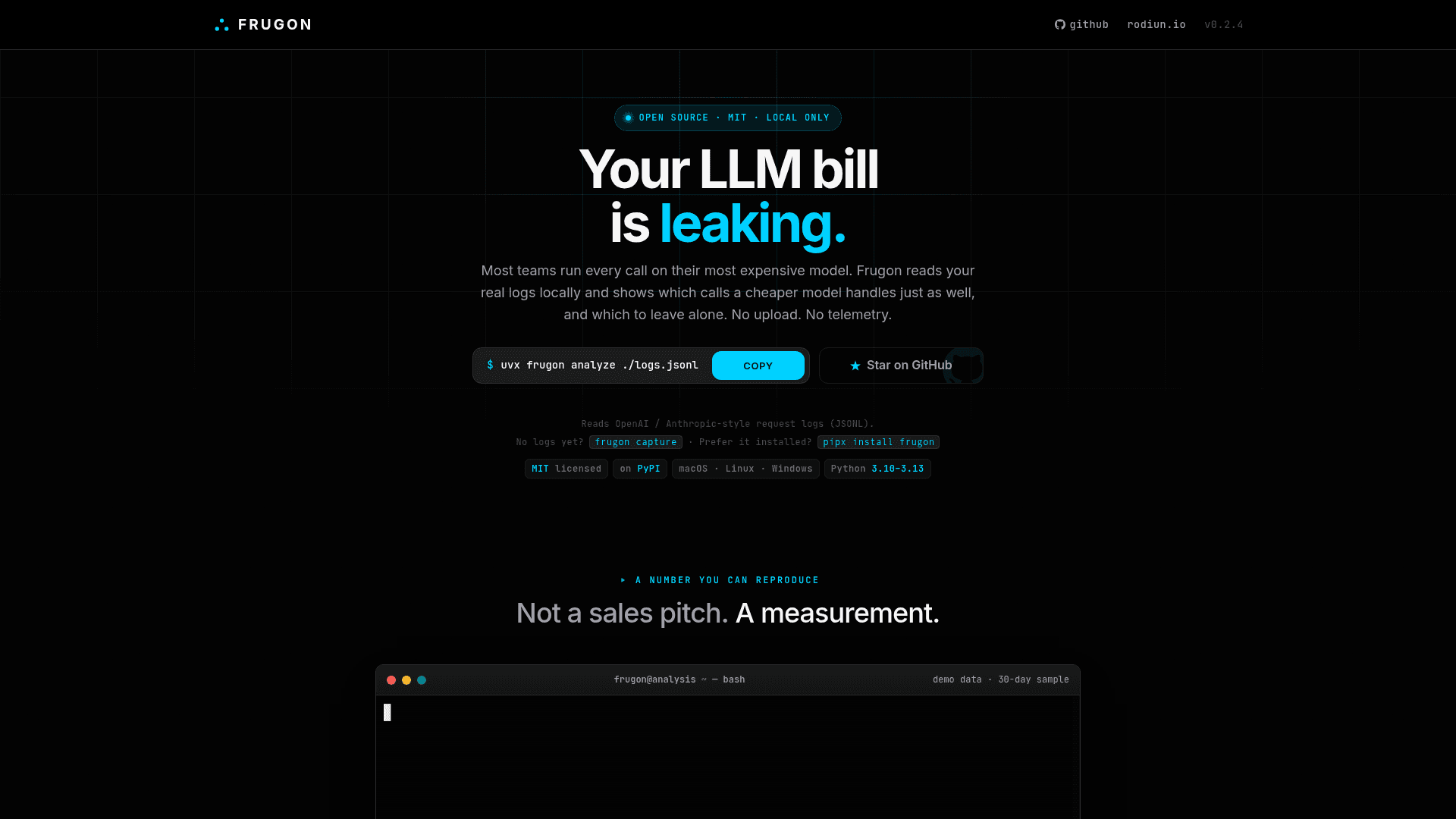
A free, local, open-source CLI tool that analyzes your LLM call logs to identify which API calls could be handled by cheaper models, projecting monthly cost savings without uploading any data.
At a Glance
About Frugon
Frugon is a free, MIT-licensed command-line tool built by Rodiun Ltd that reads your LLM request logs locally and shows exactly where your AI API spend can be reduced by routing calls to cheaper models. It runs entirely on your machine — no accounts, no telemetry, no data uploads — and is available on macOS, Linux, and Windows for Python 3.10–3.13. The current release is v0.2.4, published on PyPI in July 2026.
What It Is
Frugon is a local-first LLM cost analyzer in the FinOps/LLMOps category. It ingests JSONL log files in the OpenAI/Anthropic request-response format and produces a routing recommendation: which percentage of your calls can safely move to a cheaper model, and which should stay on the expensive one. The analysis uses token counting via the tokencost library, pricing data synced weekly from the LiteLLM registry, and quality tiers anchored to LMArena rankings — no LLM calls are made during the analysis itself.
How the Analysis Works
Frugon assembles three existing, verifiable data sources rather than inventing its own methodology:
- Token counting & pricing — uses
tokencostfor tokenization and the LiteLLM model registry for per-token prices, re-synced weekly via CI or on demand withfrugon pricing update. - Quality tiers — anchored to LMArena rankings so the "within tolerance" label reflects a published benchmark, not a proprietary score.
- Savings ranges — informed by RouteLLM/LMSYS published research, which reports 30–50% savings on general mixed workloads, up to ~85% on easy/repetitive traffic, and ~30% on hard reasoning tasks. Frugon's output is always derived from your actual log data, not these ranges.
An optional --measure flag samples real prompts through your own provider API keys (sent directly to your provider, never to a Frugon endpoint) to verify quality estimates against actual outputs.
Getting Logs and Running an Analysis
Two paths exist for producing the required JSONL input:
frugon capture— a local HTTP proxy shim that sits between your app and your provider, forwarding every call unchanged and saving it as a JSONL line. It adds no latency overhead and makes no calls to any Frugon endpoint.- Write JSONL directly — if you already capture logs via middleware or SDK callbacks, write one JSON object per line with
model,request,response,usage, and an optionaltimestampfield.
Once logs exist, a single command (uvx frugon analyze ./logs.jsonl) produces a cost breakdown, a routing split (e.g., "route 64% of easy calls to deepseek-v4-flash, keep 18% on gpt-5.5"), and projected monthly savings. Adding --report savings.html generates a shareable HTML or Markdown report for team or budget reviews.
Target Audience
The README identifies five primary use cases: agent builders running expensive frontier models on simple hops, AI dev teams with real monthly LLM bills, RAG and support pipelines where the retrieval step is cheap but the answer call is not, data-ETL pipelines with repetitive batch extraction, and indie hackers optimizing runway. The tool is deliberately scoped to six commands (analyze, capture, models, update, pricing, quality) with gateways, live routing proxies, web UIs, and multi-tenant accounts explicitly out of scope.
Update: v0.2.4
The latest release, v0.2.4, was published to PyPI on 2026-07-06. The repository was created on 2026-06-20 and last pushed on 2026-07-09, indicating active early development. The homepage notes that continuous automatic routing (as opposed to the current one-time snapshot analysis) is a planned future capability, with an email waitlist for notification when it ships.
Community Discussions
Be the first to start a conversation about Frugon
Share your experience with Frugon, ask questions, or help others learn from your insights.
Pricing
Open Source
Fully free and open-source under the MIT license. Install via uvx, pipx, or pip. No accounts, no telemetry, no usage limits.
- Local LLM cost analysis from JSONL logs
- frugon capture proxy shim for log collection
- Routing recommendations with quality tiers
- Shareable HTML/Markdown reports
- Weekly pricing sync from LiteLLM registry
Capabilities
Key Features
- Local-only LLM cost analysis — no data uploads, no telemetry
- Reads OpenAI/Anthropic-style JSONL request logs
- Token counting via tokencost library
- Pricing synced weekly from LiteLLM registry
- Quality tiers anchored to LMArena rankings
- Routing recommendation: which calls to move vs. keep
- Optional --measure flag to verify quality with your own provider keys
- frugon capture proxy shim to record logs without code changes
- Shareable HTML and Markdown report output (--report)
- Supports multiple candidate models for comparison
- Works with OpenAI, Anthropic, and compatible providers
- No accounts required, ever
- Fast local analysis — comfortable past 100k records
- Demo mode with bundled ~56,100-call sample dataset
- frugon models command to browse available candidate models
- frugon pricing update to manually refresh pricing data