
Fusion
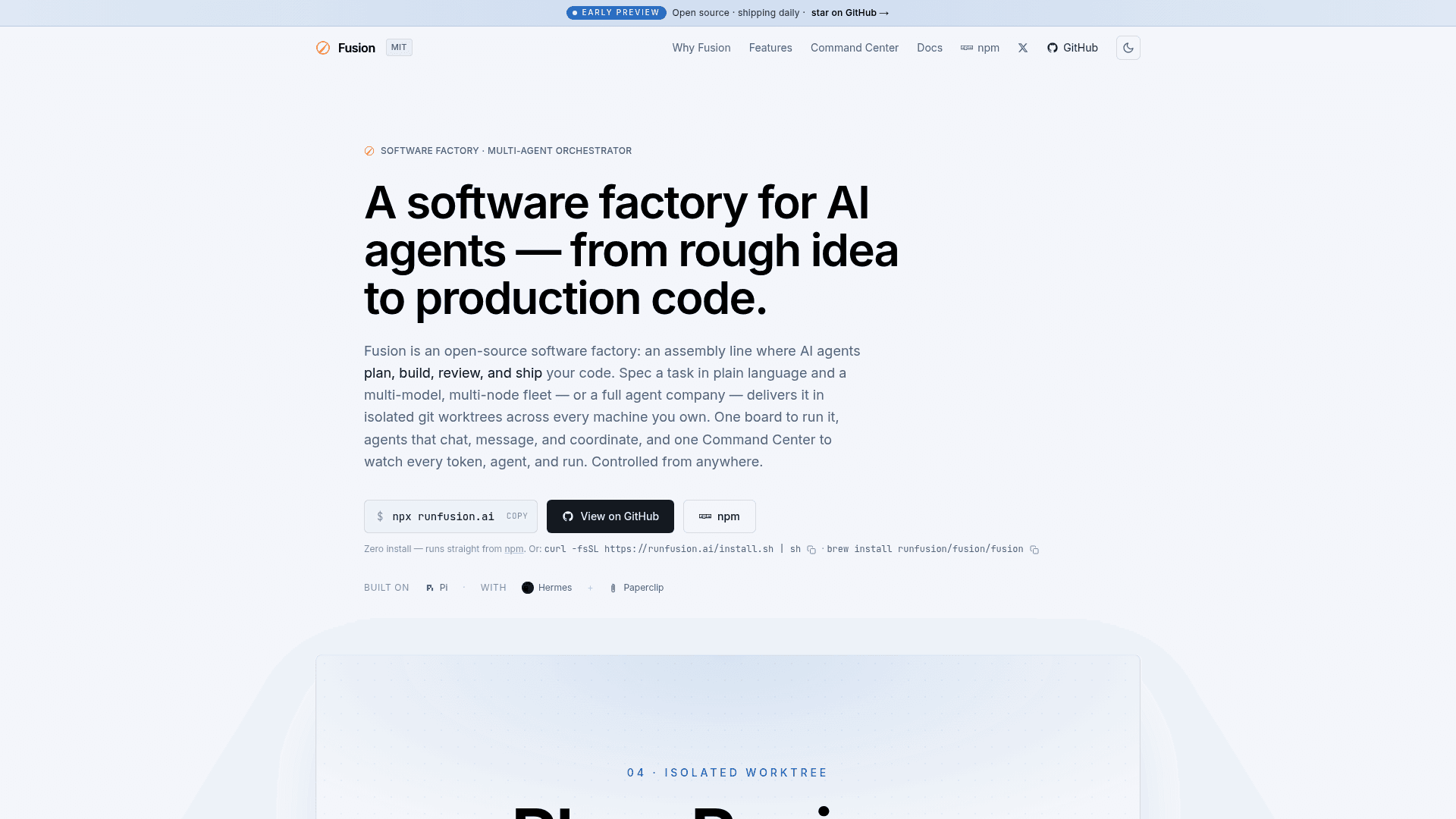
An open-source multi-agent software factory that takes a plain-language task description and autonomously plans, builds, reviews, and ships production code across any device.
At a Glance
Fully open-source under MIT license. Free to use, modify, and self-host.
Engagement
Available On
Alternatives
Listed Aug 2026
About Fusion
Fusion is an open-source, MIT-licensed software factory built by Runfusion that orchestrates a fleet of AI agents to take a rough idea all the way to merged, production-ready code. It is currently in early preview and shipping weekly, with the latest release at v0.74.0 as of August 2026. The project has accumulated over 1,000 GitHub stars since its April 2026 launch.
What It Is
Fusion is a multi-agent orchestration platform designed to function like an automated assembly line for software development. Users describe a task in plain language; a planning agent converts it into a structured PROMPT.md spec with acceptance criteria; then a fleet of specialized agents plans, reviews, executes, and reviews again — all inside isolated git worktrees — before squash-merging to main. The result is a kanban-style board where every column (Triage → Todo → In Progress → In Review → Done) is driven by AI agents rather than human developers.
How the Agent Pipeline Works
Every task flows through a deterministic five-stage lifecycle:
- Triage / Planning — A planning agent reads the project context and writes a
PROMPT.mdwith steps, file scope, and acceptance criteria. An optional planning wizard asks structured questions before drafting the spec. - Todo — The task is scheduled for execution.
- In Progress — For each step: Plan → Review → Execute → Review. Agents loop until the step is approved or rethought.
- In Review — All quality gates (docs, QA, security, performance, accessibility) must pass before merge.
- Done — Fusion squash-merges and keeps history linear. Conflicts are resolved by agents in isolation before main ever sees them.
Parallel tasks run in separate git worktrees (fusion/{task-id} branches), so concurrent agents never collide on the same file. Dependent tasks auto-rebase in the correct order.
Multi-Node Mesh and Platform Coverage
Fusion is designed to run across every device a developer owns simultaneously. A mesh networking layer auto-discovers nodes on LAN or cloud, syncing task state, agent heartbeats, missions, and board state across all of them. The same codebase ships as:
- Desktop apps for macOS (Intel + Apple Silicon), Windows 10/11, and Linux (deb, rpm, AppImage)
- Native iOS/iPadOS and Android apps via Capacitor
- An installable PWA
- A web dashboard served from the
fn dashboarddaemon - A CLI (
fnbinary) for terminal-first workflows
Agent Companies and Autonomous Missions
Fusion supports importing pre-built agent teams using the companies.sh standard — the same format used by Paperclip. According to the project's documentation, the catalog includes 440+ agents across 16 companies, importable with a single npx companies.sh add command. Once imported, agents are assigned roles (CEO, CMO, CTO, engineers), communicate via a built-in inter-agent mailbox, and can run autonomously for weeks on hierarchical mission plans (Mission → Milestone → Slice → Feature → Task). After each task, agents reflect on their output and update their own AGENTS.md prompts with sharper heuristics — a self-improvement loop the project calls "agent performance reviews."
Command Center Observability
The Command Center is Fusion's live analytics surface for the entire agent fleet. It exposes eleven tab views covering tokens and USD cost by model, autonomy ratio, per-agent output, task throughput, anomaly signals, system vitals (CPU, memory, heap), GitHub activity, and ecosystem health. Data is exportable to CSV or via OpenTelemetry (OTLP). The dashboard supports 70+ color themes and is accessible from any connected device.
Model Support and Architecture
Fusion supports multiple AI providers simultaneously, with a model router that selects the right provider per task and falls back gracefully. Supported providers include Anthropic, OpenAI, Google Generative AI (Gemini), Z.ai, Ollama, Kimi K3, and user-defined custom OpenAI-compatible endpoints. Five independent model lanes — executor, planner, validator, merger, and title summarizer — can be configured globally, per project, or per task. The platform also supports the Agent Client Protocol (ACP) for interoperability with Gemini CLI, Claude, and Cursor agents, and MCP for tool integrations. Storage defaults to embedded PostgreSQL for local runtime metadata.
Update: v0.74.0
The latest release is v0.74.0, published August 3, 2026. The project badges "shipping weekly" and the GitHub repository shows daily pushes. Recent additions documented in the README include selectable workflows with a visual Workflow Editor, planner oversight levels (off/observe/steer/autonomous), multi-agent Chat Rooms, an inter-agent mailbox (Agent Mail), PostgreSQL as the default storage backend (replacing SQLite), and a research mode with web search and LLM synthesis. The project is explicitly labeled "Early Preview" on its homepage.
Community Discussions
Be the first to start a conversation about Fusion
Share your experience with Fusion, ask questions, or help others learn from your insights.
Pricing
Open Source
Fully open-source under MIT license. Free to use, modify, and self-host.
- Full multi-agent orchestration
- Unlimited tasks and projects
- All model providers (Anthropic, OpenAI, Gemini, Ollama, etc.)
- Desktop, mobile, web, and CLI apps
- Command Center observability
Capabilities
Key Features
- Multi-agent task orchestration (plan, review, execute, review)
- AI-generated PROMPT.md specs with acceptance criteria
- Git worktree isolation per task — zero file conflicts
- Selectable workflows: Coding, Quick Fix, Review-heavy, Stepwise, Compound Engineering
- Visual Workflow Editor for custom workflow graphs
- Planner oversight levels (off / observe / steer / autonomous)
- Command Center with 11 analytics views (tokens, cost, autonomy, vitals)
- OpenTelemetry (OTLP) and CSV export
- Multi-node mesh networking — auto-discovery across LAN and cloud
- Agent companies import (440+ agents, 16 companies via companies.sh)
- Hierarchical missions (Mission → Milestone → Slice → Feature → Task)
- Inter-agent mailbox (Inbox, Outbox, Approvals)
- Multi-agent Chat Rooms with mention routing
- Direct and per-task agent chat with resumable streams
- Auto-merge with squash on passing all quality gates
- Conflict resolution by agents in isolation
- GitHub issue import and PR lifecycle management
- Queryable markdown-based persistent agent memory (qmd)
- Agent self-improvement via AGENTS.md reflection after each task
- Model router with cheap-tier routing and fallback
- Five independent model lanes (executor, planner, validator, merger, title)
- Per-task model overrides
- Custom OpenAI-compatible provider support
- Cron-based automations and routines (global and project scope)
- Webhook-triggered routines
- Plugin system compatible with Pi extensions
- Docker and headless deployment
- Desktop apps (macOS, Windows, Linux)
- Native iOS and Android apps (Capacitor)
- Installable PWA
- 70+ color themes
- Research mode with web search and LLM synthesis