
Main Menu
  • Tools
  • Developers
  • Topics
  • Discussions
  • News
  • Blogs
  • Builds
  • Contests
Create
Sign In
    EveryDev.ai
    Sign inSubscribe
    Home
    Tools

    1,624+ AI tools

    • New
    • Trending
    • Featured
    • Compare
    Categories
    • Coding737
    • Agents659
    • Marketing313
    • Infrastructure299
    • Design241
    • Analytics231
    • Research228
    • Projects222
    • Integration148
    • Testing129
    • Data127
    • Learning116
    • MCP114
    • Security108
    • Extensions96
    • Communication81
    • Prompts80
    • Commerce72
    • Voice72
    • Web59
    • DevOps46
    • Finance12
    Sign In
    1. Home
    2. Tools
    3. Gambit
    Gambit icon

    Gambit

    Agent Harness

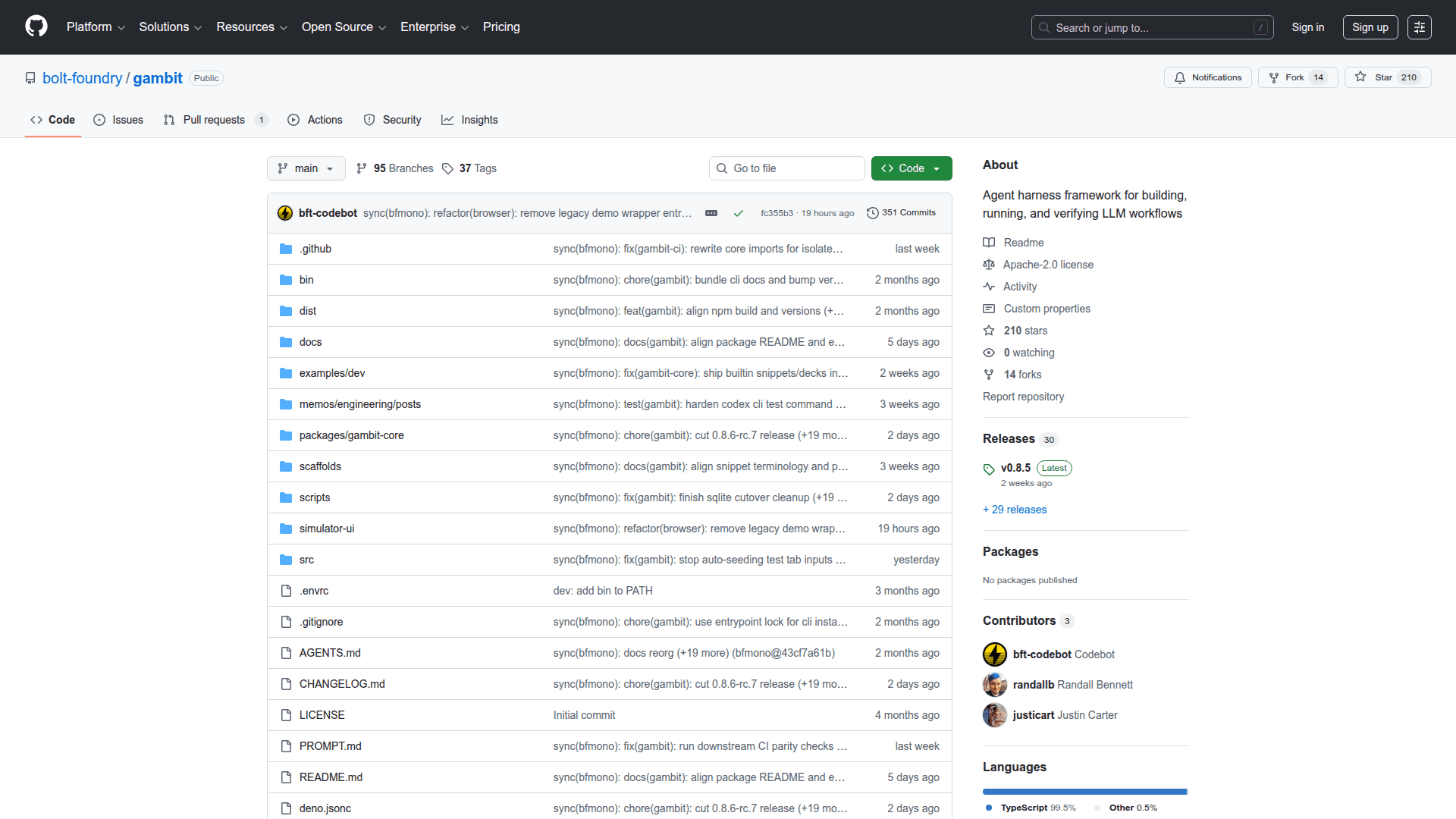
    Gambit is an open-source agent harness framework by Bolt Foundry for building, running, and verifying LLM workflows using typed decks.

    Visit Website

    At a Glance

    Pricing

    Open Source

    Freely available open-source project on GitHub under Apache-2.0 license.

    Engagement

    Available On

    Web
    API
    SDK

    Resources

    WebsiteDocsGitHubllms.txt

    Topics

    Agent HarnessAgent FrameworksLLM Evaluations

    Listed Mar 2026

    About Gambit

    Gambit is an open-source agent harness framework by Bolt Foundry for building, running, and verifying LLM workflows. It introduces the concept of "decks" — small, typed units with explicit inputs, outputs, and guardrails — that compose together into reliable AI pipelines. Decks can mix LLM calls and plain compute tasks interchangeably, feeding models only the context they need at each step instead of dumping entire documents into a single prompt.

    Gambit runs locally via CLI (npx or Deno) and ships with a built-in Debug UI for streaming traces, inspecting transcripts, and reproducing failures without relying on provider logs. The framework supports REPL mode for interactive development, test-bot personas for automated testing, and session grading for evaluation.

    • Typed Decks - Define workflows as small composable units with Zod-validated input and output schemas, written in Markdown or TypeScript.
    • Local-First Debugging - Stream traces, inspect transcript lanes, and reproduce failures using the built-in simulator UI at localhost.
    • Mixed LLM and Compute - Combine model-powered steps and pure TypeScript compute steps within the same deck tree.
    • CLI Tooling - Run decks, start REPLs, launch the debug server, and grade sessions from the command line via npx or Deno.
    • Test Bot and Grading - Run persona decks against your workflows and grade saved sessions to evaluate LLM behavior systematically.
    • Action Decks - Attach child decks as tool actions that LLM-powered parent decks can call, enabling agent-style tool use.
    • Schema-Driven UI - The Debug UI auto-renders input forms from deck schemas with defaults and a raw JSON tab.
    • Session Persistence - Save and replay sessions with trace files and state snapshots stored locally under .gambit/.
    Gambit - 1

    Community Discussions

    Be the first to start a conversation about Gambit

    Share your experience with Gambit, ask questions, or help others learn from your insights.

    Pricing

    OPEN SOURCE

    Open Source

    Freely available open-source project on GitHub under Apache-2.0 license.

    • Full source code access
    • Community contributions
    • GitHub Actions CI/CD
    • Issues and project tracking
    View official pricing

    Capabilities

    Key Features

    • Typed deck-based workflow composition with Zod schemas
    • Local-first CLI execution via npx or Deno
    • Built-in Debug UI with streaming traces and transcript lanes
    • REPL mode for interactive deck development
    • Mixed LLM and compute task steps in a single deck tree
    • Test bot personas for automated workflow testing
    • Session grading for LLM behavior evaluation
    • Action decks for agent-style tool use
    • Schema-driven input forms in the Debug UI
    • Session persistence with local trace and state files
    • Markdown and TypeScript deck authoring
    • OpenRouter API integration for model access

    Integrations

    OpenRouter
    GitHub
    GitHub Actions
    Deno
    Node.js
    API Available
    View Docs

    Reviews & Ratings

    No ratings yet

    Be the first to rate Gambit and help others make informed decisions.

    Developer

    Bolt Foundry

    Bolt Foundry builds open-source tools and frameworks for AI application development. The team focuses on creating developer-friendly utilities that streamline building, testing, and iterating on AI-powered systems. Their projects are publicly available on GitHub and welcome community contributions.

    Read more about Bolt Foundry
    WebsiteGitHub
    1 tool in directory

    Similar Tools

    harness-kit icon

    harness-kit

    A Python toolkit for building and evaluating AI agent harnesses, enabling structured testing and benchmarking of LLM-based agents.

    OpenAI Symphony icon

    OpenAI Symphony

    Symphony is an open-source multi-agent orchestration framework by OpenAI, built with Elixir, for coordinating AI agents in complex workflows.

    GitHub Spec Kit icon

    GitHub Spec Kit

    A specification framework for defining AI agent constitutions and behavioral guidelines on GitHub.

    Browse all tools

    Related Topics

    Agent Harness

    Infrastructure, orchestrators, and task runners that wrap around LLM coding agents — covering session management, context delivery, worktree isolation, architecture enforcement, and issue-to-PR pipelines.

    18 tools

    Agent Frameworks

    Tools and platforms for building and deploying custom AI agents.

    141 tools

    LLM Evaluations

    Platforms and frameworks for evaluating, testing, and benchmarking LLM systems and AI applications. These tools provide evaluators and evaluation models to score AI outputs, measure hallucinations, assess RAG quality, detect failures, and optimize model performance. Features include automated testing with LLM-as-a-judge metrics, component-level evaluation with tracing, regression testing in CI/CD pipelines, custom evaluator creation, dataset curation, and real-time monitoring of production systems. Teams use these solutions to validate prompt effectiveness, compare models side-by-side, ensure answer correctness and relevance, identify bias and toxicity, prevent PII leakage, and continuously improve AI product quality through experiments, benchmarks, and performance analytics.

    46 tools
    Browse all topics
    Back to all tools
    Explore AI Tools
    • AI Coding Assistants
    • Agent Frameworks
    • MCP Servers
    • AI Prompt Tools
    • Vibe Coding Tools
    • AI Design Tools
    • AI Database Tools
    • AI Website Builders
    • AI Testing Tools
    • LLM Evaluations
    Follow Us
    • X / Twitter
    • LinkedIn
    • Reddit
    • Discord
    • Threads
    • Bluesky
    • Mastodon
    • YouTube
    • GitHub
    • Instagram
    Get Started
    • About
    • Editorial Standards
    • Corrections & Disclosures
    • Community Guidelines
    • Advertise
    • Contact Us
    • Newsletter
    • Submit a Tool
    • Start a Discussion
    • Write A Blog
    • Share A Build
    • Terms of Service
    • Privacy Policy
    Explore with AI
    • ChatGPT
    • Gemini
    • Claude
    • Grok
    • Perplexity
    Agent Experience
    • llms.txt
    Theme
    With AI, Everyone is a Dev. EveryDev.ai © 2026
    Sign in
    1view
    0upvotes
    0discussions