
GitReverse
Reverse engineer any public GitHub repository or website into a single synthetic user prompt for vibe coding with AI tools like Cursor, Claude Code, or Codex.
At a Glance
Fully free and open-source; self-host with your own LLM API keys.
Engagement
Available On
Alternatives
Listed Sep 2026
About GitReverse
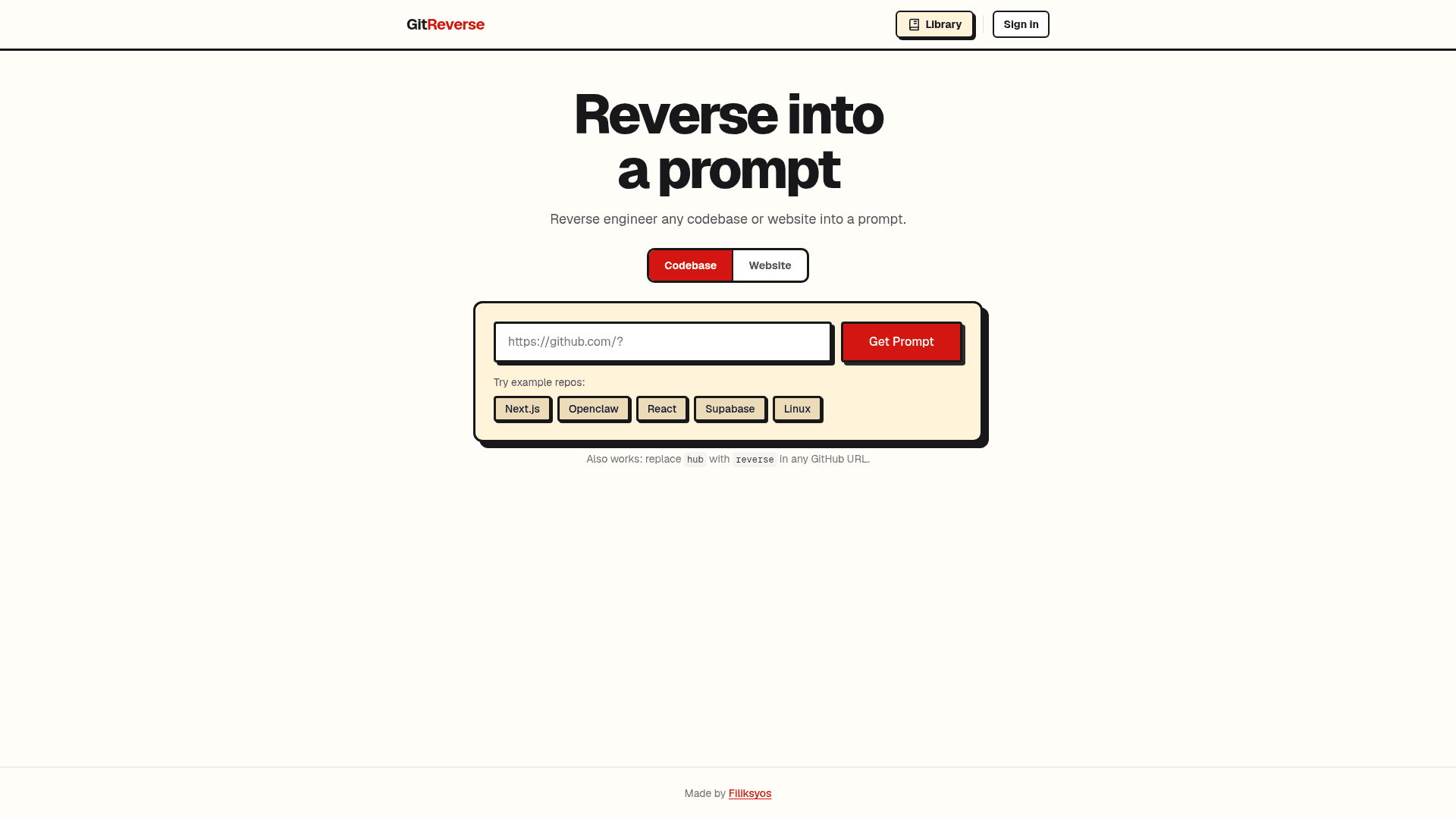
GitReverse is an open-source web tool built by Filiksyos that takes any public GitHub repository and converts it into a concise, conversational prompt you can paste directly into AI coding assistants. It pulls repo metadata, a root file tree, and the README, then uses an LLM to synthesize a single prompt grounded in that context. The project has accumulated over 1,900 GitHub stars and 320 forks since its creation.
What It Is
GitReverse sits at the intersection of prompt engineering and reverse engineering. Given a GitHub URL or an owner/repo slug, it produces one short prompt that captures the essence of a codebase — the kind of prompt someone might use to recreate the project from scratch using a vibe-coding workflow. It also supports website reverse engineering, turning a live site into a similar synthetic prompt. The tool is self-hostable and open source, built on Next.js 16, React 19, TypeScript, Tailwind CSS 4, with optional Supabase and Stripe integrations.
How It Works
The reverse flow is straightforward:
- Paste a GitHub URL, an
owner/reposlug, or a website URL on the home page - GitReverse fetches repo metadata, the root file tree (depth 1), and the README via the GitHub API
- An LLM synthesizes a single short, conversational prompt from that context
- The result is shareable via a
/owner/repopath (e.g.,/vercel/next.js)
GitHub-style /owner/repo/tree/... URLs redirect cleanly to /owner/repo, so deep links don't 404. Subfolder-aware context scoped to a specific path is noted in the README as a planned future improvement.
LLM Provider Flexibility
GitReverse supports five LLM providers for the quick reverse endpoint, configurable via environment variables:
- Grok (xAI) — defaults to
grok-3 - OpenRouter — defaults to
google/gemini-2.5-pro - Azure OpenAI — defaults to
gpt-5.4 - Google AI Studio — defaults to
gemini-2.5-pro - ApiSmart — an OpenAI-compatible gateway, defaults to
DEEPSEEK_V4_FLASH
In auto mode, the app uses whichever key it finds first in the order: Grok → OpenRouter → Azure → Google → ApiSmart. Embeddings for the /library prompt cache and hybrid search use Azure embeddings by default, with an OpenAI fallback.
Deployment and Self-Hosting
The project is designed to be self-hosted. Setup requires copying .env.example to .env.local and supplying at least one LLM API key. Optional Supabase integration enables server-side caching of prompts and exposes the /library browse page. A VIEWS_IP_SALT environment variable is required in production for privacy. The stack uses pnpm for package management and runs a standard Next.js dev/build/start workflow.
Adoption Signal
According to GitHub metadata, the repository has 1,936 stars and 320 forks as of late 2026, with 14 open issues and active maintenance. The project tags itself under prompt-engineering, reverse-engineering, and vibe-coding on GitHub, reflecting its positioning as a tool for developers who want to understand or recreate codebases using AI-assisted workflows.
Community Discussions
Be the first to start a conversation about GitReverse
Share your experience with GitReverse, ask questions, or help others learn from your insights.
Pricing
Open Source
Fully free and open-source; self-host with your own LLM API keys.
- Reverse engineer any public GitHub repo into a prompt
- Reverse engineer websites into prompts
- Shareable /owner/repo links
- Five LLM provider options
- Optional Supabase prompt caching
Capabilities
Key Features
- Reverse engineer any public GitHub repository into a single AI prompt
- Reverse engineer websites into prompts
- Shareable /owner/repo links for any reverse-engineered prompt
- Supports five LLM providers: Grok, OpenRouter, Azure OpenAI, Google AI Studio, ApiSmart
- Auto LLM provider selection based on available API keys
- Optional Supabase integration for prompt caching and library browsing
- Prompt history with optional Supabase sync
- GitHub-style URL redirect support
- Hybrid search via /library page
- Self-hostable open-source codebase