Gortex
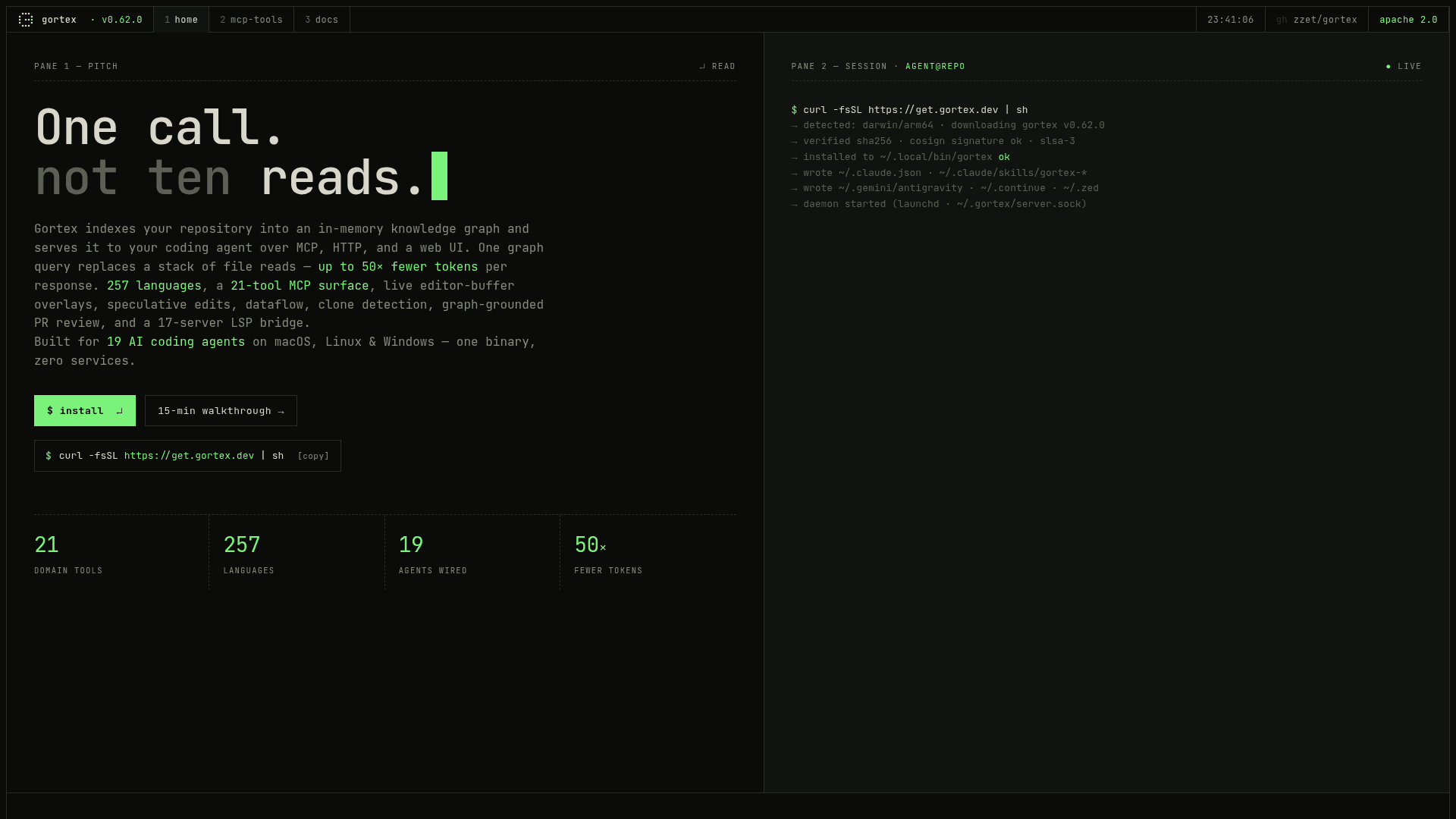
A high-performance code-intelligence engine that indexes repositories into an in-memory knowledge graph and serves it to AI coding agents via MCP, HTTP, and a web UI — supporting 257 languages with up to 50× fewer tokens per response.
At a Glance
About Gortex
Gortex is an open-source code-intelligence engine built by Andrey Kumanyaev (zzet) and released under Apache 2.0. It indexes a repository into an in-memory knowledge graph and exposes that graph to AI coding agents through a 21-tool MCP surface, a versioned HTTP API, a CLI, and a web UI — all from a single static binary with zero external dependencies. The project is actively developed on GitHub (zzet/gortex) and is currently at v0.63.8.
What It Is
Gortex sits between your codebase and your AI coding agent. Instead of letting the agent issue a series of file reads, greps, and globs to understand context, Gortex answers the same question in one graph query — returning callers, callees, imports, blast radius, and interface implementors in a single response. The project claims this approach delivers up to 50× fewer tokens per response compared to naive file reads, with reproducible benchmarks published in the repository. It supports 257 languages through a three-tier extraction pipeline (bespoke tree-sitter for deep resolution, regex for niche/legacy languages, and forest-backed signature-only for the long tail), and wires into 19 AI coding agents out of the box.
Architecture and Deployment Model
Gortex ships as a single static binary (~20 MB, CGO-on) for macOS, Linux, and Windows on both amd64 and arm64. Everything runs in-process and in memory — no database to run, no container to orchestrate. Key internal components include:
- Knowledge graph core — nodes for files, symbols, imports, calls, fields, SQL tables, K8s resources, Dockerfile images, and more; edges computed with Tarjan SCC, Leiden/Louvain communities, and a precomputed reach index for sub-millisecond blast-radius queries.
- Long-living daemon — a Unix-socket daemon holds one graph per tracked repo, with live fsnotify watching, per-session isolation, and launchd/systemd auto-start.
- LSP bridge — wired to 17 language servers (gopls, tsgo, pyright, rust-analyzer, clangd, jdtls, and others) for compiler-grade resolution.
- MCP server — stdio and Streamable HTTP (MCP 2026) transports; named agents get a compact 21-tool surface by default, with a 175-tool catalogue available on demand.
- GCX1 wire format — a published, round-trippable compact text format that the project reports delivers a median −27.4% token reduction versus JSON at the same fidelity.
Releases are Sigstore-signed with SLSA Level 3 build provenance and tracked by OpenSSF Scorecard.
Agent Integrations
gortex init auto-detects every supported coding agent on the machine and writes the correct configuration for each. The project lists 19 first-class adapters:
- Claude Code (slash commands, skills, hooks)
- Cursor, Windsurf, VS Code / Copilot, Continue.dev, Cline, Zed, Aider
- Kiro, OpenCode, Codex CLI, Gemini CLI, Antigravity, Kilo Code
- OpenClaw, Hermes, Oh My Pi, Pi, Kimi
Each adapter writes agent-specific config files (.mcp.json, CLAUDE.md, .cursor/rules, .windsurfrules, etc.) and community-routing blocks so the agent knows how to use Gortex's graph tools.
Key Capabilities
Beyond basic symbol lookup, Gortex exposes a broad set of analysis tools:
- Speculative execution —
change(preview)andchange(simulate)answer "what changes if I apply this edit?" without touching disk. - Live editor overlays — push unsaved buffers as a shadow graph; all subsequent tool calls read through a per-request layered view.
- Dataflow and taint analysis —
trace(flow)returns ranked dataflow paths;trace(taint)runs source→sink sweeps for security audits. - Clone detection — MinHash + LSH banding emits
similar_toedges at index time. - Cross-repo API contracts — auto-detected across HTTP, gRPC, GraphQL, Kafka/NATS/Redis pub/sub, WebSocket, OpenAPI, and Temporal workflows; normalised to canonical IDs and matched provider↔consumer across repos.
- Graph-grounded PR review — a deterministic rulepack (NPE, thread-safety, N+1, logic-error) runs over a changeset and emits a BLOCK/REVIEW/APPROVE verdict with line-anchored comments.
- Semantic search — hybrid BM25 + vector with RRF fusion; default-on with a baked GloVe-50d table (3.8 MB embedded, CPU-only); opt-in MiniLM, Ollama, or OpenAI.
- Token savings dashboard —
gortex savingsreports tokens saved versus naive file reads per-call, per-session, and cumulatively.
Update: v0.63.8
The latest release is v0.63.8, published on 2026-08-20. Recent changelog entries on the homepage (since v0.58) include: indexer and resolver SQLite hot-path performance sweep, Merkle parsed-source reuse, lazy clone sketches, Terraform Lambda env var contract providers, Java Type::new and qualified method reference support, overloaded method ref binding, layered .gitignore handling, Visual Studio/MSBuild artifact exclusion, test-file exemption from coverage debt in PR review, the explore(localize) tool, a compact 21-tool MCP surface for named agents, instruction profiles (core/localization/full), the gortex guide verb and gortex://guide resource, and Kimi + Pi adapters bringing the total to 19 wired agents. The project has 1,487 GitHub stars and 135 forks as of the last recorded update.
Community Discussions
Be the first to start a conversation about Gortex
Share your experience with Gortex, ask questions, or help others learn from your insights.
Pricing
Open Source
Fully free and open source under Apache 2.0, including commercial use with patent grant. Zero dependencies, single static binary.
- Full knowledge graph engine
- 257-language support
- 21-tool MCP surface (175-tool catalogue)
- 19 AI coding agent adapters
- Live editor overlays and speculative execution
Capabilities
Key Features
- In-memory knowledge graph of code symbols, calls, imports, and contracts
- 257-language support via three-tier extraction (tree-sitter, regex, forest-backed)
- 21-tool MCP surface (175-tool catalogue available on demand)
- Up to 50× fewer tokens per response vs naive file reads
- 19 AI coding agent adapters with auto-detection via gortex init
- Live editor buffer overlays (shadow-graph sessions)
- Speculative execution: preview and simulate edits without touching disk
- Dataflow and taint analysis for security audits
- Clone detection via MinHash + LSH banding
- Cross-repo API contract detection (HTTP, gRPC, GraphQL, Kafka, Temporal, etc.)
- Graph-grounded PR review with BLOCK/REVIEW/APPROVE verdict
- 17-server LSP bridge for compiler-grade resolution
- Hybrid BM25 + vector semantic search (GloVe-50d embedded, CPU-only)
- GCX1 compact wire format (−27% tokens vs JSON)
- Long-living daemon with fsnotify watching and per-session isolation
- Token savings dashboard (gortex savings)
- Sigstore-signed releases with SLSA Level 3 build provenance
- Cross-session symbol-anchored memory (remember/recall)
- Structural and unsafe pattern scanning via tree-sitter S-expressions
- Concurrency analyzers (race writes, unclosed channels)
- Health score rollup (coverage + complexity + recency + churn)
- Web UI with force-directed 3D knowledge graph visualization
- Versioned HTTP API (/v1/*) and MCP 2026 Streamable HTTP transport
- Telemetry off by default; opt-in anonymous counts only