
GPUStack
Open-source GPU cluster manager for deploying, governing and scaling AI model serving and GPU instances on any hardware.
At a Glance
Self-hosted, fully open source GPUStack under the Apache 2.0 license.
Engagement
Available On
Listed Oct 2026
About GPUStack
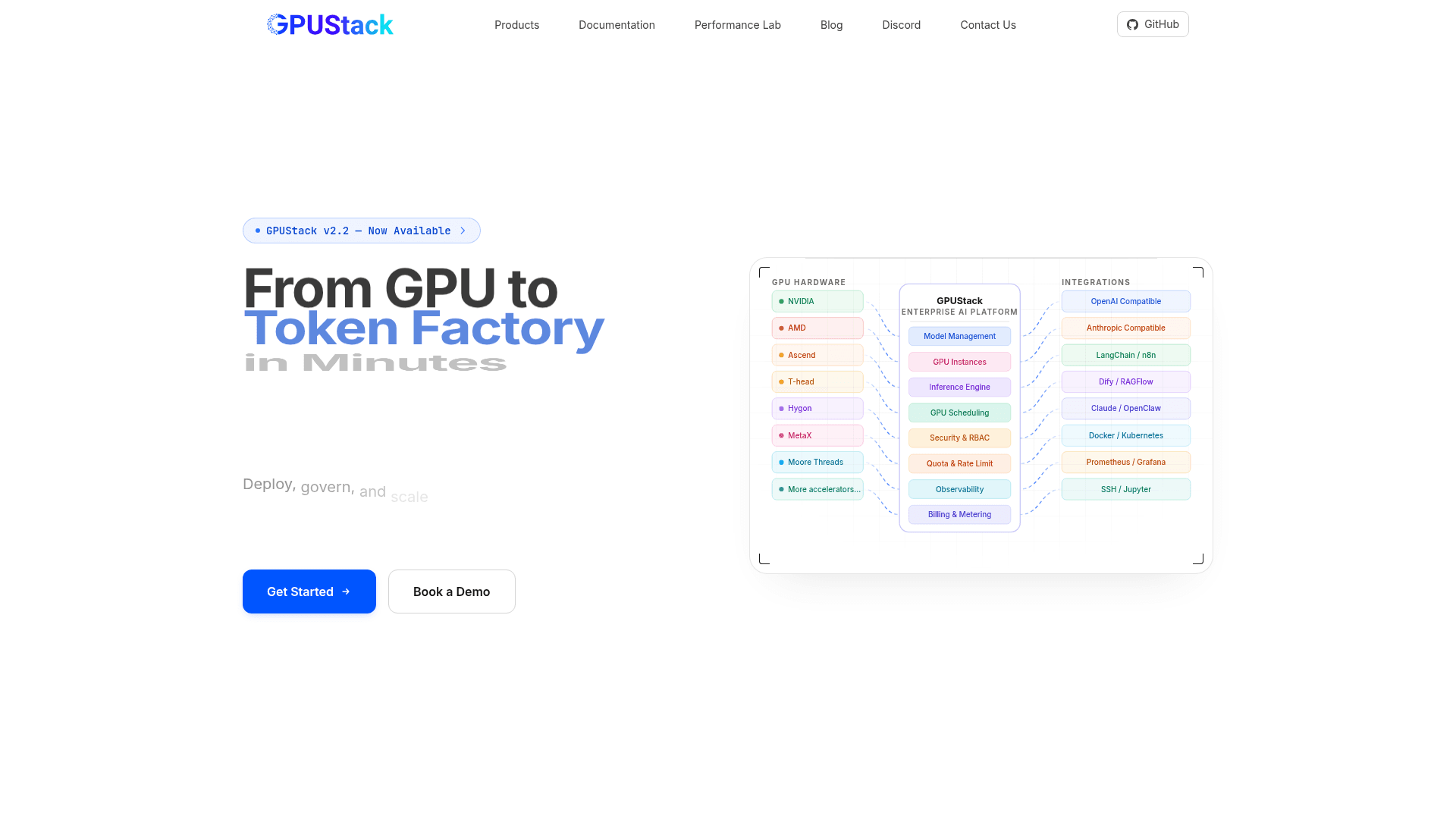
GPUStack is an open-source GPU cluster manager for AI model serving and on-demand GPU instance provisioning. It configures and orchestrates inference engines such as vLLM, SGLang and TensorRT-LLM across on-premise, Kubernetes and cloud GPU environments, and exposes models through OpenAI-compatible and Anthropic-compatible APIs. The latest release listed on GitHub is v2.2.3, and the project is licensed under Apache 2.0.
What It Is
GPUStack is a management layer that sits on top of inference engines and GPU hardware. Teams connect GPU workers to a GPUStack server, deploy models from a catalog or from Hugging Face, ModelScope or local files, and serve them through standard APIs. It also launches SSH-accessible GPU instances for development, fine-tuning and interactive workloads, with Jupyter Notebook access and persistent storage.
How the Workflow Runs
The server can run on a CPU-only machine via a single Docker command, and workers are added from the web UI by running a generated Docker command on each GPU node. Deployment includes automated compatibility checks, and GPUStack maps hardware to a matching inference engine version. Large models can be distributed across nodes and GPUs using tensor and pipeline parallelism. Performance modes (throughput, latency, standard, custom), KV cache extensions such as LMCache and HiCache, and speculative decoding methods like EAGLE3, MTP and N-grams are supported. The vendor reports tuned-deployment gains over unoptimized vLLM baselines in its Performance Lab.
Hardware and Model Coverage
Supported accelerators include NVIDIA, AMD, Ascend NPU, Hygon DCU, Moore Threads, MetaX, Cambricon MLU, Iluvatar and T-Head PPU. Worker nodes run on Linux only; macOS is not supported for workers. Supported model types include LLM, multimodal, embedding, reranker, image, speech and OCR models.
Governance and Enterprise Edition
The platform includes user authentication, API key management, token quotas and rate limits, usage analytics, metering, and Prometheus and Grafana monitoring. The Enterprise Edition adds control plane and model service high availability, multi-tenancy with organization isolation, RBAC with LDAP/OIDC/SAML SSO, audit logs, IP allow and block lists, resource topology view, billing reports and white-label branding.
Community Discussions
Be the first to start a conversation about GPUStack
Share your experience with GPUStack, ask questions, or help others learn from your insights.
Pricing
GPUStack Open Source
Self-hosted, fully open source GPUStack under the Apache 2.0 license.
- Apache License 2.0
- Multi-cluster GPU management
- Pluggable inference engines (vLLM, SGLang, TensorRT-LLM)
- OpenAI-compatible API
- Built-in user authentication and access control
GPUStack Enterprise
Enterprise edition with HA, multi-tenancy, governance and white-label branding. Contact sales.
- Control plane HA
- Model service HA
- Multi-tenancy with organization isolation
- RBAC & SSO (LDAP, OIDC, SAML)
- Audit logs and IP access control
- Token quotas and rate limits
- Resource topology view
- Token and GPU time billing
- White-label branding
Capabilities
Key Features
- Multi-cluster GPU management across on-premise, Kubernetes and cloud
- Pluggable inference engines (vLLM, SGLang, TensorRT-LLM, llama.cpp, MindIE, custom)
- Automatic inference engine selection and compatibility checks
- Distributed inference across multiple nodes and GPUs
- OpenAI-compatible and Anthropic-compatible APIs
- Throughput, latency, standard and custom performance modes
- KV cache extensions and speculative decoding
- SSH-accessible GPU instances with Jupyter and persistent storage
- GPU partitioning and overcommit
- Load balancing, failover and traffic weight routing
- RBAC, API key scoping, token quotas and rate limits
- Usage metering and billing reports
- Prometheus and Grafana monitoring
- Resource topology view
- Enterprise HA, multi-tenancy, SSO, audit logs and white-label branding