Graphlit
Graphlit is a cloud API platform that provides organizational knowledge infrastructure for AI agents, handling content ingestion, entity extraction, semantic search, and RAG in one unified API.
At a Glance
About Graphlit
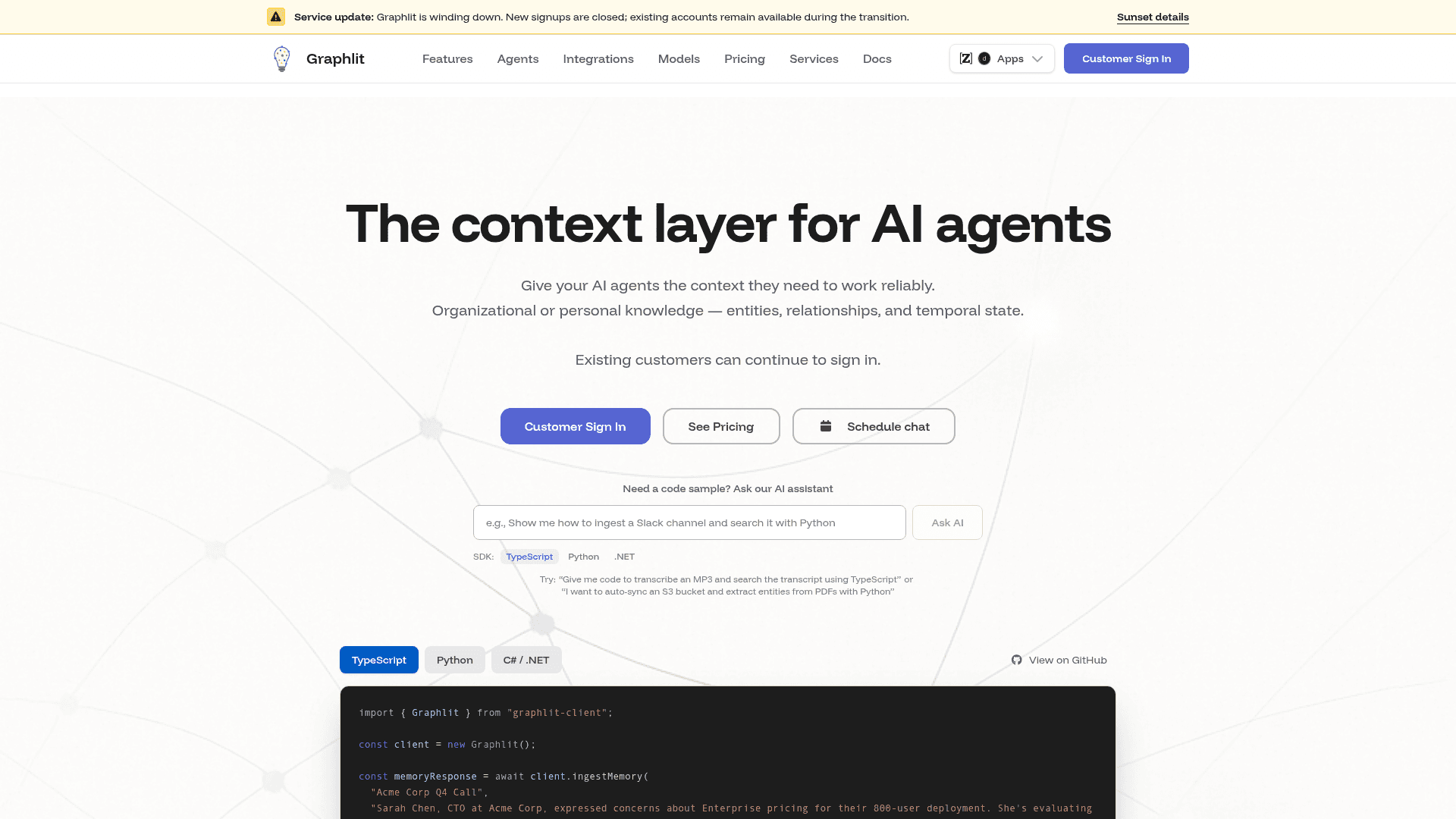
Graphlit is a cloud platform built by Unstruk Data Inc. that serves as the context layer for AI agents, providing organizational memory through structured entity extraction, relationship modeling, and continuous content ingestion. It is currently winding down — the pricing page notes that new signups are closed and existing accounts remain available during the transition. The platform is accessed via TypeScript, Python, and .NET SDKs, and exposes an MCP server for direct integration with tools like Cursor, VS Code, Claude Desktop, and ChatGPT.
What It Is
Graphlit positions itself as organizational knowledge infrastructure rather than a simple vector database or chat memory tool. Where vector databases store static embeddings and chat memory tools persist per-user conversations, Graphlit models entities, relationships, temporal state, and provenance across an organization's full content corpus. The platform ingests documents, audio, video, web pages, emails, Slack messages, Jira tickets, and more — then extracts structured knowledge that AI agents can query reliably. The result is a single API that covers ingestion, enrichment, storage, and retrieval without requiring developers to stitch together separate services.
How the Knowledge Model Works
Graphlit's core abstraction is the "Observable model" — a structured representation of entities (people, companies, decisions), events (changes, updates), ownership, temporal state, and relationships. According to the platform's documentation, this goes beyond cosine similarity search by resolving entities using LLM-powered matching rather than rule-based heuristics. Every answer is traceable to its source through full provenance tracking, which the platform claims dramatically reduces hallucinations compared to ungrounded retrieval.
Key modeling capabilities include:
- Entity extraction — people, companies, and relationships pulled automatically from ingested content
- Knowledge graph queries — graph traversal, entity co-occurrence, and relationship queries via
queryGraphandqueryFactsGraphmethods - Temporal state — how entities and facts evolve over time
- Provenance — cited sources traceable to origin for every retrieved answer
Integration Breadth and MCP Support
Graphlit connects to over 30 data sources through built-in connectors, including Google Drive, OneDrive, Dropbox, Box, SharePoint, Amazon S3, Azure Blob, Slack, Gmail, Outlook, Google Calendar, Microsoft Calendar, Notion, Confluence, GitHub, GitLab, Linear, Jira, Zendesk, Intercom, HubSpot, Attio, Reddit, Twitter/X, LinkedIn, Discord, Microsoft Teams, Zoom, Fireflies, Fathom, RSS feeds, and website crawling. The platform also ships an MCP server (npx -y graphlit-mcp-server) that connects Graphlit's knowledge layer directly to MCP-compatible clients. AI model support spans OpenAI (including GPT-5.4 via the Responses API), Anthropic Claude, Google Gemini, xAI, Deepseek, Groq, Mistral, Cohere, Cerebras, and AWS Bedrock — all with tool calling and streaming.
TypeScript SDK and Agent Framework
The TypeScript client SDK (MIT-licensed, available on GitHub) is the primary developer interface. Recent releases have added significant agent-oriented capabilities:
- v1.6.0 introduced a first-class Agent entity, the
runAgent()autonomous harness with stuck detection, a Skills API for reusable agent skills, and an agent scratchpad for persistent state - v1.5.0 added context management with token windowing, artifact collection, conversation queueing, and thinking/reasoning storage across turns
- Streaming Provider Resilience —
streamAgentandrunAgentnow retry transient LLM provider errors (HTTP 500, 503, 429, network failures) with exponential backoff across all 10 supported streaming providers - OpenAI Responses API — GPT-5.4 and eligible models are automatically routed through the Responses API for improved intelligence, lower latency, and higher cache hit rates
Current Status: Winding Down
The pricing page explicitly states: "Graphlit is winding down. New signups are closed; existing accounts remain available during the transition." A dedicated sunset details page is linked. Existing customers can continue to sign in and manage usage-based credits, and the support contact (questions@graphlit.com) handles account, transition, and data export questions. The founder's manifesto on the site describes Graphlit as the agent memory substrate, with a companion product called Zine (at zine.ai) serving as the human memory interface — both developed by Kirk Marple, Founder and CEO of Unstruk Data Inc.
Community Discussions
Be the first to start a conversation about Graphlit
Share your experience with Graphlit, ask questions, or help others learn from your insights.
Pricing
Free
Limited free usage for content ingestion, search, and chatbot conversations.
- Ingest any content (PDFs, audio, video, web pages)
- Content feeds (RSS, Web, Notion, blob storage)
- Search by text or vector similarity
- Chatbot conversations with RAG
- Configurable workflows (prep, extraction, enrichment)
Hobby
For individual developers building with Graphlit.
- Everything in Free tier
- $0.10/credit usage
- Up to 10GB content storage
- Up to 10K content items
- Unlimited feeds
- Unlimited chatbot conversations
- MCP server access (Claude, Cursor, ChatGPT)
- Email and community Discord support
Starter
For growing teams needing more storage and priority support.
- Everything in Hobby tier
- $0.09/credit usage
- Up to 100GB content storage
- Up to 100K content items
- Unlimited feeds
- Unlimited chatbot conversations
- Priority email, private Slack support
Growth
For production workloads with unlimited storage and dedicated support.
- Everything in Starter tier
- $0.08/credit usage
- Unlimited content storage
- Unlimited content items
- Unlimited feeds
- Unlimited chatbot conversations
- Priority email, private Slack support
- Dedicated technical contact
- SLA (coming soon)
- SOC 2 (coming soon)
Custom
Custom integrations, dedicated solutions engineer, and private managed instances.
- Everything in Growth tier
- Custom integrations (from $5K)
- Dedicated solutions engineer
- Custom agent development
- White-glove onboarding
- Private managed instances
Capabilities
Key Features
- Content ingestion (PDFs, audio, video, web pages, emails, Slack messages)
- Entity extraction and LLM-powered entity resolution
- Knowledge graph with relationships, temporal state, and provenance
- Hybrid vector and keyword semantic search
- RAG chatbot conversations with source citations
- Configurable workflows (preparation, extraction, enrichment)
- Continuous data feeds and real-time sync
- MCP server for Cursor, VS Code, Claude Desktop, ChatGPT integration
- Multi-tenant RBAC with encrypted-at-rest storage
- Streaming agent framework with tool calling
- Autonomous agent harness (runAgent) with stuck detection
- Skills API for reusable agent skills
- Agent scratchpad for persistent state
- Reasoning/thinking detection across providers
- Stream cancellation via AbortController
- Automatic retry with exponential backoff for provider errors
- 30+ data source connectors
- Support for 10 LLM providers (OpenAI, Anthropic, Google, xAI, Deepseek, Groq, Mistral, Cohere, Cerebras, AWS Bedrock)
- OpenAI Responses API automatic routing for GPT-5.4
- OCR, transcription, and visual object detection built-in
- TypeScript, Python, and .NET SDKs