
Grim Prompter
A prompt library and agent skill that guides AI coding agents through evidence-traced threat modeling of your repository.
At a Glance
Grim Prompter, including its prompts and documentation, is MIT licensed and free to use, modify and distribute. Requires your own coding agent (Claude Code, Codex, etc.), whose costs are external.
Engagement
Available On
Alternatives
Listed Nov 2026
About Grim Prompter
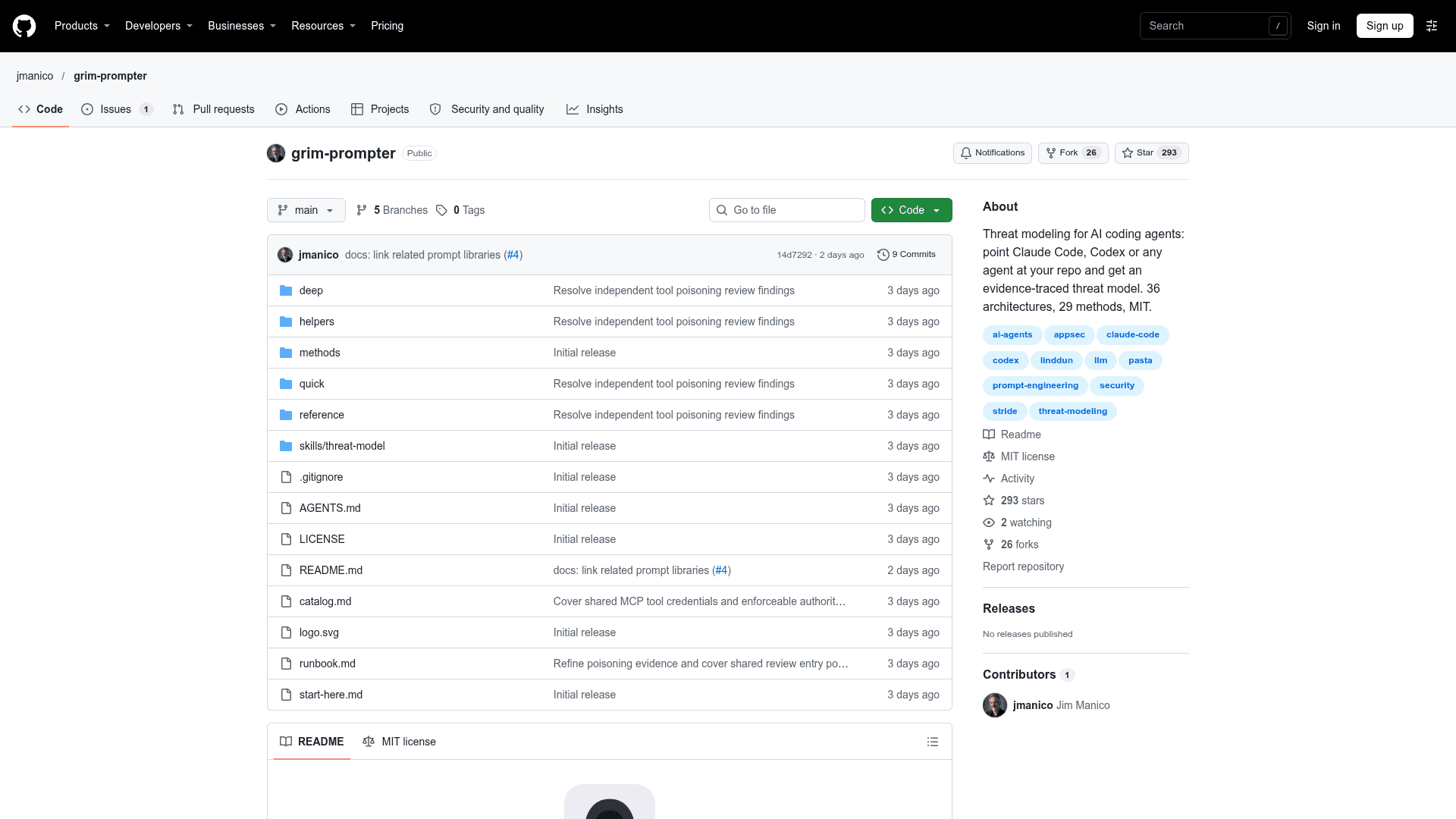
Grim Prompter is an MIT-licensed prompt library by Jim Manico that lets AI coding agents such as Claude Code and Codex threat model a project. It provides 36 architecture workflows and 29 method and analysis prompts, and the agent follows a structured review of code, trust boundaries, threats, existing controls, and proposed mitigations with checkable evidence.
What It Is
Grim Prompter is a set of Markdown prompts, a runbook, and a threat-model skill that you link into your coding agent. You open your project in the agent and ask for a quick or deep threat model, a single method such as STRIDE per element, or a review of how a branch changes an existing model. For agents without skill support, a project snippet for AGENTS.md, CLAUDE.md, or GEMINI.md points the agent at the runbook.
How a Run Works
The runbook requires read-only inspection and file-and-line citations; builds, tests, scripts, installs, and network access need explicit authorization. Results are written to a new folder under threat-model/, containing SYSTEM_UNDER_REVIEW.md (scope, evidence, assumptions, gaps), report.md with findings, mitigations, and verification plans, and JSON artifacts for later reviews. Deep runs go through six stages: scope, system modeling, threat analysis, challenge, treatment planning, and reporting, with each stage reading the previous stage's file.
Architectures and Methods
Architecture prompts cover applications, application structure, cloud and platforms, data and AI, devices and physical systems, identity, money and collaboration, and distributed systems, including RAG and agentic AI. Method prompts include STRIDE, PASTA, Trike, LINDDUN, attack trees, STPA, FMEA, CSA MAESTRO, MITRE ATLAS, ATT&CK, CAPEC, CVSS, and DREAD. Helper prompts cover evidence gathering, architecture and method selection, model challenging, and change review. For MCP servers and agent tools, the review maps tools to credentials and permissions where evidence supports it and records unknowns as gaps.
Review Expectations
The README states the prompts are drafts, that a threat model does not certify a system as secure, and that risk ratings and approvals should come from the user rather than the agent. Reports should be reviewed for sensitive details before being committed to version control.
Community Discussions
Be the first to start a conversation about Grim Prompter
Share your experience with Grim Prompter, ask questions, or help others learn from your insights.
Pricing
Open Source (MIT)
Grim Prompter, including its prompts and documentation, is MIT licensed and free to use, modify and distribute. Requires your own coding agent (Claude Code, Codex, etc.), whose costs are external.
- 36 architecture workflows
- 29 method and analysis prompts
- Claude Code skill and Codex CLI skill
- Works with any agent via AGENTS.md project snippet
- Outputs SYSTEM_UNDER_REVIEW.md, report.md and JSON artifacts
Capabilities
Key Features
- 36 architecture threat-modeling workflows with quick and deep variants
- 29 method and analysis prompts including STRIDE, PASTA, LINDDUN, and attack trees
- Six-stage deep analysis workflow
- Read-only repository inspection with file-and-line citations
- Markdown reports and JSON artifacts for later reviews
- Change review against a saved JSON baseline
- Helper prompts for evidence gathering, selection, and model challenging
- MCP server and agent tool credential boundary review
- Skill for Claude Code and Codex CLI plus AGENTS.md snippet for other agents