EveryDev.ai
Subscribe
Home
Tools

2,945+ AI tools

  • New
  • Trending
  • Featured
  • Compare
  • Arena
Categories
  • Agents2063
  • Coding1441
  • Infrastructure665
  • Marketing524
  • Projects470
  • Research437
  • Design408
  • Analytics371
  • MCP268
  • Security265
  • Testing255
  • Data249
  • Integration183
  • Prompts183
  • Communication172
  • Learning166
  • Extensions163
  • Voice146
  • Commerce132
  • DevOps115
  • Web84
  • Finance24
AI Tools by Topic
  • AI Coding Assistants
  • Agent Frameworks
  • MCP Servers
  • AI Prompt Tools
  • Vibe Coding Tools
  • AI Design Tools
  • AI Database Tools
  • AI Website Builders
  • AI Testing Tools
  • LLM Evaluations
Follow Us
  • X / Twitter
  • LinkedIn
  • Reddit
  • Discord
  • Threads
  • Bluesky
  • Mastodon
  • YouTube
  • GitHub
  • Instagram
Get Started
  • About
  • Editorial Standards
  • Corrections & Disclosures
  • Community Guidelines
  • Advertise
  • Contact Us
  • Newsletter
  • Submit a Tool
  • Start a Discussion
  • Write A Blog
  • Share A Build
  • Terms of Service
  • Privacy Policy
Explore with AI
  • ChatGPT
  • Gemini
  • Claude
  • Grok
  • Perplexity
Agent Experience
  • llms.txt
Theme
With AI, Everyone is a Dev. EveryDev.ai © 2026
    1. Home
    2. Tools
    3. HALO agent optimizer
    HALO agent optimizer icon

    HALO agent optimizer

    Agent Harness
    Featured

    HALO is an RLM-based agent harness optimizer that analyzes production execution traces to identify systemic failures and generate actionable improvement recommendations.

    Visit Website

    At a Glance

    Pricing
    Open Source

    Fully open-source MIT-licensed tool available via GitHub, PyPI, and desktop installer at no cost.

    Engagement

    Available On

    Windows
    macOS
    Linux
    CLI
    API

    Resources

    WebsiteDocsGitHubllms.txt

    Topics

    Agent HarnessLLM EvaluationsObservability Platforms

    Alternatives

    InferenceBenchVerifiersExploitBench
    Developer
    Inference.netSan Francisco, CAEst. 2022$11.8M raised

    Listed Jun 2026

    About HALO agent optimizer

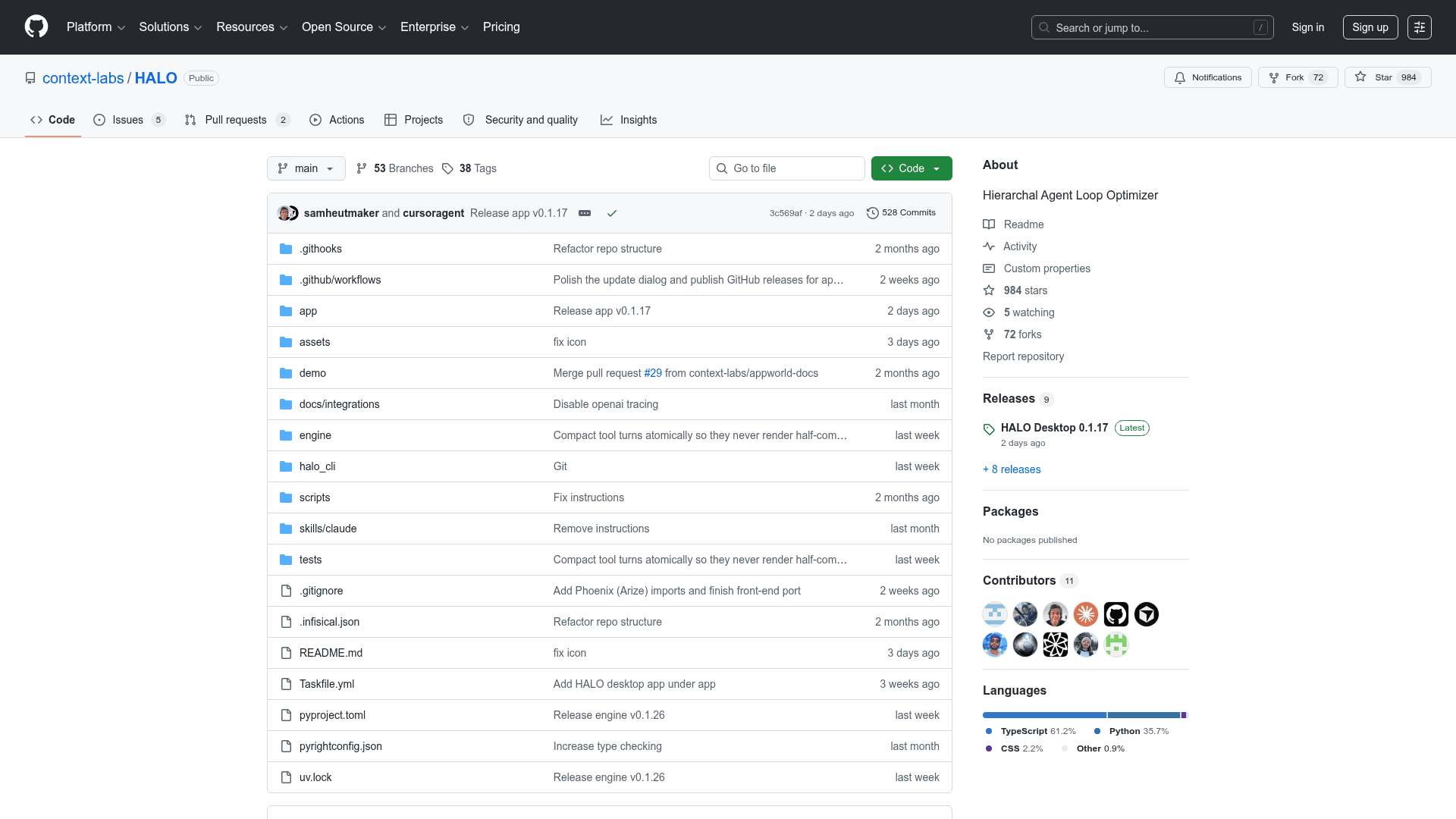
    HALO is an open-source tool built by Context Labs that uses a specialized Recursive Language Model (RLM) engine to analyze production agent traces and drive iterative improvements to agent harnesses. It is available as a desktop app, a Python package on PyPI, and a CLI, and is released under the MIT license.

    What It Is

    HALO is a methodology and toolset for building recursively self-improving agent harnesses. Rather than relying on a general-purpose coding agent to review traces, HALO uses a purpose-built RLM engine designed to reason about systemic agentic behavior across many executions. The core insight is that general-purpose harnesses like Claude Code tend to overfit to errors in individual traces rather than identifying harness-level patterns — HALO's specialized engine is designed to generalize across the full trace dataset.

    The HALO Loop

    The optimization cycle HALO implements is straightforward:

    1. Collect traces — Instrument your agent harness with OpenTelemetry-compatible tracing.
    2. Feed traces to the RLM engine — The engine decomposes traces to identify common failure modes.
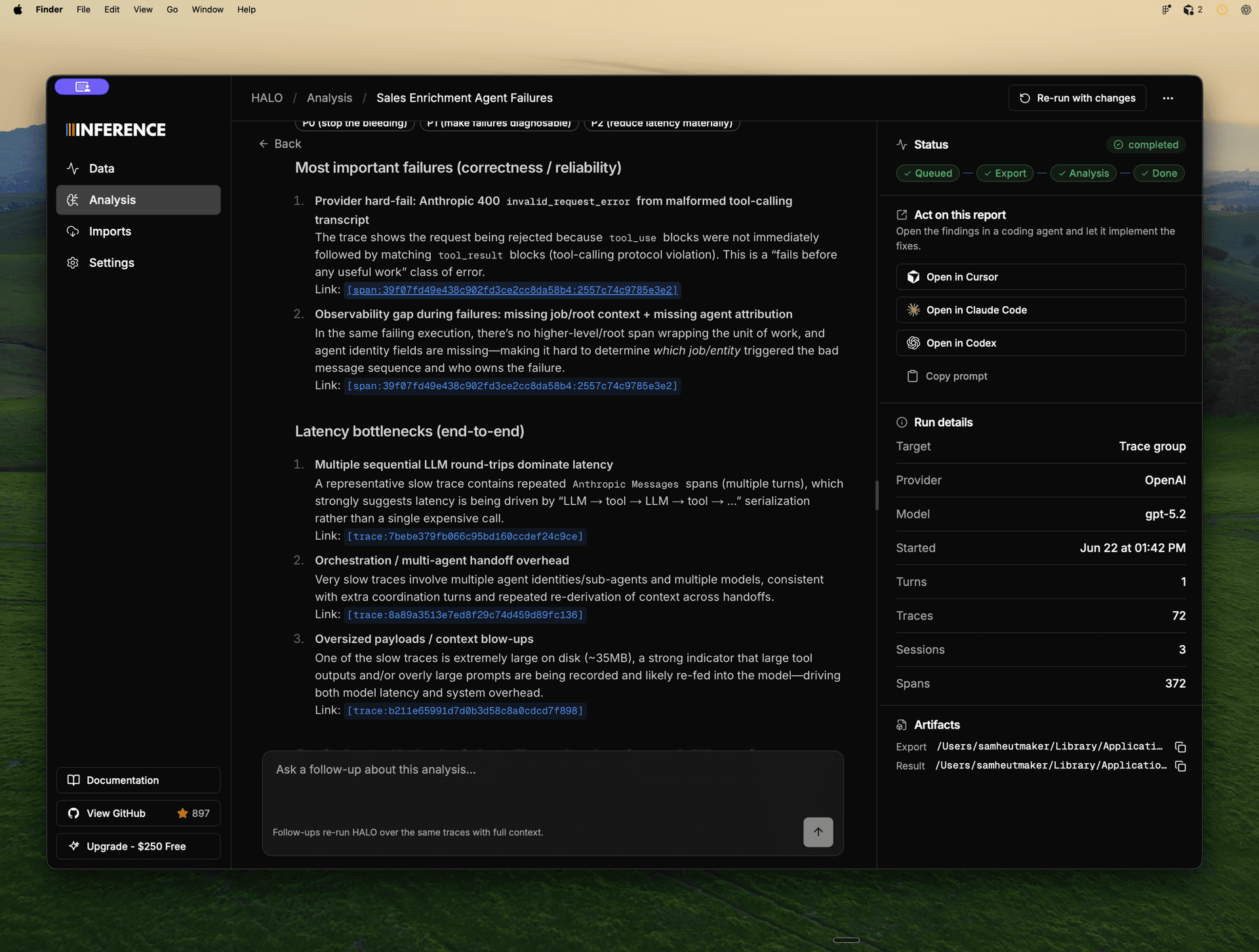
    3. Generate a report — Ranked failures, bottlenecks, and concrete recommendations are produced.
    4. Apply fixes via a coding agent — Reports are sent to Cursor, Claude Code, or similar tools for implementation.
    5. Redeploy and repeat — New traces are gathered and the cycle continues.

    The engine surfaces issues such as hallucinated tool calls, redundant tool arguments, refusal loops, and semantic correctness problems, each of which maps to a direct prompt or harness edit.

    Benchmarks and Evidence

    The README documents HALO's application to the AppWorld benchmark, which tests LLM ability to use multi-app services like Spotify, Venmo, file systems, and phone contacts. According to the project's published results:

    • Gemini 3 Flash: dev SGC improved from 36.8% to 52.6% (+15.8 points); test_normal SGC from 37.5% to 48.2% (+10.7 points).
    • Sonnet 4.6: dev SGC improved from 73.7% to 89.5% (+15.8 points); test_normal SGC from 62.5% to 73.2% (+10.7 points).

    The project notes that the harness was iterated on the dev split and the test_normal split was used as a proxy to confirm improvements did not result from overfitting.

    Deployment and Integration

    HALO supports multiple deployment paths:

    • Desktop app: Installed via a shell script or directly from GitHub releases; macOS uses a signed, notarized DMG.
    • CLI: Installed via pip install halo-engine; accepts JSONL trace files and an OpenAI-compatible API key.
    • Python SDK: Exposes sync and async entry points (run_engine, stream_engine_async, etc.) for embedding the engine in custom pipelines.
    • Trace sources: Supports Langfuse, Arize, JSONL files, and local agents.
    • Model flexibility: Uses OpenAI env vars by default but supports any OpenAI-compatible provider via OPENAI_BASE_URL, including OpenRouter.

    Telemetry of HALO's own activity can be emitted as OpenInference traces, either uploaded to inference.net Catalyst over OTLP or written locally as JSONL.

    Releases and Hosted Option

    The latest desktop release is HALO Desktop 0.1.17, published on June 24, 2026, and the engine and desktop app receive frequent tagged releases. For teams that prefer not to run HALO locally, the project notes that a hosted, plug-and-play version is available through inference.net.
    HALO agent optimizer - 1
    HALO agent optimizer - 2

    Community Discussions

    Be the first to start a conversation about HALO agent optimizer

    Share your experience with HALO agent optimizer, ask questions, or help others learn from your insights.

    Pricing

    OPEN SOURCE

    Open Source

    Fully open-source MIT-licensed tool available via GitHub, PyPI, and desktop installer at no cost.

    • Desktop app (macOS, Windows, Linux)
    • CLI via pip install halo-engine
    • Python SDK with sync and async APIs
    • OpenTelemetry trace ingestion
    • Langfuse, Arize, JSONL trace sources

    Capabilities

    Key Features

    • RLM-based trace analysis engine
    • Desktop app with signed macOS DMG installer
    • CLI via pip install halo-engine
    • Python SDK with sync and async entry points
    • OpenTelemetry-compatible trace ingestion
    • Supports Langfuse, Arize, JSONL, and local agent traces
    • Ranked failure reports with concrete recommendations
    • OpenInference telemetry emission (local JSONL or OTLP upload)
    • Configurable model routing via OpenAI-compatible base URL
    • Parallel subagent execution with configurable depth and concurrency
    • AppWorld benchmark integration and demo
    • OpenAI Agents SDK demo project included

    Integrations

    OpenAI
    OpenRouter
    Langfuse
    Arize
    Cursor
    Claude Code
    Codex
    OpenTelemetry
    inference.net Catalyst
    OpenAI Agents SDK
    API Available
    View Docs

    Ratings & Reviews

    No ratings yet

    Be the first to rate HALO agent optimizer and help others make informed decisions.

    Developer

    Inference.net

    Context Labs builds HALO, an open-source RLM-based agent harness optimizer, and operates inference.net, a hosted platform for AI inference and observability. The team focuses on tools that make production AI agents more reliable through trace-driven, recursive self-improvement loops. Their work spans desktop apps, Python SDKs, and cloud-hosted observability infrastructure.

    Founded 2022
    San Francisco, CA
    $11.8M raised
    Read more about Inference.net
    WebsiteGitHubX / Twitter
    1 tool in directory

    Similar Tools

    InferenceBench icon

    InferenceBench

    An open-source benchmark that evaluates whether frontier AI coding agents can optimize LLM serving workloads under a fixed compute budget across four inference scenarios.

    Verifiers icon

    Verifiers

    An open-source Python library by Prime Intellect for creating environments to train and evaluate LLMs using reinforcement learning.

    ExploitBench icon

    ExploitBench

    ExploitBench measures how far AI agents can climb the exploitation ladder, from reaching vulnerable code to achieving arbitrary code execution, using a five-tier grading system against real CVEs.

    Browse all tools

    Related Topics

    Agent Harness

    Infrastructure, orchestrators, and task runners that wrap around LLM coding agents — covering session management, context delivery, worktree isolation, architecture enforcement, and issue-to-PR pipelines.

    106 tools

    LLM Evaluations

    Platforms and frameworks for evaluating, testing, and benchmarking LLM systems and AI applications. These tools provide evaluators and evaluation models to score AI outputs, measure hallucinations, assess RAG quality, detect failures, and optimize model performance. Features include automated testing with LLM-as-a-judge metrics, component-level evaluation with tracing, regression testing in CI/CD pipelines, custom evaluator creation, dataset curation, and real-time monitoring of production systems. Teams use these solutions to validate prompt effectiveness, compare models side-by-side, ensure answer correctness and relevance, identify bias and toxicity, prevent PII leakage, and continuously improve AI product quality through experiments, benchmarks, and performance analytics.

    97 tools

    Observability Platforms

    Comprehensive platforms that combine metrics, logs, and traces with AI-powered analytics to provide deep insights into complex distributed systems and application behavior.

    99 tools
    Browse all topics
    Back to all toolsSuggest an edit
    ratings
    discussions