
Harness Remote
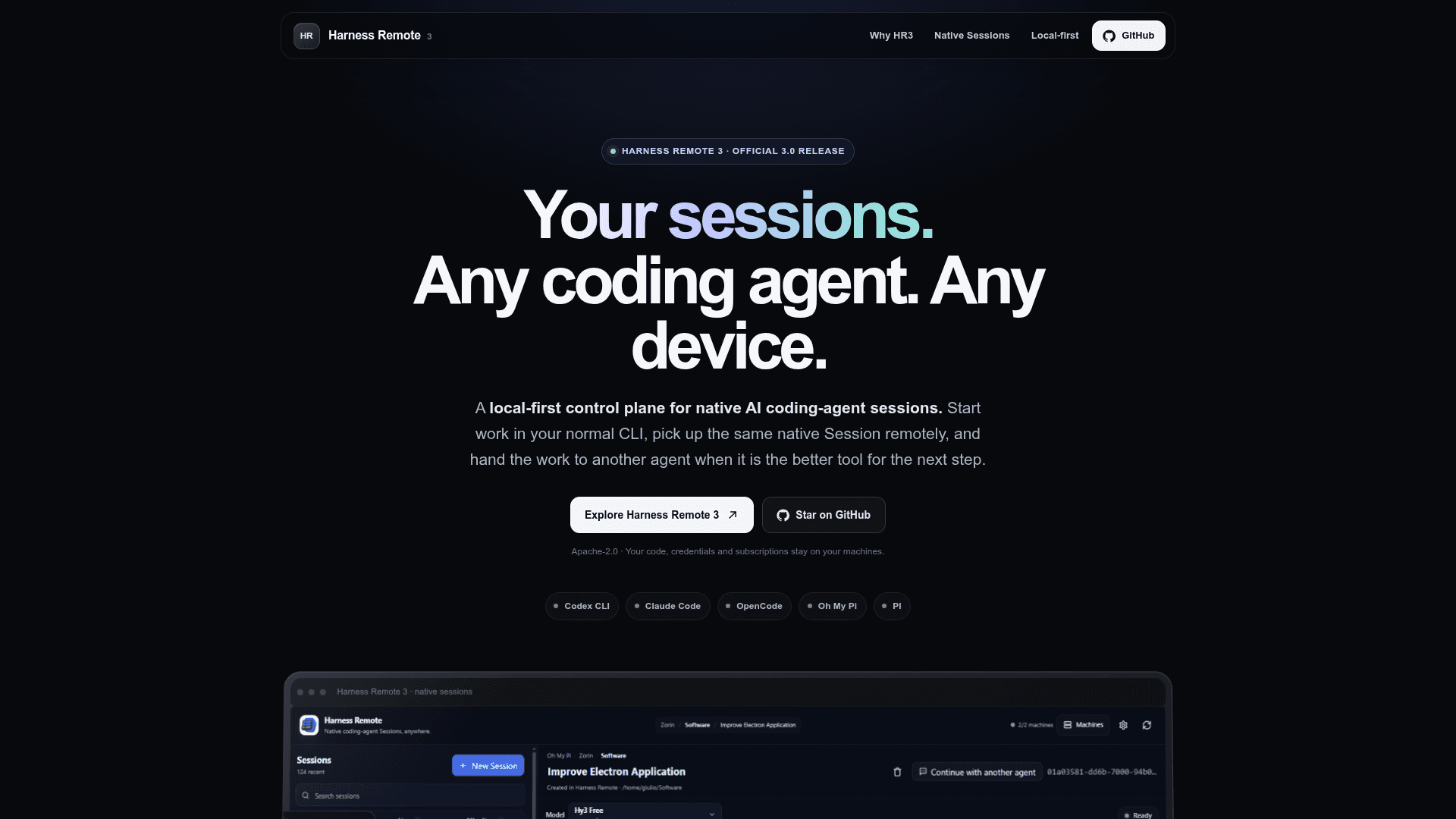
A local-first control plane for running, resuming and handing off native AI coding-agent sessions across machines and devices.
At a Glance
Harness Remote core is released under the Apache-2.0 license; code, credentials and subscriptions stay on your own machines.
Engagement
Available On
Listed Nov 2026
About Harness Remote
Harness Remote is an open-source (Apache-2.0) control plane for native AI coding-agent sessions, published by the GitHub user giuliastro. It lets you start work in your normal coding-agent CLI, then find, observe and continue the same native session from desktop, web or Android. Source code, credentials and native session persistence stay on your own machines.
What It Is
Harness Remote is not another coding agent. It is a remote-control and continuity layer around agents you already use, organized as Machine → Project → Native Session. The README lists support for Codex CLI, Claude Code, GitHub Copilot CLI, OpenCode, DeepSeek Harness, MiMo Code, Oh My Pi and PI, mostly through ACP integrations or adapters, with the OpenCode legacy path using HTTP and a live event stream.
How native sessions and handoff work
The coding agent keeps ownership of its transcript, reasoning, tool execution, permissions, memory, compaction and resume semantics. Harness Remote owns machines, projects, session discovery, remote control, capability and model discovery, handoff lineage and reconciliation. A continuation creates a real native session on the target harness and records its link to the source session. The handoff can carry bounded, inspectable context such as objective, decisions, unresolved work and checks already run. It also works across configured machines, with project identity checks.
Setup path
The desktop app on Windows and macOS starts and supervises a local machine runtime automatically. To control another computer, install Node.js 20+ and at least one authenticated agent CLI, then run the npx harness-remote gateway. Android pairs by scanning a short-lived QR code, and a hosted web/PWA client is available when the gateway allows its origin. Notifications for permissions, completion and failures are available on Android, desktop and web.
Local-first model and plugins
The project advises using a trusted LAN or VPN and not exposing a gateway to the public internet. It describes itself as a control plane, not an operating-system sandbox or hosted inference proxy. A plugin center includes a built-in Token Harness plugin for allowance, local savings and model routing.
Community Discussions
Be the first to start a conversation about Harness Remote
Share your experience with Harness Remote, ask questions, or help others learn from your insights.
Pricing
Open Source (Apache-2.0)
Harness Remote core is released under the Apache-2.0 license; code, credentials and subscriptions stay on your own machines.
- Apache License 2.0 (OSI-approved) licensed core
- Local-first control plane for native coding-agent sessions
- Desktop, web and Android clients
- Supports Codex CLI, Claude Code, OpenCode, Oh My Pi and PI
- Agent provider subscriptions and credentials remain external and local to your machines
Capabilities
Key Features
- Native session discovery, observation and resume
- Remote prompting, stop and permission/question handling
- Cross-agent continuation with recorded lineage
- Cross-machine continuation with project identity checks
- Model discovery from the running harness
- Queued prompts while an agent is working
- Notifications on Android, desktop and web
- QR-code machine pairing on Android
- Desktop app with automatically managed local runtime
- Plugin center with Token Harness plugin