
Hermit framework
Open-source framework for training, evaluating and deploying harness adapters that adapt existing agents to new tasks without changing their model or harness.
At a Glance
Hermit framework core released under the Apache License 2.0; free to use, modify and distribute. Model API usage or Codex/ChatGPT plan costs are external.
Engagement
Available On
Alternatives
Listed Nov 2026
About Hermit framework
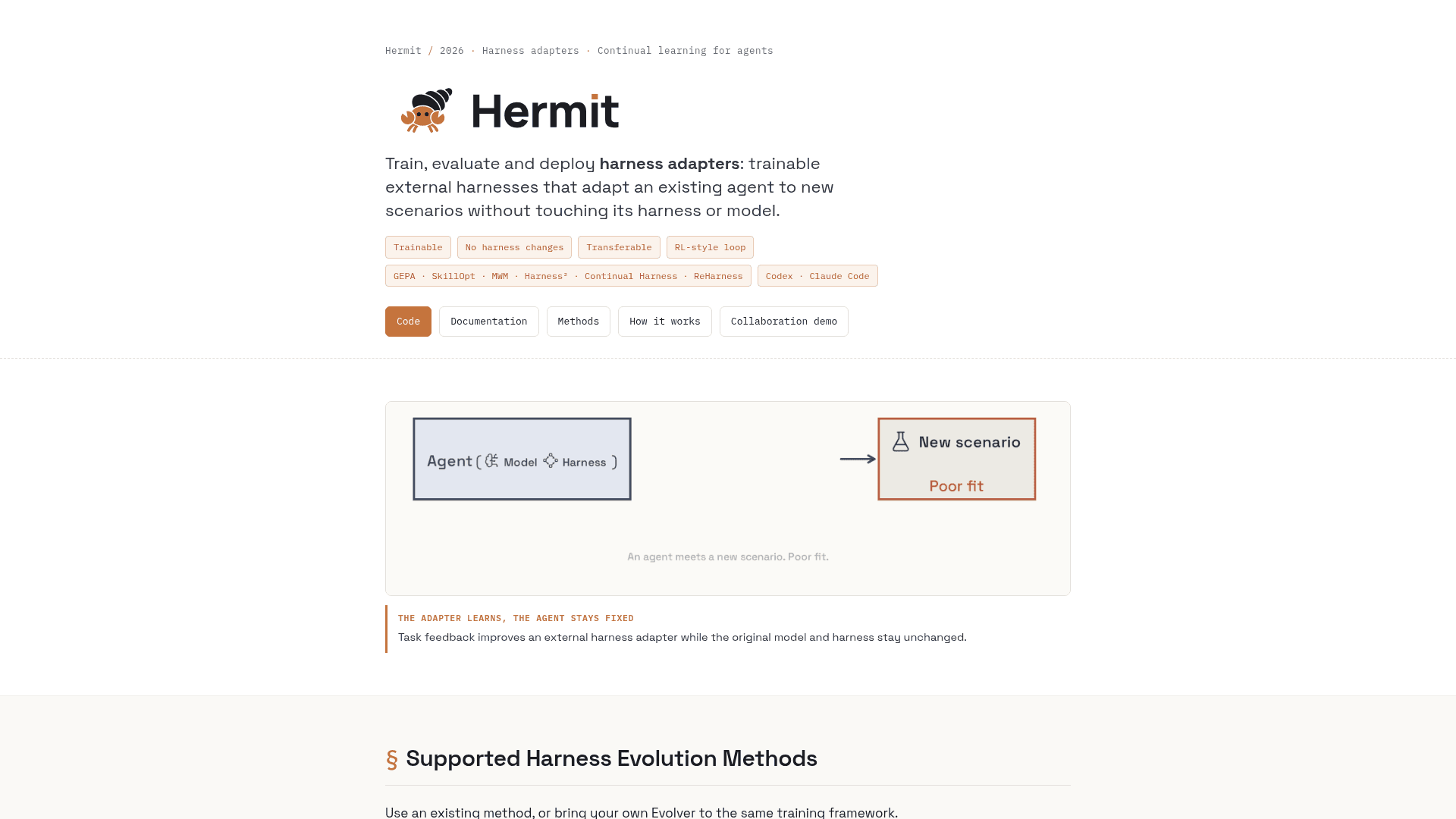
Hermit is an open-source framework from Infini-AI-Lab for training, evaluating and deploying harness adapters. A harness adapter is a trainable external harness that adapts an existing agent to new scenarios while the original model and harness stay unchanged. The latest release listed is v0.2.0, and the project is licensed under Apache 2.0.
What It Is
Hermit provides a single RL-style training loop for harness adapters. Users bring their tasks, an acting agent, an evaluator and model access, then choose a built-in evolution method or write their own Evolver. An adapter can contain instructions, skills, memory, tools, executable code and agent coordination logic, and it can be an entire repository implementing an external harness.
How the Training Loop Works
The Trainer runs a batch of tasks through the acting agent with the current adapter and scores them with a judge. It then passes trajectories and feedback to an Evolver, which proposes a new adapter. The Trainer checks the proposal against the adapter specification and commits it as the next version. Adapters are stored as files in a git tree, so each version can be inspected, rolled back or shipped.
Methods and Recipes
Supported evolution methods include GEPA, SkillOpt, MetaWorld Model, Harness², Continual Harness, ReHarness, Meta-Harness Adapter, ACE, AHE Adapter, RRSI Adapter and EvoSafeHarness. Runnable recipes cover OfficeQA, CL-Bench and ServeLearnBench. A Lean collaboration example coordinates five Codex agents through a shared adapter to prove a theorem together.
Setup and Deployment
Hermit requires Python 3.12+ and Git. It can be installed from source or from PyPI as hermit-harness, and it exposes a hermit CLI with commands for check, train, eval, deploy and convert. Trained adapters can be deployed as workspaces for Codex, Claude Code or Pi, or converted into native plugins for compatible hosts. Models are referenced by backend, including Fireworks, OpenAI, Anthropic, DeepSeek, vLLM, SGLang and Ollama. The README also describes plan-backed recipes that use a Codex/ChatGPT subscription for acting and learning.
Community Discussions
Be the first to start a conversation about Hermit framework
Share your experience with Hermit framework, ask questions, or help others learn from your insights.
Pricing
Open Source (Apache-2.0)
Hermit framework core released under the Apache License 2.0; free to use, modify and distribute. Model API usage or Codex/ChatGPT plan costs are external.
- Apache-2.0 licensed framework for training, evaluating and deploying harness adapters
- One Trainer for every method with built-in evolution methods and a custom Evolver interface
- Adapters stored as files in a git tree with versioning and rollback
- Deploy workspaces for Codex, Claude Code or Pi, or export as a native plugin
- Install from source or via PyPI (hermit-harness); requires Python 3.12+ and Git
Capabilities
Key Features
- Single Trainer loop for rollouts, judge feedback, Evolver step, checked commit and versioning
- Built-in harness evolution methods plus interface for custom Evolvers
- Adapters stored as files in a git tree with inspection and rollback
- Deploy adapters as workspaces for Codex, Claude Code or Pi
- Convert adapters into native plugins for codex, claude-code, pi and hermes targets
- Adapter specification checks and sandboxing for supported learner programs
- Multiple model backends by reference
- Runnable recipes for OfficeQA, CL-Bench and ServeLearnBench
- Offline quick start requiring no model account or GPU