
Hippo Memory
Biologically-inspired persistent memory system for AI agents with decay, retrieval strengthening, and sleep consolidation — zero runtime dependencies.
At a Glance
Fully free and open-source under the MIT License. Install via npm and use without restrictions.
Engagement
Available On
Listed Apr 2026
About Hippo Memory
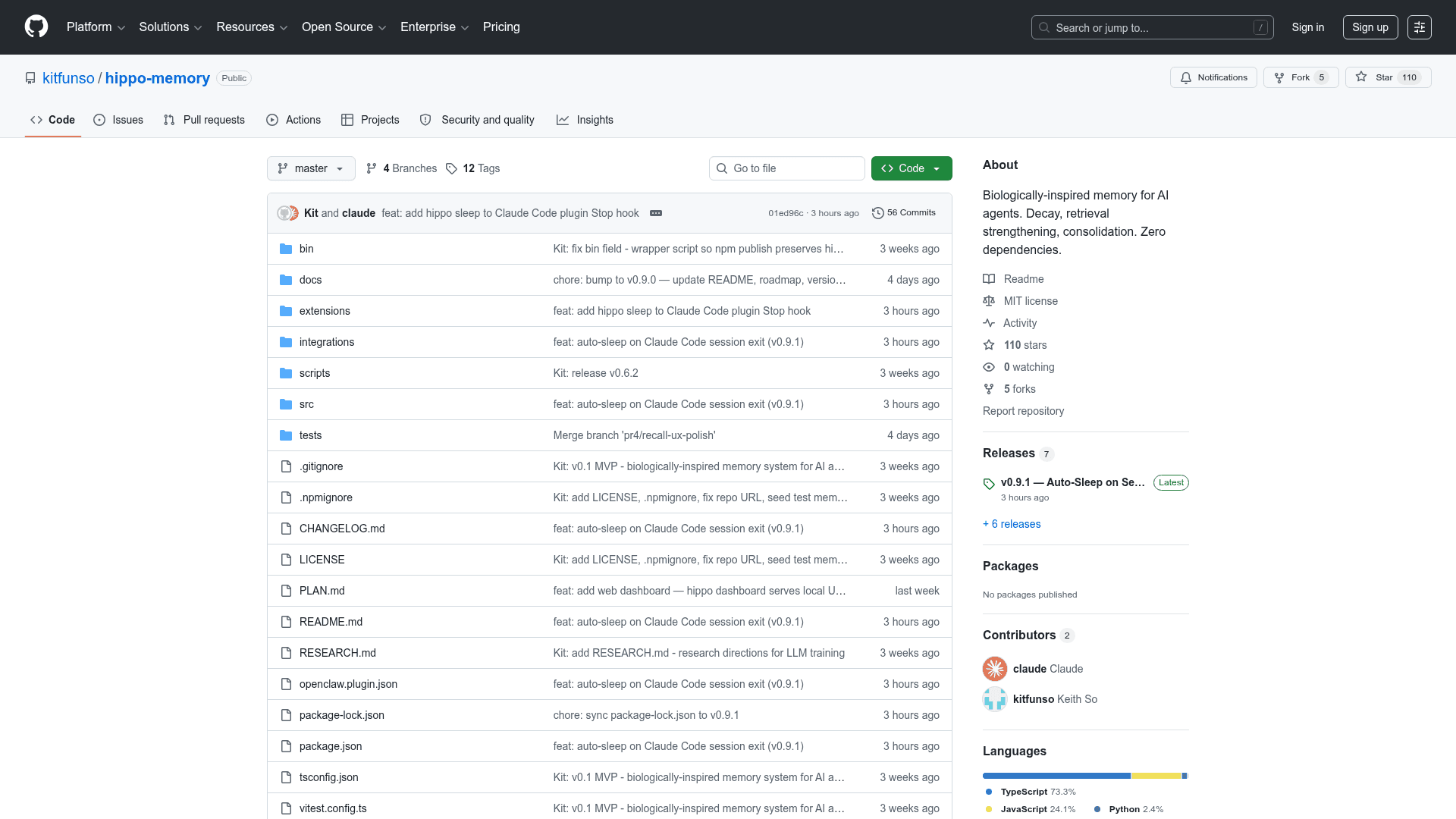
Hippo is a CLI-based memory layer for AI coding agents that models human hippocampal memory mechanics: decay by default, retrieval strengthening, sleep consolidation, and reward-proportional decay. It solves the problem of agents forgetting everything between sessions and context being trapped inside individual tools like ChatGPT, Claude, or Cursor. Hippo uses a SQLite backbone with markdown/YAML mirrors, making memories git-trackable and human-readable, with zero runtime dependencies.
- Decay by default — every memory has a configurable half-life (7 days default); persistence must be earned through retrieval or explicit pinning
- Retrieval strengthening — each recall extends a memory's half-life by 2 days, implementing the testing effect mechanically
- Sleep consolidation —
hippo sleepcompresses repeated episodic memories into semantic patterns, removes decayed entries, and merges related episodes - Error memories stick — memories tagged
--errorreceive 2× the half-life and a 1.5× strength multiplier, so hard lessons don't fade quietly - Confidence tiers — memories carry
verified,observed,inferred, orstalelabels so agents know how much to trust each piece of context - Hybrid search — BM25 keyword search with optional cosine embedding similarity via
@xenova/transformersfor semantic recall - Cross-tool import — import memories from ChatGPT exports, CLAUDE.md,
.cursorrules, or any markdown/text file withhippo import - Auto-hook install —
hippo initdetects Claude Code, Codex, Cursor, OpenClaw, and OpenCode and patches the right config file automatically - MCP server —
hippo mcpstarts an MCP server over stdio, exposing tools likehippo_recall,hippo_remember, andhippo_contextto any MCP-compatible client - Active invalidation —
hippo learn --gitdetects migration commits and actively weakens memories referencing replaced patterns; manual invalidation also supported - Architectural decisions —
hippo decidestores one-off decisions with a 90-day half-life and supports superseding chains as architecture evolves - Working memory & session handoffs — bounded scratchpad (
hippo wm) for current-session notes andhippo handofffor persisting session summaries across agent switches - Outcome feedback —
hippo outcome --good/--badapplies reward-proportional decay modulation inspired by R-STDP in spiking neural networks - Token budgets —
hippo recall --budget 2000ranks memories by relevance × strength × recency and fills the budget with highest-signal results first
Community Discussions
Be the first to start a conversation about Hippo Memory
Share your experience with Hippo Memory, ask questions, or help others learn from your insights.
Pricing
Open Source (MIT)
Fully free and open-source under the MIT License. Install via npm and use without restrictions.
- Full CLI with all memory commands
- SQLite backbone with markdown/YAML mirrors
- Decay, retrieval strengthening, and sleep consolidation
- Cross-tool import (ChatGPT, Claude, Cursor, markdown)
- Auto-hook install for all supported agent frameworks
Capabilities
Key Features
- Decay-based memory lifecycle with configurable half-lives
- Retrieval strengthening (half-life extension on recall)
- Sleep consolidation (episodic → semantic compression)
- Error memories with 2× half-life
- Confidence tiers: verified, observed, inferred, stale
- Hybrid BM25 + embedding search
- Cross-tool import from ChatGPT, Claude, Cursor, markdown
- Auto-hook install for Claude Code, Codex, Cursor, OpenClaw, OpenCode
- MCP server over stdio
- Active invalidation from git commit detection
- Architectural decision memory with 90-day half-life
- Working memory scratchpad with importance-based eviction
- Session handoffs for cross-session continuity
- Reward-proportional decay modulation
- Token budget-aware recall
- Conflict detection and resolution
- Multi-agent shared memory with transfer scoring
- Auto-learn from git commit history
- Watch mode for auto-capturing command failures
- Explainable recall with --why flag
- Web dashboard at localhost:3333
- Path-based memory triggers
- Outcome feedback loop