
HiRoute
A local model router that sends routine agent work to economical models and keeps stronger models for harder stages of long-horizon tasks.
At a Glance
HiRoute core (local model router, Desktop app and headless CLI/daemon) is licensed under Apache License 2.0 and free to use. External model/API/subscription costs are separate.
Engagement
Available On
Alternatives
Listed Oct 2026
About HiRoute
HiRoute is an open-source local model router from the higress-group organization, released under the Apache-2.0 license. It sits between agents such as Codex, Claude Code, Qoder, Pi, and DeepSeek Harness and the models they use, choosing a model for each stage of a long task. The latest stable release listed is 0.3.1, available as a macOS desktop app and a Linux headless CLI and daemon.
What It Is
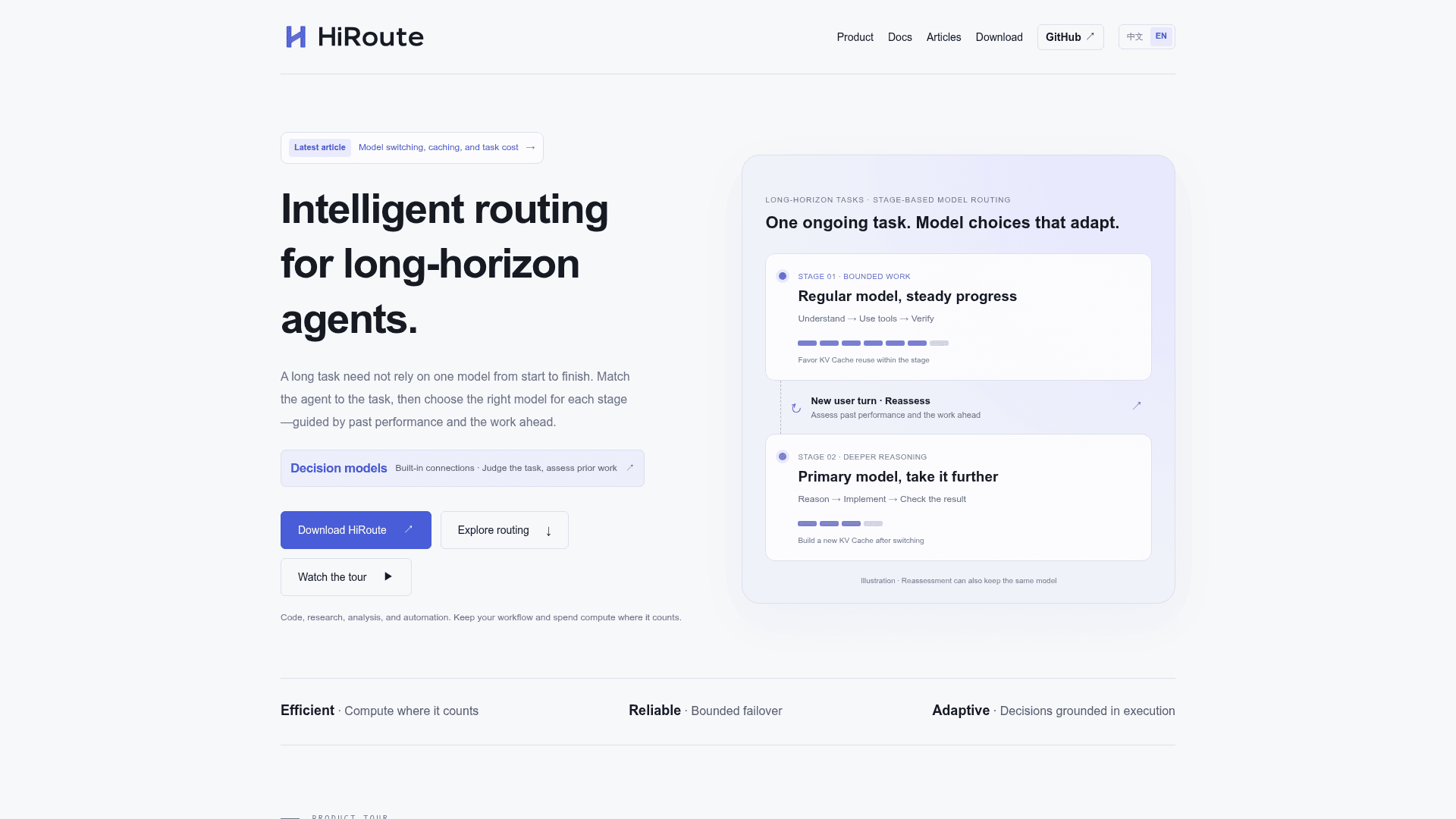
HiRoute is a model router for long-horizon agent work such as coding, research, analysis, and automation. With a difficulty-routing plan, it judges each new user message. Routine work like reading code or gathering facts can go to an economical model, while design decisions and hard fixes stay with a primary model or subscription. Subscriptions, API keys, and local models are managed in one place, and each session shows which model actually ran, its usage, and its cost.
How routing works
HiRoute offers four routing modes: fixed model, difficulty routing, custom branches, and free first. Each mode uses ordered candidates for bounded failover, and exhaustion fails explicitly rather than silently switching.
- Difficulty routing has regular and primary model groups. The regular group is chosen when the simple-task probability meets the user's threshold and no applicable, complete assessment falls below the competence floor.
- Custom branches first separate task categories such as drafting and review, then use the degree within the category to pick a group.
- Tool continuations within one turn inherit that turn's frozen decision, which helps reuse the KV cache. A new user message triggers a fresh decision that may keep the same model.
Decision models and evidence
Built-in decision connections (Bailian, OpenRouter Jev, TypeSafe, or a compatible endpoint) return a task category, degree probabilities, and an optional assessment of the prior stage in one call. No self-hosted Jev service is needed. Difficulty routing also supports heuristic rules. A custom extension API with an OpenAPI document is available for teams that want their own judgment or scoring logic. Desktop session views show stage competence scores tied to a plan, revision, model, and execution stage, alongside execution records.
Agents and delegation
Codex, Claude Code, Qoder, Pi, and DeepSeek Harness are listed as available now. OpenCode, Hermes Agent, and OpenClaw are listed as planned. A main agent can also discover allowed work plans and delegate independent tasks to other agents, and delegation stays separate from model routing.
Setup path
On macOS 15 or later, install the desktop app. On Linux x86_64 or ARM64, install the current-user CLI and daemon without sudo. Then connect a model source, create and publish a routing plan, and enable HiRoute routing for an agent client. A CLI quickstart command reports the current service state and next steps.
Community Discussions
Be the first to start a conversation about HiRoute
Share your experience with HiRoute, ask questions, or help others learn from your insights.
Pricing
Open Source (Apache-2.0)
HiRoute core (local model router, Desktop app and headless CLI/daemon) is licensed under Apache License 2.0 and free to use. External model/API/subscription costs are separate.
- Apache License 2.0
- macOS Desktop and Linux headless (CLI and daemon)
- Four routing modes: fixed model, difficulty routing, custom branches, free first
- Bounded failover across ordered candidates
- Local session, usage, cost and competence views
Capabilities
Key Features
- Stage-based model routing for long-running agent tasks
- Four routing modes: fixed model, difficulty routing, custom branches, free first
- Built-in decision model connections for task judgment and prior-stage assessment
- Bounded failover across ordered candidates
- KV cache-aware decision reuse across tool continuations
- Per-session view of actual model, usage, and cost
- Stage competence scoring linked to execution records
- Agent work plans and task delegation to other agents
- Custom decision extension API with OpenAPI document
- Desktop app and headless CLI/daemon