HungryGPU
A hardware-aware catalogue that tracks open-weight models, community inference recipes, and upstream patches so you can discover what you can actually run on your local GPU.
At a Glance
Full access to the catalogue, recipes, patches, papers, and MCP server without an account.
Engagement
Available On
Listed Sep 2026
About HungryGPU
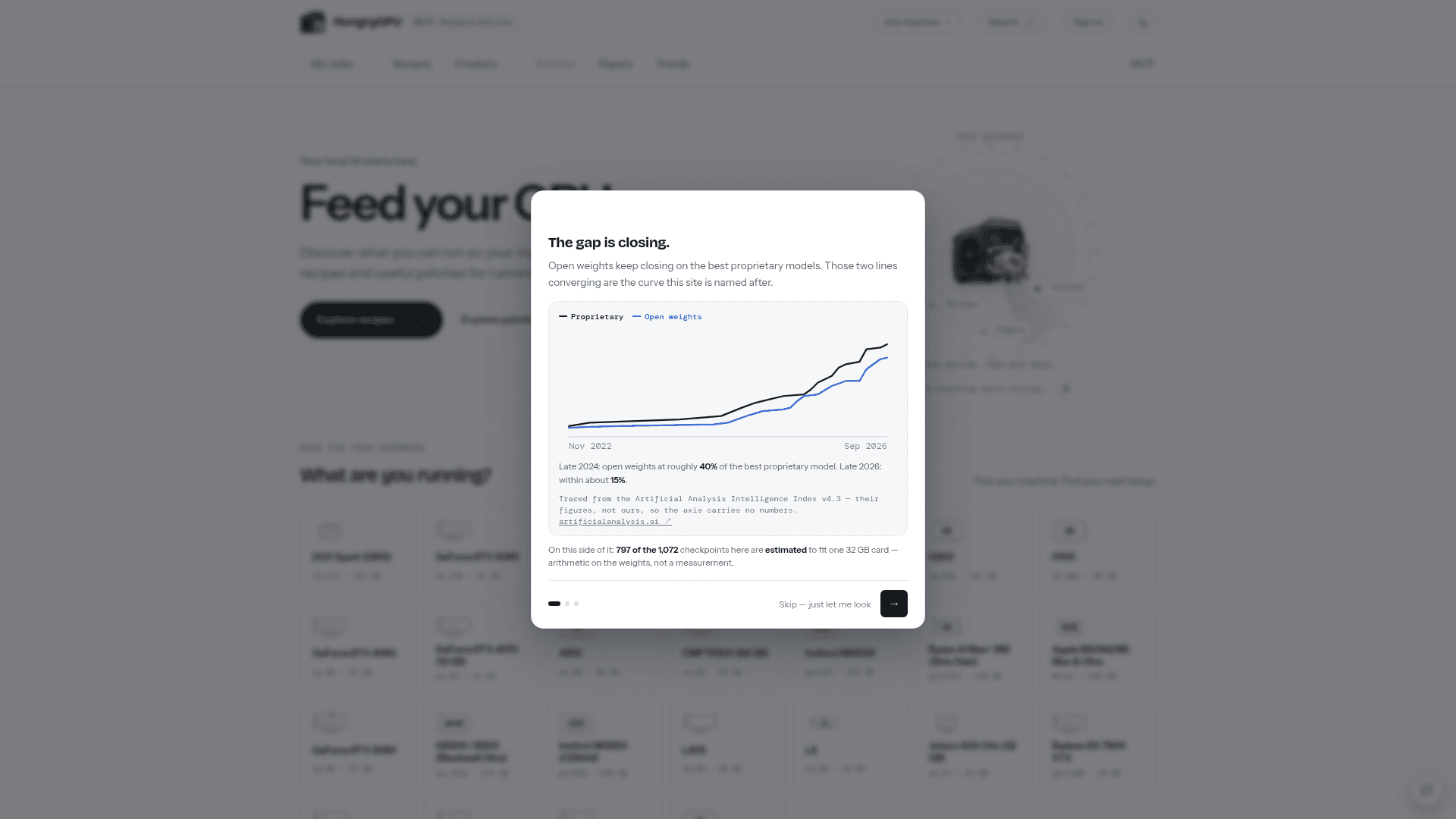
HungryGPU is a web-based catalogue in beta that reads merged pull requests, model releases, community setups, and arXiv papers daily, then tags each item with the specific GPU hardware it helps — and the hardware it leaves behind. The site is built around the idea that the gap between open-weight and proprietary model quality is closing, and its goal is to help local-inference practitioners track what that means for their specific machine.
What It Is
HungryGPU is a hardware-filtered discovery tool for local AI inference. Users pick one or more machines from a catalogue of 25 tracked GPUs — ranging from consumer cards like the RTX 3060 to data-centre hardware like the H200 and DGX Spark — and the site filters every piece of content (patches, recipes, papers, model releases) to show what is relevant to those boxes. It is not a benchmark aggregator or a model leaderboard; it is an operational feed for people who run models themselves.
What the Catalogue Covers
The site collects and cross-references several distinct data streams, each with its own collection date and coverage window:
- Merged pull requests — 1,169 rows from 8 repositories, read for which machines a change helps or excludes, with the literal diff line shown as evidence.
- Open-weight model releases — 1,072 checkpoints, with memory-fit estimates computed as parameters × bytes × 1.2 overhead margin (arithmetic, not a measured run).
- Community recipes — 2,040 setups contributed by practitioners, each tied to a specific model, engine, quantisation, and hardware, with measured tok/s figures where the author provided them.
- Third-party benchmark scores — 5,563 rows, each attributed to its source; scores are never averaged across evaluations or carried from a base model to a quantised derivative.
- arXiv papers — 10,681 rows scored twice by the same rubric, with the lower of the two votes used and disagreement kept visible.
- OpenRouter application usage — 200 rows showing tokens routed in the last 30 days, never combined with GitHub stars or commit counts.
How the Tagging Works
Every patch entry carries two layers of analysis. A regex reads architecture gates directly off diff + and - lines — compute capabilities, file paths, gate shapes. A separate LLM pass answers what no regex can: when a gate is rewritten, which machines end up inside. The site keeps the two layers visually separate so disagreements stay readable. Of 1,169 PRs tagged, 140 failed the substring evidence check and are marked unverified. The site documents that at temperature 0, two complete passes over the same pull requests produced identical labels on all six fields only 19.6% of the time — a transparency note about the floor of reproducibility.
MCP Integration for Agents
HungryGPU exposes its catalogue over the Model Context Protocol (MCP) at https://hungrygpu.com/api/mcp, so agents can query it directly without a browser. Without an account, agents can call whats_new, can_i_run, find_setups, records, and machines. With a token, agents additionally get my_setup, propose, submit_run, and my_runs, and the hardware-description argument is dropped from calls because the token carries the setup. Tokens are minted one at a time, shown once, stored hashed, and revoked individually; the account travels in Authorization: Bearer and never in a cookie.
The GLM-5.3-Flash / DGX Spark Community Recipe
The GitHub repository linked from the site (tenhkspark/glm53-flash-nvfp4-dgx-spark, MIT licence) is a concrete example of the kind of community recipe HungryGPU is built to surface. It documents a one-file Python overlay that patches the vLLM SM120 sparse-MLA attention backend to run NVIDIA's official GLM-5.3-Flash NVFP4 checkpoint on DGX Spark (GB10, sm_121) — hardware the official image did not support. The fix zero-fills the 64 rope dimensions the SM120 kernel requires but the no-rope model does not provide, making the computation mathematically identical to a native no-rope run. The author measured 61.5 tok/s aggregate across two DGX Spark nodes at 16 concurrent requests, with the full startup log, timestamps, and 15 documented failure points published alongside the overlay.
Current Status
HungryGPU is in public beta as of the collection date shown on the site (2026-09-12). The catalogue is described as "young" and figures are noted to "still move." The site collects daily, with the last recorded pass completing in 36.7 minutes across 9 steps. Sign-in is optional and changes nothing about what is published; the site explicitly states it honours Do Not Track and uses anonymous tab-scoped usage counts alongside Google Analytics.
Community Discussions
Be the first to start a conversation about HungryGPU
Share your experience with HungryGPU, ask questions, or help others learn from your insights.
Pricing
Free
Full access to the catalogue, recipes, patches, papers, and MCP server without an account.
- Hardware-filtered model and patch discovery
- Community recipes with measured throughput figures
- MCP server access (whats_new, can_i_run, find_setups, records, machines)
- arXiv paper feed with dual-pass scoring
- OpenRouter usage data
Capabilities
Key Features
- Hardware-filtered model and patch discovery across 25 tracked GPUs
- Daily ingestion of merged PRs, model releases, community recipes, arXiv papers, and OpenRouter usage
- Memory-fit estimates computed as arithmetic on weights (not measured runs)
- Community recipes with measured tok/s figures, engine, quantisation, and hardware details
- MCP server at hungrygpu.com/api/mcp for agent-based querying
- Two-layer tagging: regex for diff facts, LLM for gate semantics, kept visually separate
- Evidence-backed tags showing the literal diff line behind each machine assignment
- Unverified entries explicitly marked when evidence check fails
- Personal setup declaration to filter all content to your specific hardware
- Throughput records and benchmarks attributed per source, never averaged across evaluations
- arXiv paper scoring with dual-pass rubric and lower vote used
- OpenRouter token-routing data shown separately from GitHub stars and commits
- Token-based MCP authentication with per-token revocation
- Atom feed for updates
- Anonymous, tab-scoped usage analytics with Do Not Track support