
Hyper-Extract
LLM-powered CLI and Python framework that turns unstructured documents into structured knowledge such as graphs, hypergraphs, and spatio-temporal graphs.
At a Glance
Hyper-Extract CLI is licensed under Apache-2.0 and free to use, modify and distribute; users supply their own LLM/embedding provider.
Engagement
Available On
Alternatives
Listed Nov 2026
About Hyper-Extract
Hyper-Extract is an open-source, LLM-powered knowledge extraction framework published by yifanfeng97. It turns unstructured documents into typed knowledge structures, ranging from simple lists to knowledge graphs, hypergraphs, and spatio-temporal graphs, through a CLI, a Python SDK, and an MCP server. The latest documented release is v0.10.5.
What It Is
Hyper-Extract is a knowledge extraction tool: you point it at a document, pick a template, and it produces a persistent structured knowledge abstract that can be searched, queried, visualized, and exported. Inputs include PDF, Word, PowerPoint, Excel, HTML, EPUB, and plain text or Markdown (rich ingestion needs the optional ingest extra). Outputs are typed structures such as AutoModel, AutoList, AutoSet, AutoGraph, AutoHypergraph, and temporal, spatial, and spatio-temporal graphs.
How the Workflow Works
The documented architecture has three layers: Auto-Types define the output data structure, Methods provide extraction algorithms, and Templates supply domain-specific presets. The README lists methods including a chunk_rag baseline, GraphRAG, LightRAG, Hyper-RAG, and KG-Gen. The project describes 80+ YAML templates covering finance, legal, medical, TCM, industry, and general domains.
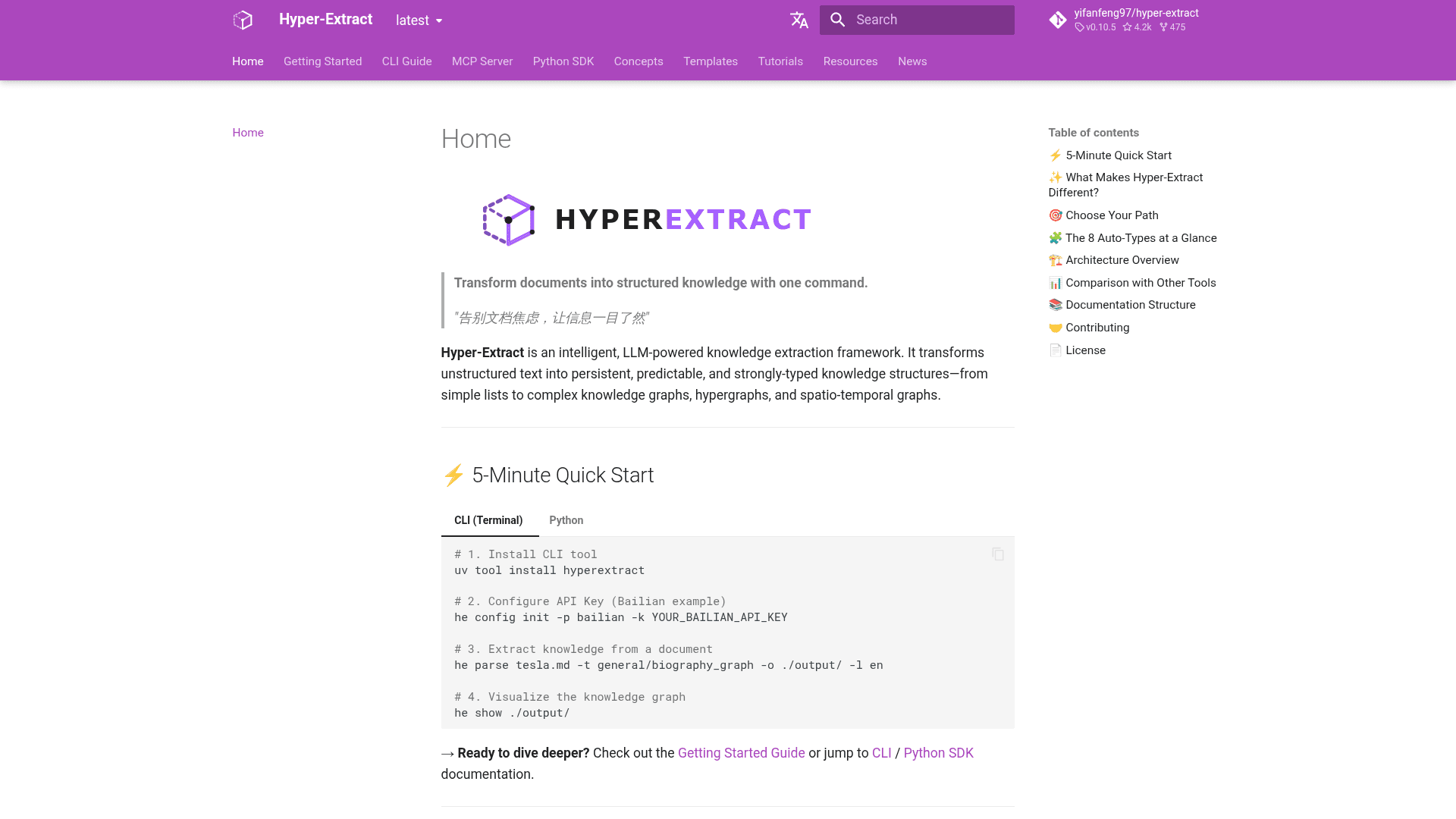
A typical CLI flow is he parse to extract, he search or he talk to query, he show to visualize, and he export obsidian to produce an Obsidian vault of Markdown notes linked with wikilinks. In Python, a template is created with Template.create and its parse method is called on the document text.
Incremental Updates and Provenance
New documents can be fed into an existing knowledge abstract with he feed. Each source is attributed, so users can audit contributions with he info --sources, tag sources and scope searches by tag, and roll back a document's contributions with he remove. Re-feeding an updated file under the same source name replaces its old facts.
Models and Providers
Extraction uses LangChain structured output with function calling, so the chosen model must support tool calling. Documented providers include OpenAI, Anthropic, Google Gemini, DeepSeek, Alibaba Bailian, and local vLLM. Embeddings work with OpenAI-compatible endpoints. Anthropic, Gemini, and DeepSeek are LLM-only and are paired with a separate embedder.
MCP Server
An optional MCP server, started with he-mcp, exposes knowledge abstracts to MCP-capable assistants in a read and export-only mode. Its tools include list_templates, info, search, ask, and exports to Obsidian, GraphML, CSV, JSON-LD, and Cypher.
Community Discussions
Be the first to start a conversation about Hyper-Extract
Share your experience with Hyper-Extract, ask questions, or help others learn from your insights.
Pricing
Open Source (Apache-2.0)
Hyper-Extract CLI is licensed under Apache-2.0 and free to use, modify and distribute; users supply their own LLM/embedding provider.
- Apache-2.0 licensed core CLI
- Self-hosted; install via uv tool install hyperextract or pipx
- Bring your own LLM/embedding provider (external cost) or local vLLM
Capabilities
Key Features
- Rich document ingestion (PDF, Word, PowerPoint, Excel, HTML, EPUB)
- 9 auto-types including graphs, hypergraphs, and spatio-temporal graphs
- 11+ extraction engines (chunk_rag, GraphRAG, LightRAG, Hyper-RAG, KG-Gen)
- 80+ YAML domain templates
- Incremental updates with source provenance and rollback
- Semantic search and Q&A over extracted knowledge
- Graph visualization
- Obsidian vault export
- MCP server with export to GraphML, CSV, JSON-LD, Cypher
- Local model support via vLLM