
Hyperresearch
A deep research agent harness for Claude Code that runs a 16-step pipeline to produce adversarially-audited reports with full source provenance and a persistent, searchable vault.
At a Glance
Free and open-source under the MIT license. Requires your own Anthropic API usage via Claude Code.
Engagement
Available On
Alternatives
Listed Sep 2026
About Hyperresearch
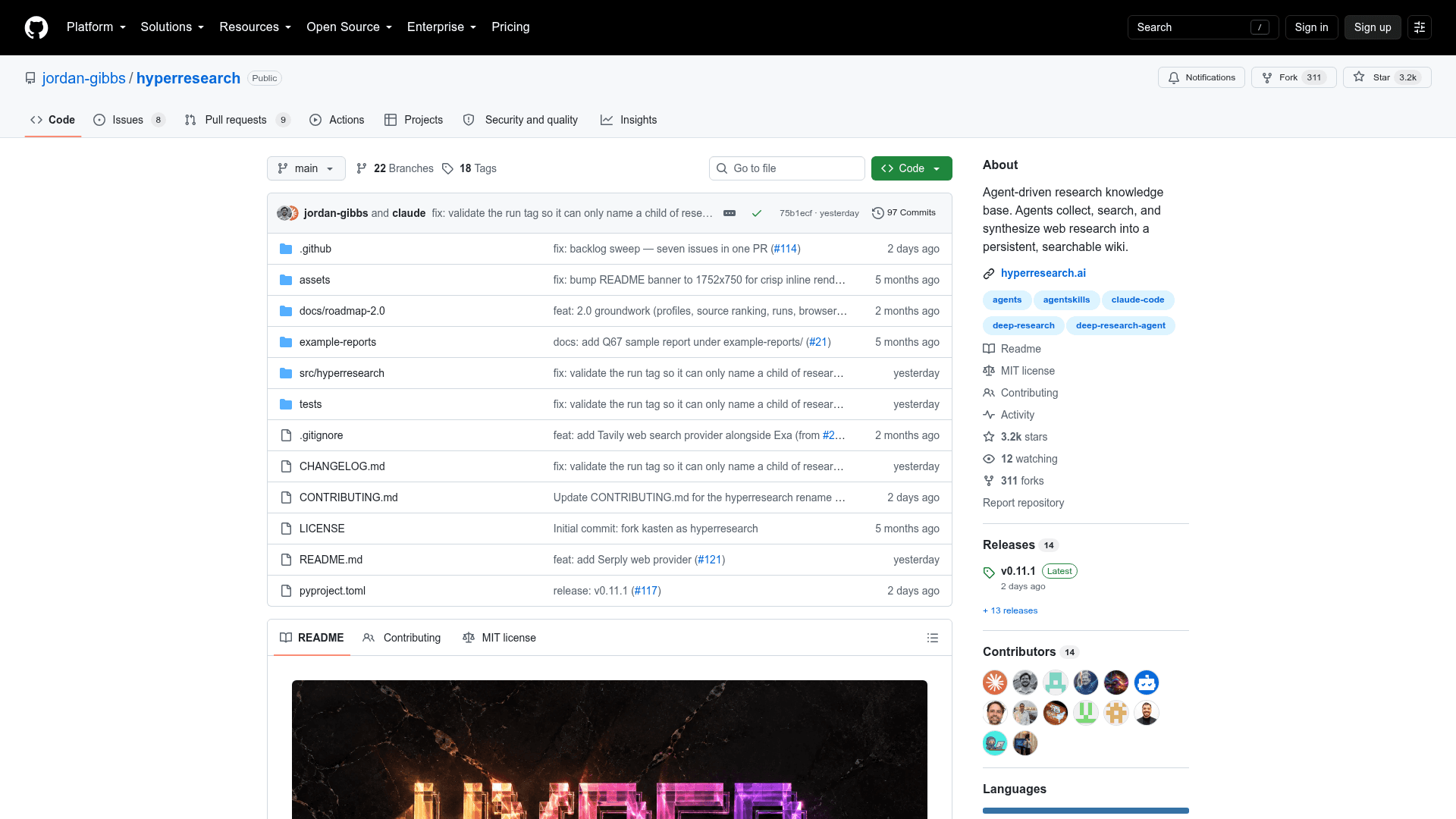
Hyperresearch is an open-source Python package that turns Claude Code into a deep research agent. Created by Jordan Gibbs and released under the MIT license, it installs via pip and integrates directly into Claude Code sessions through a slash command. The project claims to lead the DeepResearch-Bench RACE leaderboard based on internally benchmarked results, with third-party validation described as pending.
What It Is
Hyperresearch is a Claude Code agent skill harness built around a tier-adaptive, multi-step research pipeline. Given a single prompt, it orchestrates a fleet of specialized subagents — fetchers, analysts, critics, drafters, and patchers — to produce a sourced, adversarially-reviewed research report. Every source it reads is stored in a persistent SQLite-indexed markdown vault that future sessions can search and reuse, so each run starts with accumulated knowledge rather than a blank slate.
The 16-Step Pipeline
The core pipeline routes queries through up to 16 discrete steps depending on the tier and gear selected:
- Light tier (bounded factual queries): 5 steps, roughly 30–40 minutes
- Full tier (default, deep argumentative analysis): all 16 steps plus cite-check, roughly 1.5–2.5 hours
- Dissertation tier (opt-in): chaptered mega-runs across 4–10 chapters, 300–450 sources, 25K–80K words, 4–8 hours
Key structural enforcements include patch-only modification after the synthesized draft is produced (steps 14–16 are tool-locked to [Read, Edit] and cannot regenerate the draft), a skeptical cite-checker that verifies citation-sentence bindings before the report ships, and a retraction sweep that re-checks every cited DOI at ship time. Four adversarial critics attack every draft in parallel, and a tool-locked patcher applies only surgical edits.
The Persistent Vault
Unlike one-shot research tools, Hyperresearch keeps everything it reads. Sources land in a SQLite-indexed vault of plain markdown files with YAML frontmatter, fully rebuildable from the markdown if the index is deleted. The vault supports:
- Full-text and semantic search (with optional embedding providers: Voyage, OpenAI, or none)
- PageRank over the link and provenance graph
- Source quality scoring incorporating citation authority, retraction flags, and vault centrality
- Independence auditing that clusters syndicated copies so five reprints of one press release count as one source
- Note lifecycle management (
draft→review→evergreen, orstale→deprecated→archive) - Export to JSON, filtered vault subsets, and git integration
The vault is also accessible outside Claude Code via an MCP server (pip install hyperresearch[mcp]) with 13 tools, and via a local web UI (hyperresearch serve --open) with no build step or JavaScript dependencies.
Scholarly Discovery and Open-Access Recovery
Hyperresearch includes a unified scholarly search client (hpr scholar search) that queries eight sources in a single call — OpenAlex, Crossref, CORE, DOAB, ClinicalTrials.gov, SEC EDGAR, and FRED — and returns one deduplicated list merged by DOI and normalized title. Works found by multiple providers carry both in an also_in field.
For paywalled papers, the tool attempts open-access full-text recovery via Unpaywall, Europe PMC, and CORE before falling back to an abstract. Every substitution is disclosed in four places: a banner in the note body, frontmatter fields, a JSON block in note show, and CLI output. A rescued recovery kind marks notes built entirely from an open-access copy when the source URL was never readable.
Prompt Injection Defense
Because a research agent reads hundreds of pages it did not choose, Hyperresearch wraps every web-fetched body in <untrusted-source url="..."> delimiters with a treat-as-data preamble on all paths that serve bodies. Forged fence tags inside fetched content are neutralized and left visible for forensics. Resolved URLs from third-party APIs are checked for scheme, embedded credentials, and publicly-routable resolution before fetching.
Update: v0.11.1
The latest release is v0.11.1, published September 11, 2026. The repository was last pushed September 12, 2026, indicating active development. The project launched in April 2026 and has accumulated over 3,000 GitHub stars and 288 forks. Web provider support spans a built-in plain HTTP fetcher, crawl4ai (headless browser with stealth and PDF extraction), Exa, Tavily, Parallel, and Serply, configurable per project via .hyperresearch/config.toml.
Community Discussions
Be the first to start a conversation about Hyperresearch
Share your experience with Hyperresearch, ask questions, or help others learn from your insights.
Pricing
Open Source
Free and open-source under the MIT license. Requires your own Anthropic API usage via Claude Code.
- Full 16-step research pipeline
- Persistent markdown + SQLite vault
- MCP server support
- Local web UI
- All web providers
Capabilities
Key Features
- 16-step tier-adaptive research pipeline
- Persistent SQLite-indexed markdown vault
- Adversarial critic review with 4 parallel critics
- Patch-only modification after synthesis (tool-locked)
- Skeptical cite-checker with citation-sentence binding verification
- Retraction sweep at ship time for all cited DOIs
- Unified scholarly search across 8 sources (OpenAlex, Crossref, CORE, DOAB, ClinicalTrials.gov, SEC EDGAR, FRED, Europe PMC)
- Open-access full-text recovery via Unpaywall, Europe PMC, and CORE
- Source independence auditing to cluster syndicated copies
- Resumable runs with per-step manifests
- Semantic search with pluggable embedding providers
- MCP server for use outside Claude Code
- Local web UI with note browsing and interactive link graph
- Authenticated crawling with browser escalation lane
- PDF extraction via pymupdf
- Prompt injection defense via untrusted-source fencing
- Configurable subagent model assignments per profile
- Dissertation tier for 25K–80K word chaptered reports
- Source quality scoring with PageRank and retraction flags
- Note lifecycle management (draft → review → evergreen)