
JustHireMe
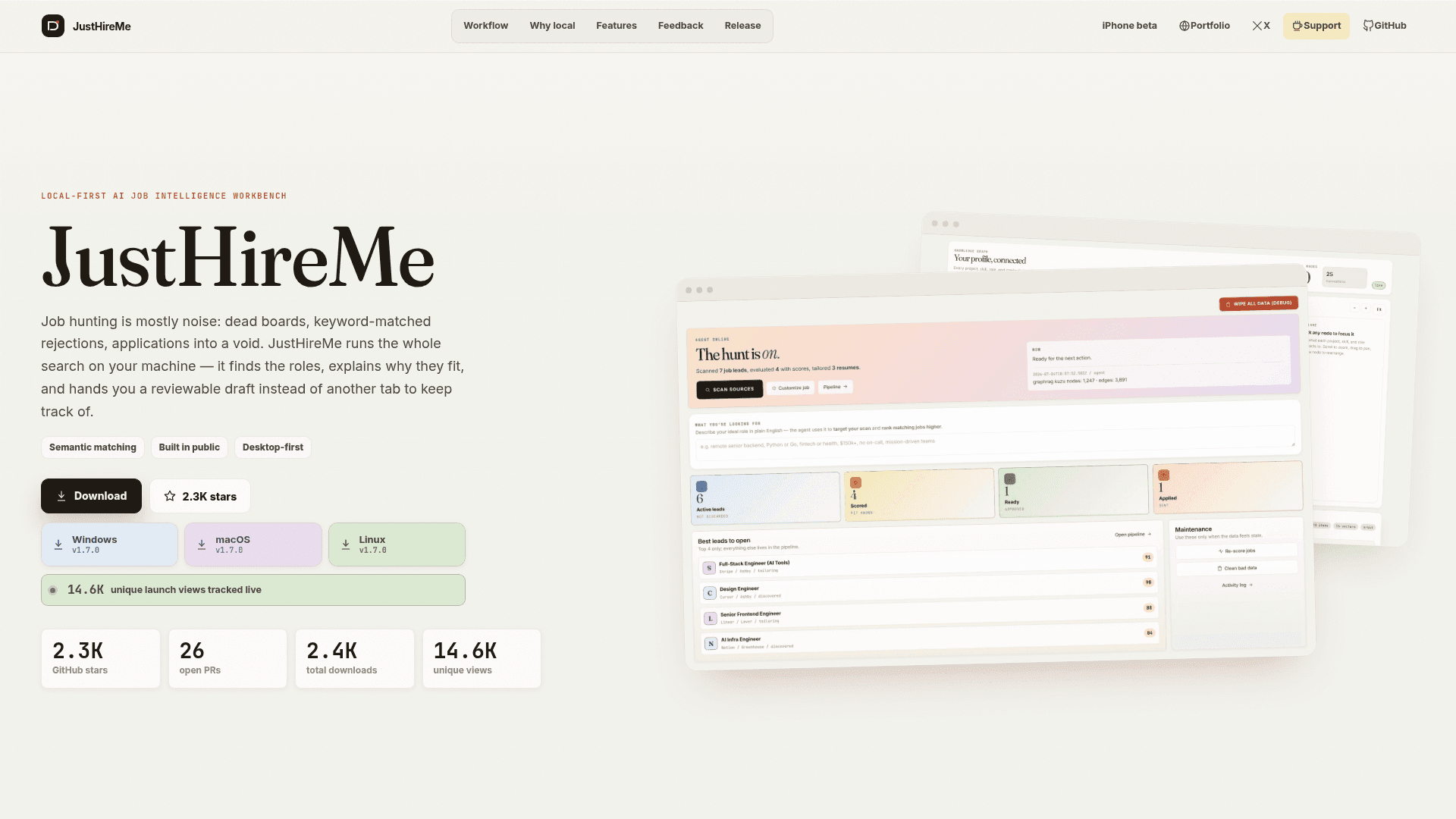
Local-first desktop workbench that scrapes job leads, ranks fit with explainable scoring, and drafts tailored application materials.
At a Glance
Local-first desktop workbench released under AGPL-3.0; self-host, modify and use with your own API keys. A commercial license is available separately for use outside AGPL terms.
Engagement
Available On
Listed Oct 2026
About JustHireMe
JustHireMe is an AGPL-3.0 licensed, local-first desktop app built by Vasudev Siddh. It imports a resume or profile, collects job leads from multiple sources, scores how well each fits, and generates tailored resumes, cover letters and outreach drafts for review. The current release is v1.7.0, with installers for Windows, macOS and Linux.
What It Is
JustHireMe is a job-search workbench that runs on the user's machine. A Tauri desktop shell hosts a React interface and a Python backend sidecar. Profile data, lead history, generated documents, graph data, vectors and settings are stored locally by default.
How the Workflow Runs
A resume (PDF, DOCX, TXT, MD, JSON Resume exports, LinkedIn zips, GitHub or portfolio URLs) is ingested into a Kuzu skill and project graph, with an import report showing what was pulled in, skipped or capped. Source adapters normalize leads from ATS boards, RSS feeds, Hacker News, GitHub, Reddit and custom sources. A deterministic quality gate rejects stale, thin, spammy or senior-only postings. Remaining leads land in a pipeline (discovered, tailoring, approved, applied, discarded) where nothing moves forward without user approval.
Explainable Matching
Ranking combines source signal, lead quality, a deterministic fit rubric, seniority caps, project and stack evidence, feedback learning and semantic similarity from LanceDB vectors. Fit scores are backed by evidence from the user's own graph. Embeddings use a bundled ONNX model (all-MiniLM-L6-v2) with a hashing fallback, so semantic matching works offline without an API key.
Generated Application Materials
For a promising lead, the customizer produces a tailored resume PDF, a cover letter PDF, a founder message, a LinkedIn note, a cold email, a keyword coverage summary and the rationale for selected projects. Drafts are for review, not automatic submission. The README says the approach works for any field and location.
Models, Agents and Setup
LLM steps can run keyless through Ollama, Claude Code CLI or Codex CLI, with optional keyed providers such as OpenAI, Anthropic, Gemini, Groq and DeepSeek. The repository also ships an agent skill and a stdio MCP server exposing score_job_fit, evaluate_lead_quality and extract_lead_intel. Browser automation and auto-apply code is experimental and disabled by default. The installer is thin, and a runtime pack downloads once on first launch. The macOS build is not yet notarized.
Community Discussions
Be the first to start a conversation about JustHireMe
Share your experience with JustHireMe, ask questions, or help others learn from your insights.
Pricing
Open Source (AGPL-3.0)
Local-first desktop workbench released under AGPL-3.0; self-host, modify and use with your own API keys. A commercial license is available separately for use outside AGPL terms.
- AGPL-3.0-only license
- Self-host, modify and use with your own API keys
- Desktop installers for Windows, macOS and Linux
- Local-first data storage
- Network-service modifications must provide corresponding source under AGPL
Capabilities
Key Features
- Multi-source job lead scraping (ATS boards, RSS, Hacker News, GitHub, Reddit, custom sources)
- Deterministic lead quality gate
- Explainable fit ranking with GraphRAG proof from a Kuzu profile graph
- Local semantic matching with LanceDB and ONNX embeddings
- Resume ingestion from PDF, DOCX, TXT, MD, JSON Resume, LinkedIn zips, GitHub and portfolio URLs
- Tailored resume and cover letter PDF generation
- Outreach drafts (founder message, LinkedIn note, cold email)
- Local SQLite CRM pipeline with human review
- Live activity stream
- Auto-update and light/dark/system theming
- Agent skill and stdio MCP server
- Experimental browser automation (disabled by default)