
Kadoa
AI-powered web data platform that uses coding agents to build deterministic ETL pipelines for extracting structured datasets from websites, PDFs, and documents — purpose-built for finance and investment firms.
At a Glance
Best for small teams. Consumption-based pricing with a free trial and all core features.
Engagement
Available On
Listed Jul 2026
About Kadoa
Kadoa is a web data platform built specifically for investment firms and financial analysts, using AI coding agents to generate and maintain deterministic ETL pipelines. Headquartered in Zurich, Switzerland, with a distributed team across North America and Europe, Kadoa positions itself as the "web data layer for finance" — enabling analysts and engineers to source structured datasets from public web sources without writing or maintaining brittle scrapers.
What It Is
Kadoa is a cloud-native data extraction and pipeline platform that combines AI-driven code generation with a structured orchestration engine. Rather than producing black-box LLM outputs, Kadoa's agents write and maintain deterministic code that extracts, transforms, and validates data from websites, PDFs, images, and spreadsheets. The result is auditable, source-grounded datasets delivered directly to data warehouses and storage systems. The platform is designed for two primary users: analysts who describe what they need in plain language and get structured datasets in minutes, and engineers who write and run ETL code natively within Kadoa.
How the Pipeline Engine Works
Kadoa's orchestration engine breaks each data job into specialized subagents and skills:
- Discover — indexes and maps target pages
- Navigation — generates browser automation code
- Extraction — generates and runs extraction code
- Transformation — cleans, formats, and structures data
- Code Review — reviews and tests generated code
- Validation — checks output for quality issues
Every extracted value is source-grounded, meaning any data point can be traced back to the exact page, paragraph, or cell it came from. The platform also includes self-healing capabilities: when a workflow breaks, Kadoa detects the failure, automatically fixes the code, and logs every change with full context.
Finance-Specific Use Cases
Kadoa's use cases are oriented around investment workflows:
- Investment Research — turn scattered public data into structured, ready-to-use datasets for signal generation
- Real-Time Alerts — detect changes in public sources before they appear in traditional data feeds, with alerts via Slack, email, or webhooks
- Documents & Filings — extract KPIs from global company filings and normalize them into backtesting-ready datasets
- Portfolio Monitoring — track pricing, hiring, and geographic signals across portfolio companies and competitors
- Custom Data Feeds — pre-built and bespoke datasets mapped to tickers and identifiers, delivered to Snowflake, S3, or API
Delivery and Integration Architecture
Kadoa is cloud-native and pushes data directly into S3, Snowflake, BigQuery, or any data warehouse. It also supports MCP (Model Context Protocol) for analyst self-service. The platform includes an observability dashboard for tracking success rate, throughput, and incidents per workflow, with the option to stream metrics into external monitoring stacks. Engineers can migrate existing pipelines into Kadoa and let the platform handle scaling, monitoring, and self-healing.
Enterprise Security and Compliance
Kadoa is SOC 2 Type II certified and built for enterprise deployment requirements:
- SSO/SAML with automated user provisioning (SCIM)
- Granular, customizable user roles
- Strict data isolation with multi-tenant architecture
- Comprehensive compliance and audit logs
- On-premise or private cloud deployment options
- Configurable compliance rules with compliance officer approval before data collection
- Automated robots.txt compliance checks
- Data is never shared between customers or used for AI training
Update: Kadoa Assistant and Web Scraping OS
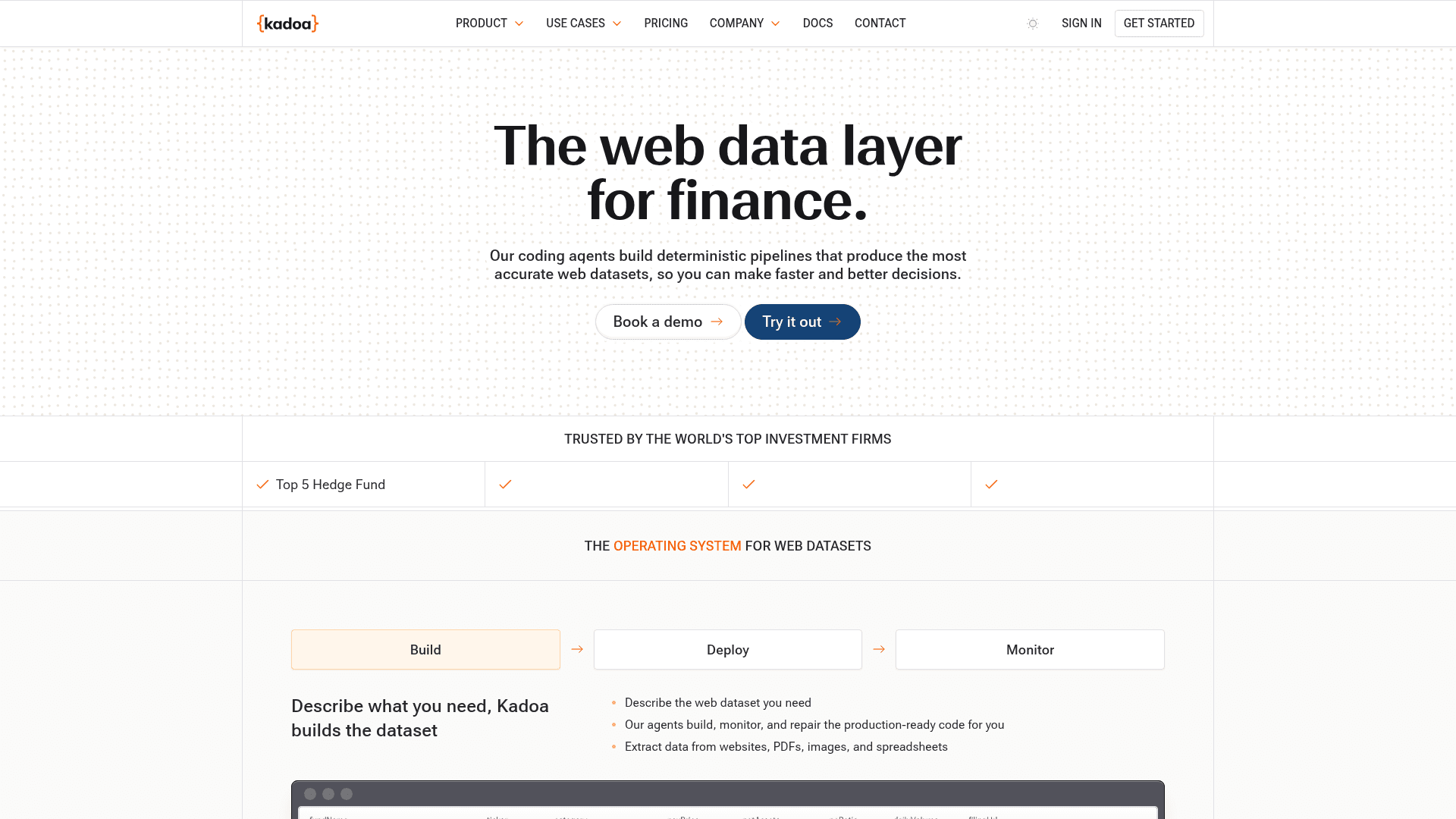
As of June 2026, Kadoa announced the launch of Kadoa Assistant, powered by what the company describes as a "Web Scraping OS" — a fundamentally new approach to web data extraction. This release introduced the assistant interface for self-serve dataset creation and formalized the operating system framing for the underlying orchestration engine. The platform now runs over 2,000 scrapers for at least one top hedge fund customer, according to a vendor-published testimonial on the homepage.
Community Discussions
Be the first to start a conversation about Kadoa
Share your experience with Kadoa, ask questions, or help others learn from your insights.
Pricing
Flex
Best for small teams. Consumption-based pricing with a free trial and all core features.
- Free trial
- Consumption-based pricing
- All core features
- Basic integrations
- Basic support
Enterprise
Built for scale and full control with custom usage limits, all integrations, and enterprise compliance.
- Custom usage limits & volume discounts
- Real-time monitors
- All integrations (Snowflake, S3, MCP, ...)
- SAML SSO
- Shared workspaces & unlimited users
- Enterprise SLA & compliance controls
- Dedicated account manager
Capabilities
Key Features
- AI coding agents that generate deterministic ETL pipeline code
- Self-healing workflows that auto-detect and fix broken pipelines
- Source-grounded outputs with full data lineage tracing
- Data quality validation on every run (completeness, plausibility, schema adherence)
- Real-time monitoring and alerts via Slack, email, or webhooks
- Browser automation code generation for dynamic websites
- PDF, image, and spreadsheet data extraction
- Cloud-native delivery to S3, Snowflake, BigQuery, and other warehouses
- MCP integration for analyst self-service
- Observability dashboard for pipeline health and metrics
- SOC 2 Type II certification
- SSO/SAML with SCIM user provisioning
- On-premise and private cloud deployment options
- Automated robots.txt compliance checks
- Configurable compliance rules with compliance officer approval
- Pre-built and custom financial datasets mapped to tickers and identifiers
- Point-in-time historical data where source archives support it
- No-code UI for analysts and native ETL code editor for engineers