
Kastor
A declarative language and toolchain for AI agents that lets you define agents, tools, and prompts in typed HCL, then generate framework projects or deploy to hosted platforms with plan/apply semantics.
At a Glance
Fully free and open-source under the Apache License 2.0. Use, modify, and distribute freely.
Engagement
Available On
Listed Jul 2026
About Kastor
Kastor describes itself as "Terraform for AI agents" — a declarative language and Go-based toolchain that brings infrastructure-as-code discipline to AI agent development. It is an open-source project under the Apache 2.0 license, currently in early development at v0.0.1-alpha, created in July 2026 by the GitHub user weirdGuy.
What It Is
Kastor addresses a gap the project README identifies: agents today are defined imperatively inside frameworks like LangGraph or CrewAI, or assembled in platform UIs like OpenAI Assistants or Bedrock Agents, with no vendor-neutral, versionable, reviewable source of truth. Kastor provides that source of truth through .agent, .tool, and .prompt files written in typed HCL (HashiCorp Configuration Language), plus a Go toolchain with two distinct paths:
kastor build— compiles the declarative spec into a runnable project for a target framework (LangGraph is the first supported target)kastor plan/kastor apply— reconciles agents as long-lived resources on hosted platforms, with local state files, three-way diffs, and drift detection
The design is explicitly not another agent runtime or framework; it sits above them as a spec and compilation layer.
How the Two Paths Work
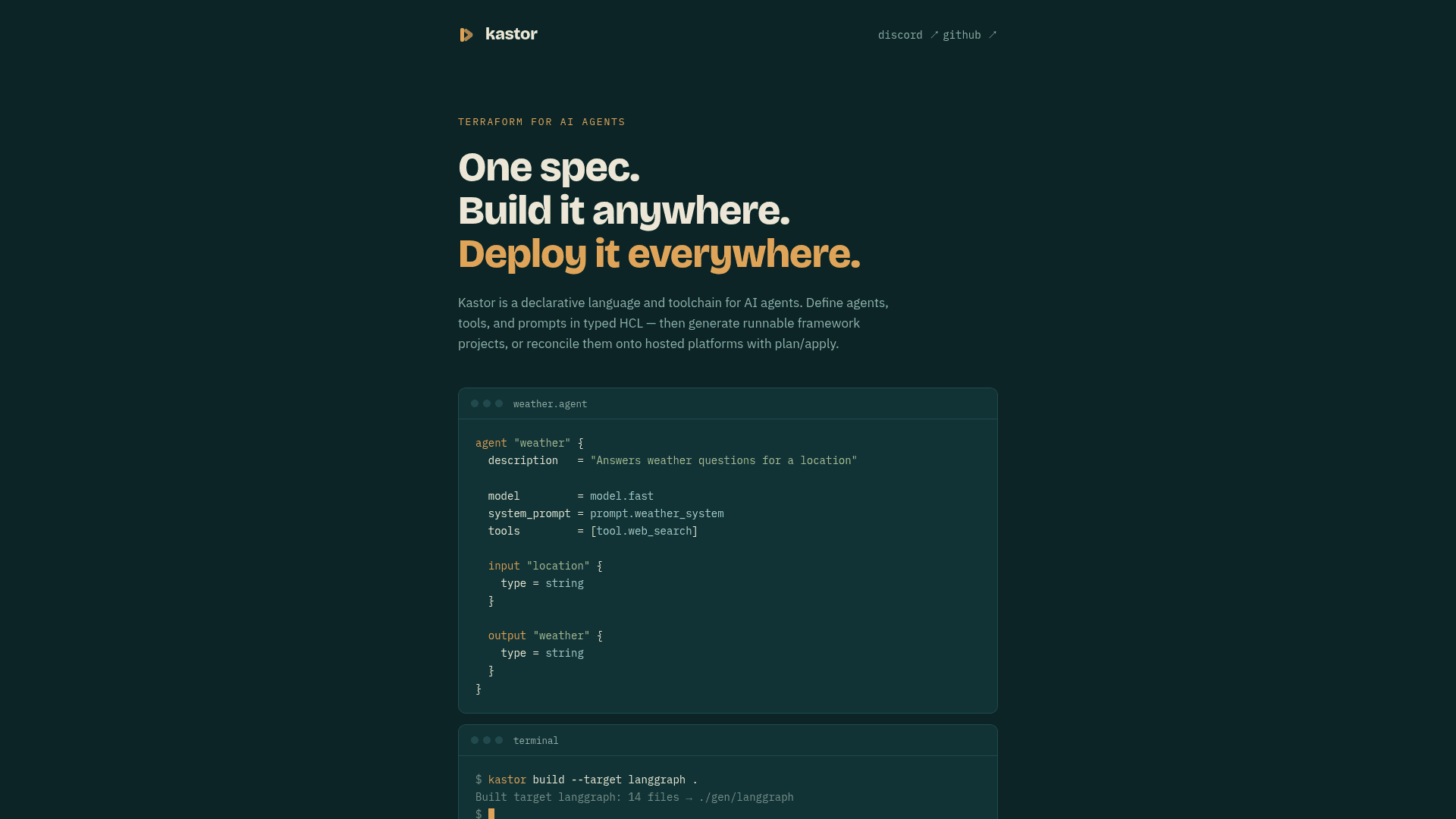
The build path takes a directory of .agent, .tool, and .prompt files and generates a complete runnable project. For LangGraph, kastor build --target langgraph . writes a Python project (with main.py, requirements.txt, and a generated README.md) to a declared output directory. Generated output is reproducible from the spec and is not committed to source control.
The plan/apply path mirrors Terraform's workflow. kastor plan performs a pure read — comparing the spec, the local state file, and the remote platform — and surfaces attribute-level diffs and out-of-band drift warnings without touching any remote resources. kastor apply then reconciles the spec onto the target platform. A built-in in-memory platform is available for local experimentation with no credentials required.
Architecture and Spec Design
Agents in Kastor are small declarative blocks that declare a model reference, a system prompt, a list of tools, and typed input/output contracts. Tools reference MCP server URIs (e.g., mcp://search-server/tavily_search), keeping the spec vendor-neutral while deferring server connection details to deployment-time configuration via mcp_servers.json. Model references use symbolic names (model.fast) resolved in a kastor.hcl workspace file, so swapping providers requires only a config change, not a spec rewrite.
The full design is documented in SPEC.md in the repository. CLAUDE.md documents day-to-day development conventions.
Current Status: v0.0.1-alpha
The project published its first alpha release on July 8, 2026. Working capabilities as of that release include:
- Parsing
.agent,.tool,.prompt, andkastor.hclfiles - Reference validation and prompt variable checking
- LangGraph code generation (
kastor build) kastor plan,kastor apply, andkastor destroyagainst the built-in in-memory platform- Two working examples: a weather agent and a content scheduler agent
Planned for v0 but not yet implemented: hosted platform providers, with OpenAI Assistants listed first, followed by AWS and Azure targets. The platform-reconciliation path for real hosted platforms is described as "in design."
Installation and Setup
Kastor can be installed via Homebrew (brew tap weirdGuy/tap && brew install kastor), a curl install script that verifies release checksums, go install with Go 1.26+, or by downloading a release archive directly. The quickstart for the weather example requires Go 1.26+, Python 3.11+, an OpenAI API key, and a Tavily API key for the MCP-backed web search tool.
Community Discussions
Be the first to start a conversation about Kastor
Share your experience with Kastor, ask questions, or help others learn from your insights.
Pricing
Open Source
Fully free and open-source under the Apache License 2.0. Use, modify, and distribute freely.
- Declarative HCL agent/tool/prompt definitions
- kastor build for LangGraph code generation
- kastor plan / apply / destroy
- Built-in in-memory platform for local testing
- Drift detection
Capabilities
Key Features
- Declarative HCL-based agent, tool, and prompt definitions
- kastor build: compile specs to runnable LangGraph projects
- kastor plan: three-way diff of spec, state, and remote platform
- kastor apply / kastor destroy: reconcile agents on hosted platforms
- Drift detection for out-of-band remote changes
- Typed input/output contracts for agents
- MCP server URI-based tool references
- Symbolic model references for vendor-neutral specs
- Built-in in-memory platform for local testing without credentials
- Reference validation and prompt variable checking at compile time
- Deterministic code generation enforced by tests
- Homebrew, install script, and go install support