kern
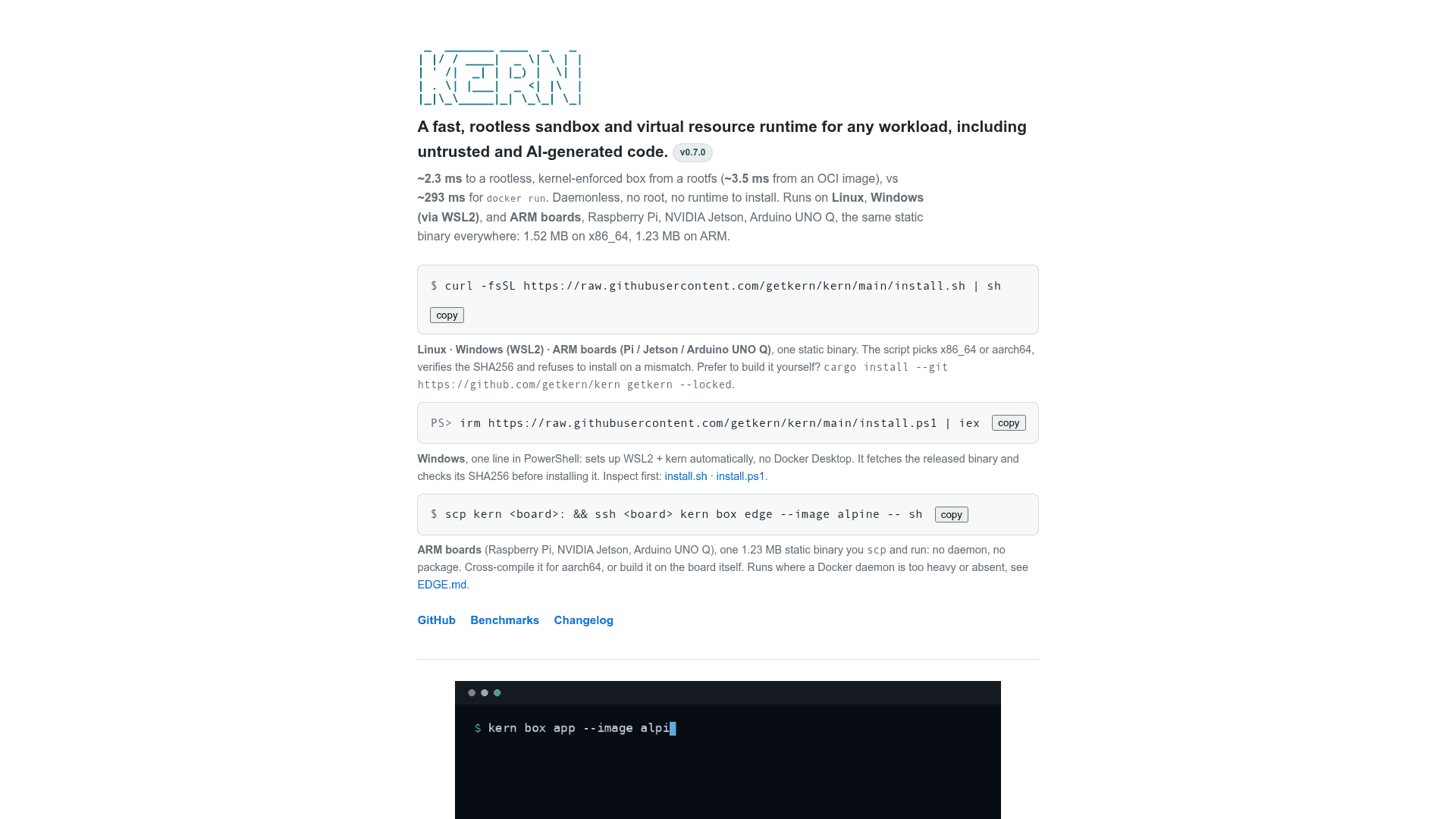
A fast, rootless sandbox and virtual resource runtime for any workload, including untrusted and AI-generated code, delivered as a single 1.52 MB static binary with no daemon.
At a Glance
Fully free and open source under the Apache-2.0 license. All features included.
Engagement
Available On
Alternatives
Listed Aug 2026
About kern
kern is a daemonless, rootless container runtime and sandbox written in Rust, distributed as a single 1.52 MB static binary under the Apache-2.0 license. It starts a kernel-enforced container from an OCI image in approximately 3.5 ms — roughly two orders of magnitude faster than Docker or Podman — with zero resident memory when idle. The project is maintained by Alex (@realexhub) under the getkern GitHub organization, with v0.7.0 as the first published release.
What It Is
kern occupies an unusual position: it is simultaneously a container runtime, a sandbox, a resource slicer, and a stack runner, all in one binary with no daemon to install or manage. Its entire Rust dependency tree is a single crate (libc); JSON and OCI manifests are parsed by hand rather than through bundled libraries. The result is a tool that runs on Linux, Windows via WSL2, and ARM boards (Raspberry Pi, NVIDIA Jetson, Arduino UNO Q) from the same static binary.
Core capabilities include:
- Real OCI containers: pull, build from a Dockerfile, commit, push, save/load — a box from an image starts in ~3.5 ms
- Always-rootless sandboxing: user, PID, mount, network, UTS, and IPC namespaces; overlay or read-only root; deny-by-default seccomp allowlist; cgroup v2 limits;
--security-profile untrustedbundles the full hardened set in one flag - Resource profiles:
vcpu:(CPU + memory),vdisk:(size-capped scratch disk), andvgpio:(device nodes) declared once inkern.tomland attached by name to any box or bare process - Stack support:
kern composereadskern-compose.tomlor an existingdocker-compose.ymlwith no conversion step - Tooling:
ps,logs,exec,stats,inspect,wait,top(live TUI),doctor, plus Python and Node SDKs and an MCP server
Performance and Architecture
The project publishes benchmark numbers measured on an Intel i7-14700KF running Linux 7.0.0. According to those figures, kern's cold start for a bare box is ~2.3 ms, matching bubblewrap and sitting roughly 125× faster than runc (~18.6 ms) and ~130× faster than Podman or Docker (~293–297 ms). Spawning 200 boxes in parallel takes ~0.11 s versus ~44.8 s for Podman and ~16.2 s for Docker. A live box consumes ~0.3 MB of memory, and the process has zero resident memory when nothing is running.
The architecture deliberately avoids linking a TLS stack: pull shells out to curl and tar already present on the machine. The binary is 1.52 MB in the size-optimized release build and 1.91 MB when built from source with cargo install.
Embedding and MCP Integration
kern ships a Python package (kern-sandbox on PyPI) and a Node package (also kern-sandbox on npm) that wrap the binary for embedding in agent or LLM-generated code workflows. Each call runs in a fresh isolated box with network off, memory and PID caps, capabilities dropped, output bounded, and a caller-enforced timeout. Faults — timeouts, OOM kills, blocked syscalls — are returned as data fields rather than exceptions.
The package also ships kern-mcp, a dependency-free stdio MCP server that exposes run_code (Python/bash/Node), write_file, read_file, and list_files to any MCP client such as Claude Desktop or Cursor. Each tool call runs in a fresh network-off box; files persist across calls in a workspace on disk.
Security Model and Tradeoffs
kern's security documentation is explicit about its boundaries. The isolation boundary is the Linux kernel, not a hypervisor, so a kernel privilege-escalation bug is an escape — a condition shared with Docker and Podman. Its isolation relies on unprivileged user namespaces, which the project's SECURITY.md describes as "a fertile source of kernel LPE bugs." The project includes four adversarial pentest suites in pentest/ that assert boundaries against the kernel rather than against kern's own reporting.
Key security mechanisms: 16 dangerous capabilities dropped before exec, an always-on seccomp allowlist (moby's default filter minus 35 escape syscalls that are hard-killed), cgroup v2 limits with --require-limits enforcement, and a deny-by-default /dev. Where a boundary is cooperative rather than kernel-enforced, the documentation names the bypass explicitly.
kern is not intended for hostile code from strangers in multi-tenant environments on a shared kernel — the project states this directly. It targets workloads where the operator chooses to run untrusted or AI-generated code and owns the blast radius: agent tool-calls, CI jobs, build steps, and code cells.
Update: v0.7.0 — First Published Release
v0.7.0, published on 2026-08-24, is the first public release of kern. The project states that the core is complete and all documented features work today, validated by 848 Rust tests, 78 Python tests, and 61 Node tests on real hardware including Linux, WSL2, Raspberry Pi 5, Jetson Orin Nano, and Arduino UNO Q. The CLI and configuration surface are not frozen and may change before 1.0, with all changes called out in CHANGELOG.md. The release tag is GPG-signed and independently timestamped; commits themselves are not signed.
Community Discussions
Be the first to start a conversation about kern
Share your experience with kern, ask questions, or help others learn from your insights.
Pricing
Open Source
Fully free and open source under the Apache-2.0 license. All features included.
- Single static binary, no daemon
- Rootless OCI container runtime
- Resource profiles (vcpu, vdisk, vgpio)
- docker-compose.yml support
- Python and Node SDK
Capabilities
Key Features
- Rootless, daemonless container runtime in a single 1.52 MB static binary
- ~3.5 ms cold start from an OCI image, ~2.3 ms for a bare box
- Full OCI image support: pull, build, commit, push, save, load
- Always-on seccomp allowlist with deny-by-default /dev
- -security-profile untrusted flag bundles full hardened sandbox
- Resource profiles: vcpu:, vdisk:, vgpio: declared in kern.toml
- docker-compose.yml support with no conversion step
- Live TUI (kern top) for boxes, CPU/RAM, profiles, volumes
- Python and Node SDK (kern-sandbox) for embedding in agent workflows
- MCP server (kern-mcp) for Claude Desktop, Cursor, and other MCP clients
- JSON output for all read verbs (ps, stats, inspect, etc.)
- Landlock LSM support for confining process writes
- cgroup v2 limits with --require-limits enforcement
- Four adversarial pentest suites included in the repository
- kern doctor pre-flight check before running boxes
- Runs on Linux, WSL2, Raspberry Pi, NVIDIA Jetson, Arduino UNO Q
- Zero resident memory when idle
- GPG-signed release tags with provenance