
Kestra
Open-source, event-driven declarative orchestration platform for data, AI, and infrastructure workflows.
At a Glance
About Kestra
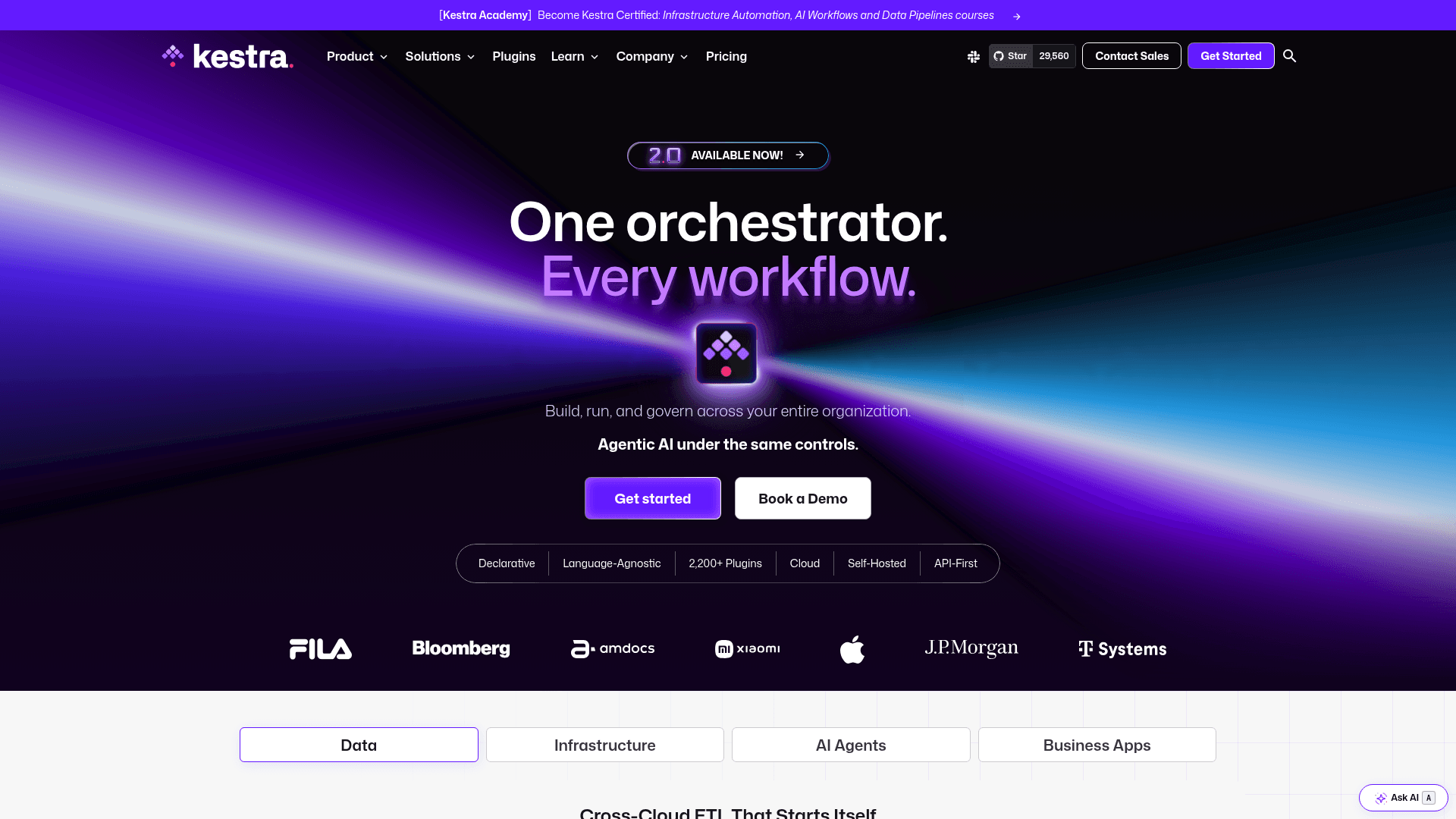
Kestra is an open-source orchestration platform from Kestra Technologies that runs scheduled and event-driven workflows defined declaratively in YAML. It targets data, infrastructure, and AI automation, and is available self-hosted (Docker or Kubernetes), as an Enterprise Edition, and as a Cloud edition by request. The repository's latest listed release is v2.0.6, following the Kestra 2.0 major release.
What It Is
Kestra is a workflow orchestrator that unifies scheduled and event-driven automation behind a language-agnostic interface. Workflows (flows) are composed of tasks, grouped into namespaces, and started by triggers such as cron schedules, webhooks, or messages from systems like Kafka, Redis, and SQS. Flows can be built in a YAML editor, a No-Code editor, or with an AI Copilot, and all three edit the same underlying YAML.
How Workflows Are Built and Run
Tasks can run scripts in Python, Node.js, R, Go, or Shell, execute SQL, make HTTP calls, or launch Docker containers and Kubernetes jobs. Task runners can execute work on remote servers or cloud VMs. Flows support inputs, outputs, variables, retries, timeouts, error handling, subflows, conditional branching, backfills, and parallel or sequential tasks. Flows can be stored in Git and deployed through CI/CD, the Terraform provider, the API, the kestractl CLI, Python and JavaScript SDKs, or a VS Code extension. Kestra says it offers over 2,200 plugins covering cloud, data, infrastructure, and messaging tools, and a library of 1,410+ blueprints.
AI Orchestration
AI Agents and RAG workflows are first-class task types, with calls to providers such as OpenAI, Anthropic, Google Gemini, Amazon Bedrock, and Ollama. A built-in MCP server and MCP Tool Trigger make flows callable from MCP-compatible agents, and Agent Skills let coding assistants generate flows. The AI Copilot offers Ask, Edit, and Plan modes.
Editions and Deployment
The open-source edition is licensed under Apache 2.0. According to the Kestra site, the Enterprise Edition adds SSO, RBAC, audit logs, multi-tenancy, isolated workers, and support for cloud, on-prem, and air-gapped environments. Kestra 2.0 moved worker communication to a gRPC worker-controller design that separates the control plane from the data plane.
Community Discussions
Be the first to start a conversation about Kestra
Share your experience with Kestra, ask questions, or help others learn from your insights.
Pricing
Open Source
Self-hosted Kestra core platform licensed under Apache 2.0.
- Apache License 2.0 licensed core
- Self-hosted
- Declarative YAML workflows
- AI Copilot, AI Agents and built-in MCP server
- 2,200+ plugins
Capabilities
Key Features
- Declarative YAML workflow definitions
- YAML, No-Code, and AI Copilot editors kept in sync
- Scheduled and event-driven triggers
- AI Agents and RAG workflow tasks
- Built-in MCP server and Agent Skills
- Run scripts in Python, Node.js, R, Go, Shell, or containers
- Task runners for Docker, Kubernetes, and cloud VMs
- Retries, timeouts, error handling, subflows, backfills
- Git version control and CI/CD integration
- Terraform provider, kestractl CLI, Python and JavaScript SDKs
- VS Code extension
- 2,200+ plugins and 1,410+ blueprints
- gRPC worker-controller architecture