
Keydris
Keydris is an AI agent authorization platform that checks and enforces what AI agents are allowed to do before each action executes, using versioned policies and decision records.
At a Glance
About Keydris
Keydris is an authorization layer purpose-built for AI agents, currently available as a Developer Preview. It sits between an agent and the systems it acts on, evaluating each governed action against an operator-defined policy before execution and returning one of three decisions: ALLOW, APPROVAL REQUIRED, or REJECT. The platform is built by Keydris, Inc. and is accessible without an invite, sales call, or credit card.
What It Is
Keydris addresses a specific gap in AI agent security: existing identity and access tools like OAuth, IAM, and API credentials establish who has access, but they do not by themselves verify that a specific governed action is inside the policy assigned to a specific agent at the moment it is attempted. Keydris adds that per-action authority check. It is not an identity provider, agent runtime, monitoring product, or universal traffic proxy — it is the authorization decision layer that sits alongside those systems.
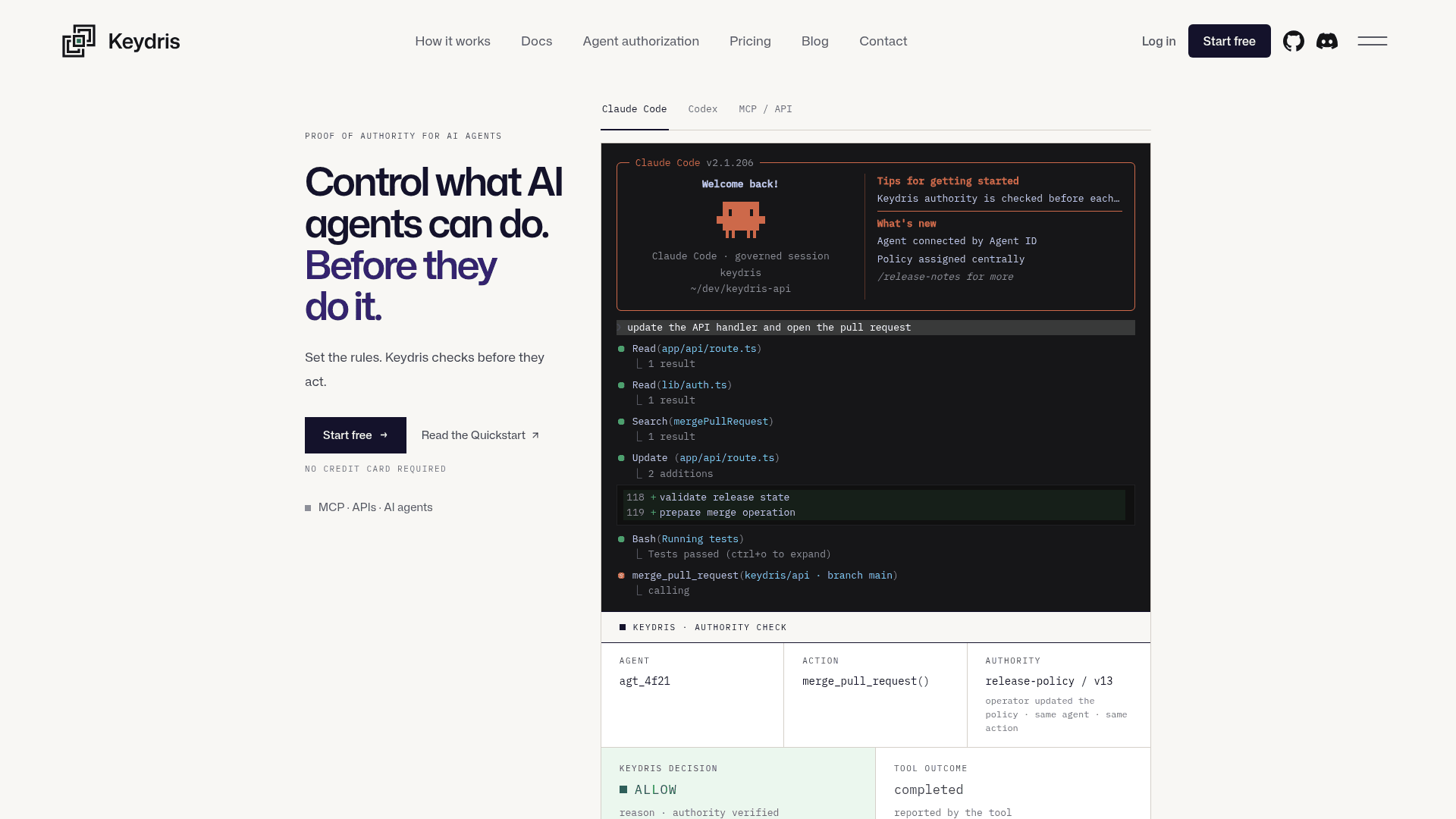
The core model works as follows: an operator registers an agent in the Keydris console, authors a policy defining what that agent may do, and assigns the policy to the agent. The agent receives a short-lived session identity called a KIT (Keydris Identity Token). When the agent attempts a governed action, the receiving boundary — a broker running in the operator's environment — requests a verification decision from the Keydris platform. The platform evaluates the action against the current policy version and returns the decision. The boundary enforces it; Keydris does not execute the action itself.
How the Authority Model Works
The authority lifecycle has several distinct components:
- Agents are operator-managed identities for AI workloads, registered in the console and assigned an Agent ID.
- KITs are short-lived runtime identities issued per session; they bind the agent to the current policy at issuance time.
- Policies are operator-authored, versioned rule sets that define permitted actions, defaults, and conditions. Updating a policy does not require redeploying the agent or redoing CLI setup.
- Decisions are exactly three: ALLOW, APPROVAL REQUIRED, or REJECT. Each decision produces a decision record capturing the evaluated action, agent, policy version, checks, outcome, and timestamp.
- Revocation invalidates the authority so the next verification attempt fails; it does not terminate the agent process or reverse completed actions.
- Fail-closed behavior: if the Keydris control plane is unavailable, an action whose authority decision cannot be obtained does not proceed. This behavior is currently fixed, not configurable.
Integrations and Deployment
Keydris currently supports governing actions across MCP tool calls and resource reads, GitHub repository actions, Slack channel reads and posts, and local shell commands. The CLI (@keydris/cli) is public on npm and supports Node.js 20+ on Windows, macOS, and Linux. Setup follows five steps: register the agent and assign a policy in the console, install the CLI, initialize the harness with the Agent ID, start the background proxy, and run the agent. The broker runs in the operator's environment; on supported self-hosted paths, payload traffic stays inside that environment and only authorization information crosses to the Keydris platform.
Decision Records and Audit Evidence
Every governed action produces a decision record that is distinct from the action's outcome. The record preserves: the decision (ALLOW, APPROVAL REQUIRED, or REJECT), the authority evaluated (policy name and version), the request (agent, action, resource), the tool outcome reported after execution, and an explicit statement of what the record does not establish — request payload, tool response body, and downstream effects are not stored or claimed. Records are available for review and export. Keydris frames these as evidence of what was checked and decided, not a guarantee of universal safety or compliance.
Current Status: Developer Preview
Keydris is in Developer Preview as of the time of writing. Production use is described as possible, but the platform documentation explicitly states there is no production SLA yet. The CLI is public on npm, the documentation and an in-browser authority demonstration are open without an account, and signup requires no invite or credit card. The docs list the integrations currently supported, and the platform notes that latency benchmarks have not yet been published.
Community Discussions
Be the first to start a conversation about Keydris
Share your experience with Keydris, ask questions, or help others learn from your insights.
Pricing
Free
Evaluate Keydris with your first agent. No credit card required.
- 1 agent
- 1 policy
- 1 team member
- 1,500 KIT issuances/month
- Unlimited verification
Builder
Build real agent workflows with Keydris.
- 3 agents
- 3 policies
- 1 team member
- 5,000 KIT issuances/month
- Unlimited verification
- Additional KIT issuances available
Pro
Operate Keydris across your team.
- 10 agents
- 10 policies
- 5 team members
- 25,000 KIT issuances/month
- Unlimited verification
- Additional KIT issuances available
- Team administration with roles
Enterprise
Govern AI agent authority across your organization with custom scale and terms.
- Unlimited verification
- Custom scale
- Organizational governance
- Enterprise administration and roles
- Custom commercial terms
Capabilities
Key Features
- Per-action authorization checks before AI agent actions execute
- Versioned, operator-authored policies with ALLOW, APPROVAL REQUIRED, and REJECT decisions
- Short-lived KIT (Keydris Identity Token) session identities for agents
- Revocation of agent authority without terminating the agent process
- Decision records with evaluated action, policy version, and outcome
- Fail-closed behavior when control plane is unavailable
- MCP tool call and resource read governance
- GitHub repository action governance
- Slack channel read and post governance
- Local shell command governance
- Broker runs in operator's environment for self-hosted enforcement
- Team administration with roles (Pro and Enterprise)
- Audit log with exportable decision evidence
- Unlimited verification on all plans
- CLI available on npm for Windows, macOS, and Linux