
Kilo Code
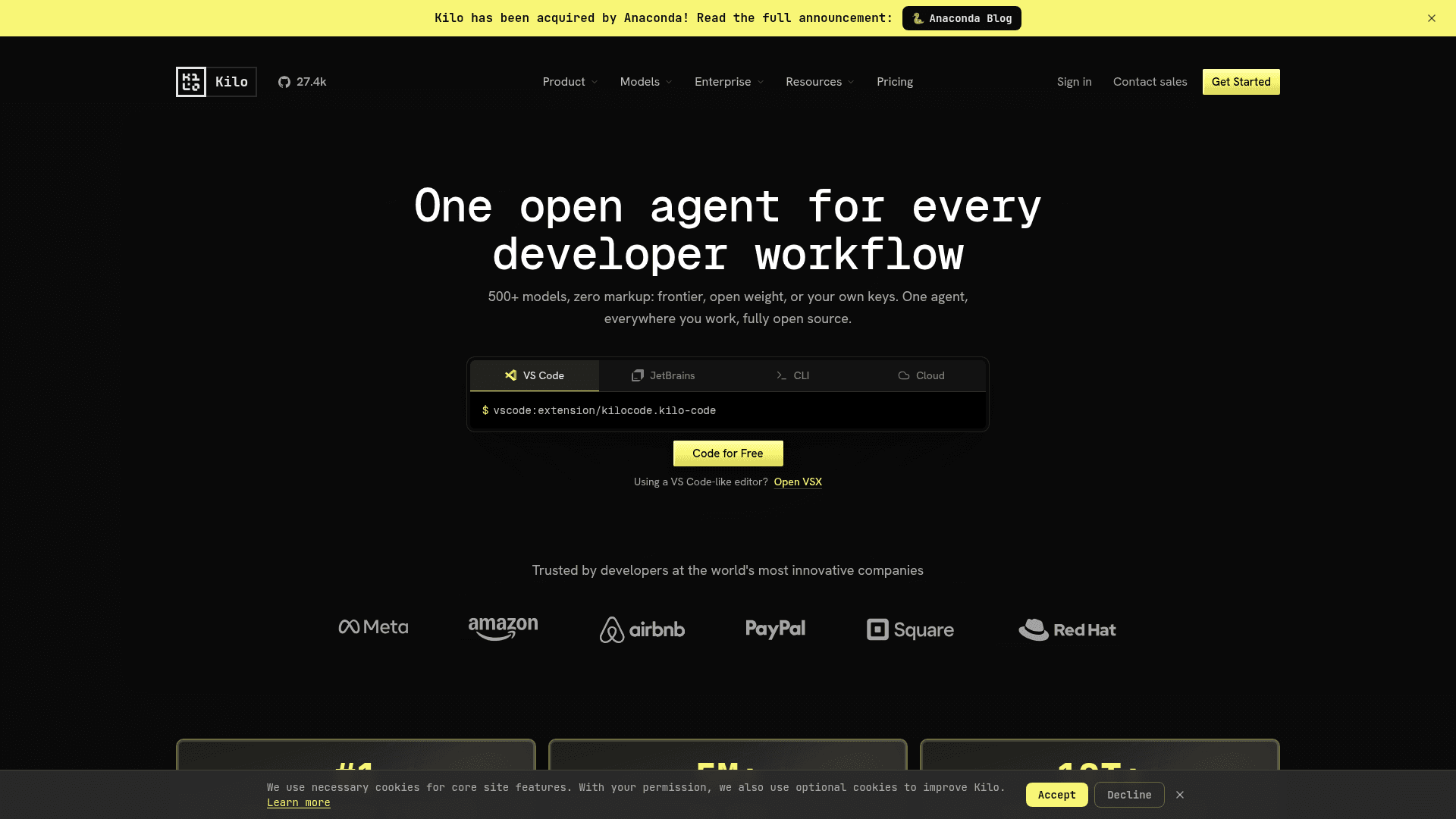
Open-source AI coding agent for VS Code, JetBrains, and CLI with 500+ models, zero markup pricing, and agentic workflows for individual developers and enterprise teams.
At a Glance
Start coding with Kilo Auto free, no credit card required. Access to free models and core agent features.
Engagement
Available On
Alternatives
Updated Oct 2026
About Kilo Code
Kilo Code is an open-source, MIT-licensed AI coding agent built by Kilo Code, Inc. (now acquired by Anaconda) that works across VS Code, JetBrains IDEs, the CLI, cloud agents, and mobile. It gives developers access to 500+ AI models at provider cost with zero markup, and ships with specialized agent modes for coding, planning, debugging, reviewing, and asking questions about a codebase.
What It Is
Kilo Code is an all-in-one agentic engineering platform designed to replace the fragmented collection of AI coding tools most developers use today. The core agent is open source under the MIT license and available on GitHub (27,000+ stars), while the hosted platform adds cloud agents, code review automation, team management, and enterprise governance on top. Developers can install it as a VS Code extension, a JetBrains plugin, or a CLI tool, and can also run agents entirely in the cloud without consuming local resources.
Agent Modes and Capabilities
Kilo ships with five built-in agent modes that developers switch between depending on the task:
- Code – Implements and edits code from natural language across multiple files
- Plan (Architect) – Designs architecture and writes implementation plans before any code is written
- Ask – Answers questions about the codebase without modifying files
- Debug – Troubleshoots and traces issues through the codebase
- Review – Surfaces issues across performance, security, style, and test coverage
Beyond modes, the agent supports inline tab autocomplete with ghost-text suggestions, terminal and browser control, MCP marketplace integration for extending capabilities, codebase indexing for semantic search, memory bank for persistent context, session forks for exploring alternate approaches, and voice prompting in the IDE.
Model Access and the Gateway
A central differentiator Kilo emphasizes is model freedom: developers access 500+ models from every major provider through a single unified endpoint called Kilo Gateway, with no AI inference markup. The platform supports bring-your-own-key (BYOK) for existing Anthropic, OpenAI, Azure OpenAI, and AWS Bedrock contracts, as well as local and open-weight models. Auto Model routing automatically selects the optimal model for each task based on cost and capability tiers (Efficient, Frontier, or Free), with a session-aware router introduced in recent releases.
Enterprise and Team Governance
The enterprise tier adds governance controls that security, platform, and finance teams require for governed rollouts:
- SSO/SAML, OIDC, SCIM provisioning, and RBAC
- Provider and model allowlists configurable at the organization level
- Agent sandboxing with OS-level file system and network isolation
- Sub-organization management with fund distribution and usage reporting
- Audit logs, data residency controls (including EU options), and SLA commitments
- Atlassian integrations (Bitbucket and Jira) alongside GitHub and GitLab
- OpenAPI usage analytics endpoints for BI and internal platform tooling
The enterprise page attributes customer quotes from Ida Infront (70 engineers onboarded), IntraPhone (5–10x developer velocity claim), and Plug&Pay (80% developer adoption claim).
Open-Source Deployment Model
The core Kilo Code agent is MIT-licensed and hosted at github.com/Kilo-Org/kilocode. The CLI is a fork of OpenCode, enhanced for the Kilo platform. Developers can fork, modify, and self-host the agent, and the repository exposes the full prompt and context window for auditability. The project supports autonomous CI/CD operation via kilo run --auto, which disables permission prompts for use in trusted pipeline environments.
Update: v7.7.5 and Recent Releases
The latest release as of September 2026 is v7.7.5, published September 18, 2026. Recent product additions include a native JetBrains extension rebuilt from the ground up, a browser extension that lives in the browser side panel, Android and iOS mobile apps for running cloud agents and reviewing pull requests, swarm subagent messaging, browser-use capabilities, GitHub integration in Agent Manager, scheduled and webhook-triggered cloud agents, and the Auto Efficient session-aware model router. Kilo was acquired by Anaconda, with the announcement published on the Anaconda blog. The about page states the platform grew from launch in March 2025 to processing over ten trillion tokens per month, per vendor-published figures.
Community Discussions
Be the first to start a conversation about Kilo Code
Share your experience with Kilo Code, ask questions, or help others learn from your insights.
Pricing
Free
Start coding with Kilo Auto free, no credit card required. Access to free models and core agent features.
- Kilo Auto (free tier model routing)
- VS Code, JetBrains, and CLI access
- 500+ models (free tier)
- Codebase indexing
- MCP marketplace
Kilo Pass
Predictable heavy usage for individual developers. Monthly or annual payment converts 1:1 into paid credits plus free bonus credits on top.
- Up to 50% free bonus credits
- Paid credits for frontier models
- Zero AI inference markup
- BYOK support
- All platforms: VS Code, JetBrains, CLI, Cloud, Mobile
- Auto Model routing
- Bonus credits expire at month end
Teams
Centralized collaboration and billing for engineering teams.
- Centralized team administration
- Shared billing and usage visibility
- BYOK centralized management
- All coding agent features
- Code review agents
- Cloud agents
- Slack integration
- Usage analytics
Enterprise
Governance, security review, policy enforcement, support commitments, and rollout controls for large organizations.
- SSO/SAML and OIDC
- SCIM provisioning
- RBAC
- Provider and model allowlists
- Agent sandboxing
- Sub-organization management
- Audit logs
- EU data residency
- SLA commitments
- Atlassian Bitbucket and Jira integration
- OpenAPI usage analytics
- Organization custom modes
- SOC 2 materials
- DPA and MSA available
- Priority support
- High-touch onboarding
Capabilities
Key Features
- 500+ AI models with zero markup
- Specialized agent modes: Code, Plan, Ask, Debug, Review
- VS Code extension
- JetBrains native plugin
- CLI tool
- Cloud agents (no local resources required)
- Auto Model routing (Efficient, Frontier, Free tiers)
- Kilo Gateway unified API endpoint
- Bring Your Own Key (BYOK) support
- Local and open-weight model support
- Inline tab autocomplete with ghost-text
- Codebase indexing for semantic search
- Memory bank for persistent context
- Session forks for alternate approaches
- MCP marketplace integration
- Terminal and browser control
- Voice prompting in the IDE
- Automated code review on pull requests
- Agent Manager for parallel agents in IDE
- Cloud agents with scheduled and webhook triggers
- Slack integration
- Mobile apps (iOS and Android)
- Browser extension
- SSO/SAML, OIDC, SCIM provisioning, RBAC (Enterprise)
- Agent sandboxing (Enterprise)
- Sub-organization management (Enterprise)
- Provider and model allowlists (Enterprise)
- Audit logs and data residency controls (Enterprise)
- Atlassian Bitbucket and Jira integration (Enterprise)
- OpenAPI usage analytics endpoints
- PDF and document upload
- Session continuity across devices
- Autonomous CI/CD mode (kilo run --auto)
- MIT-licensed open source core
Integrations
Demo Video
