
KiroGraph
Local semantic code knowledge graph MCP server for Kiro that gives AI agents instant symbol lookups with fewer tool calls.
At a Glance
KiroGraph core is released under the MIT License and runs 100% locally.
Engagement
Available On
Alternatives
Listed Nov 2026
About KiroGraph
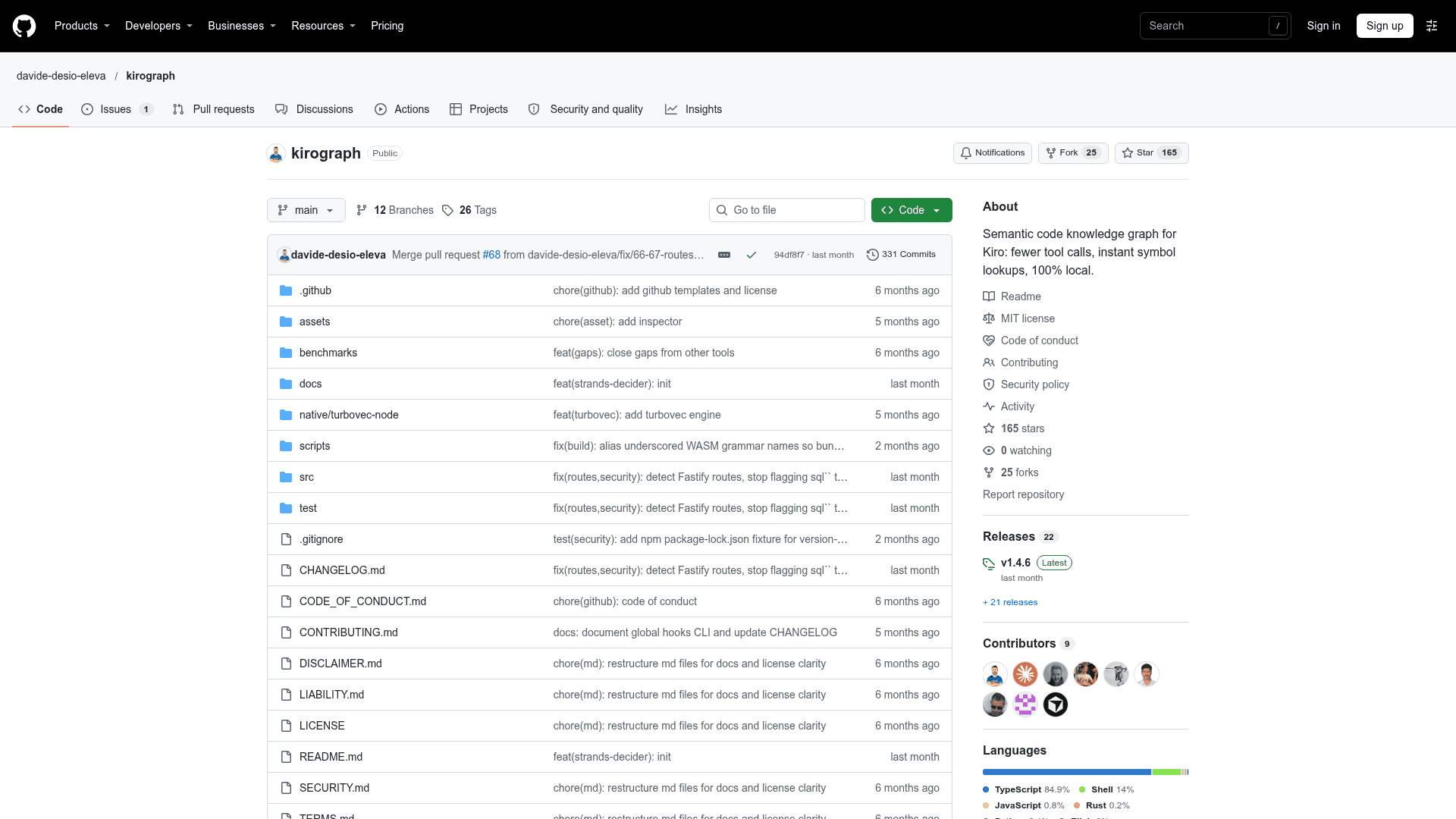
KiroGraph is a semantic code knowledge graph built for the Kiro IDE and exposed through MCP and hooks. It pre-indexes a codebase into a local SQLite database so an AI agent can query symbols, call graphs and impact radius in a single tool call instead of repeated file reads and greps. The README states that nothing leaves the machine and no API keys are needed for core use.
What It Is
KiroGraph is an MCP server and CLI that parses source files with tree-sitter into an AST and stores nodes (functions, classes, interfaces, routes, dependencies and more) and edges (calls, imports, extends, implements and others) in .kirograph/kirograph.db. Kiro then queries this graph, for example through kirograph_context, which returns entry points, related symbols and code snippets for a task description. It is inspired by CodeGraph for Claude Code and rebuilt natively for Kiro. Full support is for Kiro; the README lists experimental auto-detected integrations for 34 other MCP-capable tools such as Cursor, Copilot, Claude Code, Windsurf and Cline.
Code Analysis Capabilities
The core graph supports impact analysis, type hierarchy traversal, circular dependency detection, dead code detection, hotspots, affected-test discovery and an interactive browser graph export. Semantic search offers nine engines (including Cosine, sqlite-vec, Orama, LanceDB, Qdrant and Typesense) plus TurboQuant embedding compression, with custom HuggingFace embedding models supported.
Opt-in Modules
Optional modules add architecture analysis with snapshots and diffs, security scanning (reachability-aware vulnerability analysis, secrets, SAST-lite, SBOM/VEX and SARIF output), cross-session memory linked to code symbols, a markdown wiki, documentation indexing, data navigation over CSV/JSON/Excel/Parquet/PDF, and token-saving shell and prose compression. Each enabled flag adds tools to the MCP tool list; the README gives a total of 126 tools when all flags are on.
Setup Path
Run kirograph install to auto-detect AI tools, or target one with --target kiro. Integration files are written to .kiro/, and Kiro IDE is then restarted. It requires Node.js 18 or newer and is released under the MIT license.
Community Discussions
Be the first to start a conversation about KiroGraph
Share your experience with KiroGraph, ask questions, or help others learn from your insights.
Pricing
Open Source (MIT)
KiroGraph core is released under the MIT License and runs 100% locally.
- MIT License
- 100% local semantic code knowledge graph for Kiro
- tree-sitter AST parsing across 33+ languages
- 9 semantic search engines
- Opt-in modules: Arch, Sec, Mem, Watchmen, Wiki
Capabilities
Key Features
- Semantic code graph via tree-sitter across 33+ languages stored in SQLite
- Single-call context building for tasks
- Impact analysis and type hierarchy traversal
- Circular dependency and dead code detection
- Hotspot detection and affected-test discovery
- Interactive graph export dashboard
- Nine semantic search engines with TurboQuant embedding compression
- Architecture analysis with snapshots and diffs
- Security scanning with reachability, SBOM/VEX and SARIF output
- Persistent memory linked to code symbols
- LLM wiki module
- Documentation indexing and data navigation
- Shell and prose token compression
- File read cache and token analytics
- Multi-tool MCP integration with auto-detection