
Kitten-TTS
Open-source text-to-speech models and Python library with voice cloning, expression control, and CPU-capable inference.
At a Glance
Self-hosted KittenTTS code under Apache License 2.0. Model weights are licensed separately; KittenTTS 2 uses the Stellon Labs Community License, which is not wholly Apache.
Engagement
Available On
Alternatives
Listed Nov 2026
About Kitten-TTS
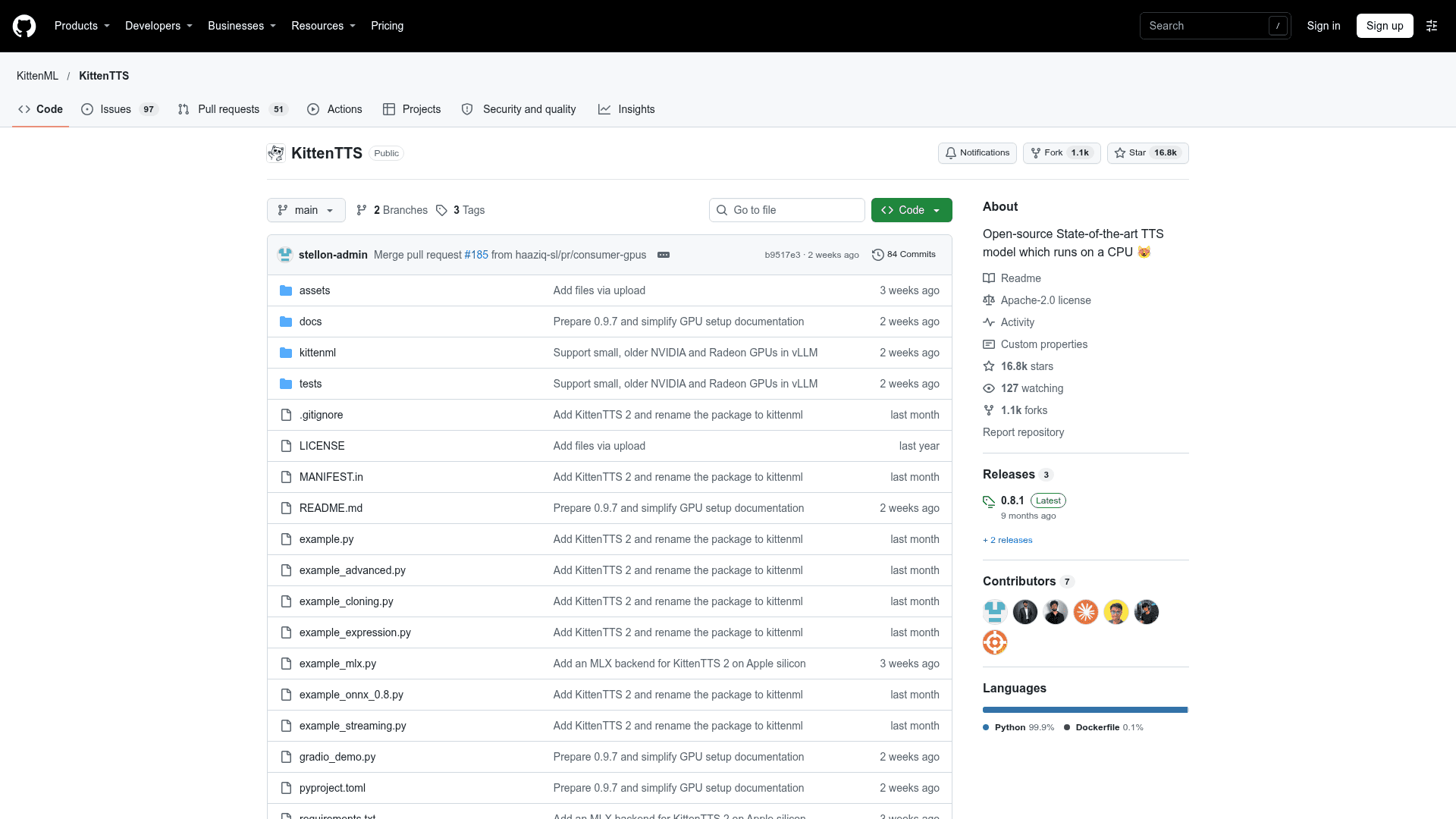
Kitten-TTS is a series of open-source text-to-speech models built by KittenML. Its flagship Kitten-TTS 2 is a 1.7B-parameter 1-bit model with in-context voice cloning and expression control, and the library also ships lightweight 15M-80M parameter ONNX models that run on CPU. Both model families load through the same KittenTTS(...) constructor.
What It Is
Kitten-TTS is a Python library (pip install kittenml) that turns text into 24 kHz speech audio. Users pick a built-in voice or supply a 5-30 second reference recording to clone a speaker without fine-tuning. The README states that Kitten-TTS 2 runs in real time on CPUs and consumer GPUs.
Voices, Languages and Expression
The library includes 115 built-in voices and supports 20 languages. Delivery can be steered with [emotion] tags, inline <event> tags and (((emphasis))) spans; the README labels expression control as beta and notes it steers delivery rather than guaranteeing it. Decoding presets trade stability against expressiveness. Text preprocessing expands numbers, currencies, dates, units and abbreviations.
Long Text and Streaming
Long input is split on sentence boundaries, synthesized chunk by chunk and joined with silence trimming and short fades. generate_stream yields chunks for early playback, but streaming is chunk-level rather than token-level, and short text yields a single chunk.
Running It
Backends include the default Python path, a C++ llama.cpp fork (beta) for fast CPU inference, an optional MLX backend for Apple silicon, and an optional vLLM backend for GPU inference on Linux or WSL2. Docs also cover a Docker image exposing an OpenAI-compatible speech API. The prerequisites are Python 3.10+ and either a CUDA GPU with roughly 8 GB free or a CPU with about 6 GB of RAM.
Licensing
The repository code is Apache 2.0, while models are licensed separately; Kitten-TTS 2 uses the Stellon Labs Community License. Commercial support is offered for integration, custom voices and enterprise licensing.
Community Discussions
Be the first to start a conversation about Kitten-TTS
Share your experience with Kitten-TTS, ask questions, or help others learn from your insights.
Pricing
Open Source (Apache 2.0)
Self-hosted KittenTTS code under Apache License 2.0. Model weights are licensed separately; KittenTTS 2 uses the Stellon Labs Community License, which is not wholly Apache.
- Code licensed under Apache License 2.0
- Lightweight V0.8 models run on CPU without a GPU
- Voice cloning from 5-30 seconds of audio
- 115 built-in voices
- 20 languages
Kitten-TTS 2 API
Free hosted Kitten-TTS 2 API announced in the README.
- Hosted API at platform.kittenml.com
Commercial Support
Commercial support for integration assistance, custom voices, and enterprise licensing.
- Integration assistance
- Custom voice development
- Enterprise licensing
Capabilities
Key Features
- Voice cloning from 5-30 seconds of audio
- 115 built-in voices
- 20 languages
- Emotion, event and emphasis expression tags
- Decoding presets
- Long-form sentence-aware chunking
- Chunk-level streaming
- Automatic text normalization
- 24 kHz audio output
- Real-time CPU inference
- MLX backend for Apple silicon
- vLLM backend for GPU
- Docker OpenAI-compatible speech API
- Lightweight ONNX models (15M-80M parameters)