
Kronos
Open-source family of decoder-only foundation models pre-trained on financial candlestick (K-line) sequences for market forecasting.
At a Glance
Kronos foundation model code released under the MIT License; free to use, copy, modify, and distribute. Pre-trained models are available on the Hugging Face Hub.
Engagement
Available On
Alternatives
Listed Oct 2026
About Kronos
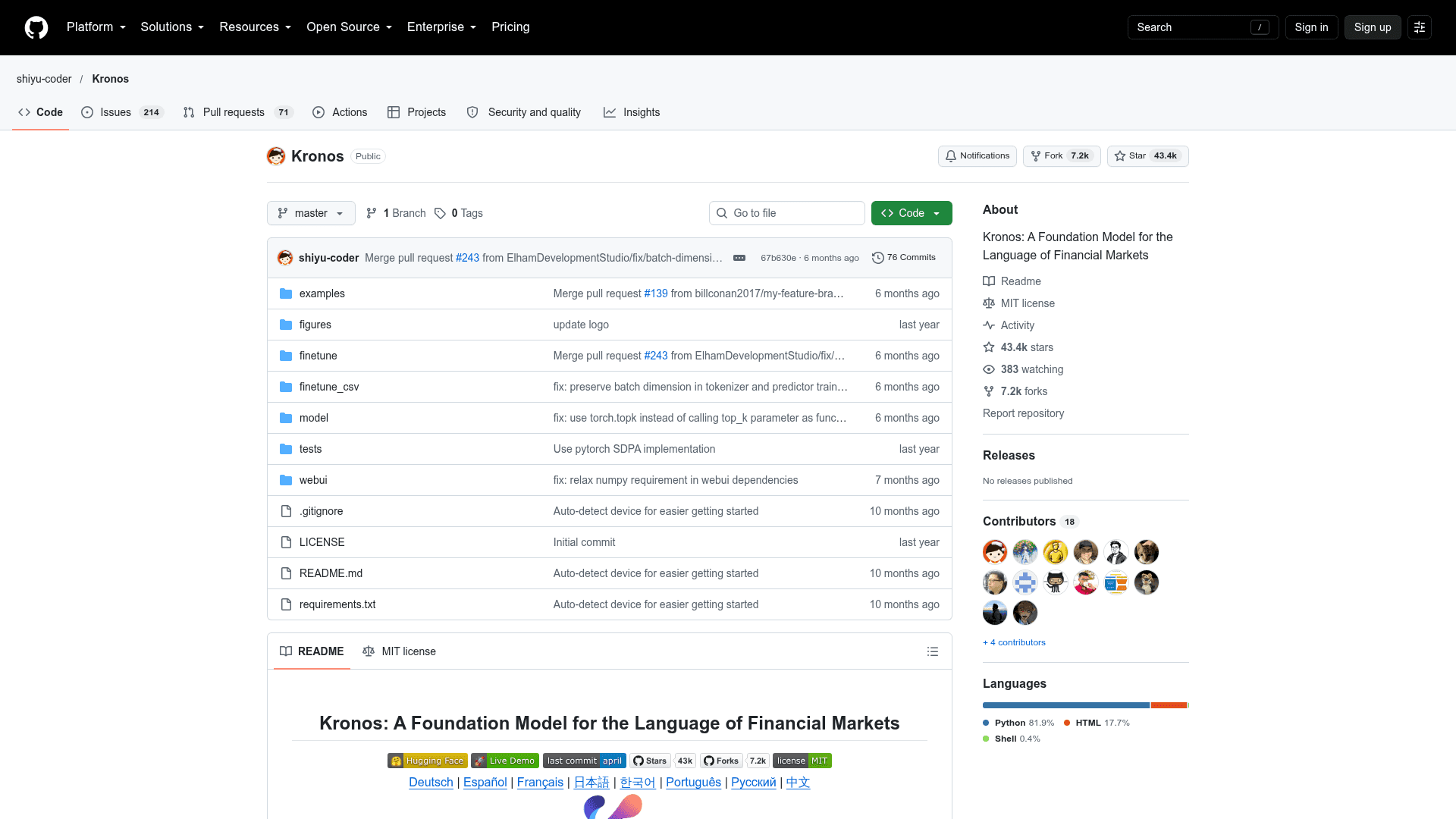
Kronos is an open-source foundation model family for financial candlestick (K-line) data, published in the shiyu-coder GitHub repository. It tokenizes OHLCV sequences and uses an autoregressive Transformer to forecast future market data. Pre-trained models are distributed through the Hugging Face Hub, and the repository includes forecasting examples and a fine-tuning pipeline.
What It Is
Kronos is a set of decoder-only models pre-trained on the "language" of financial markets. The README states it is the first open-source foundation model for K-lines, trained on data from over 45 global exchanges. Unlike general-purpose time-series foundation models, it is designed for the high-noise characteristics of financial data.
It uses a two-stage framework: a specialized tokenizer quantizes continuous multi-dimensional OHLCV data into hierarchical discrete tokens, and a large autoregressive Transformer is pre-trained on those tokens to serve as a unified model for quantitative tasks.
Forecasting Workflow
Users load a tokenizer and a model from Hugging Face, then wrap them in the KronosPredictor class, which handles preprocessing, normalization, prediction, and inverse normalization. Input is a pandas DataFrame with open, high, low and close columns (volume and amount are optional), plus historical and future timestamps. Sampling parameters such as temperature, top-p, and sample count control probabilistic forecasts. The output is a DataFrame of forecasted open, high, low, close, volume, and amount values. A predict_batch method forecasts multiple series in parallel, provided they share the same lookback and prediction length. Example scripts produce plots comparing forecasts with ground truth.
Model Zoo
The released models are Kronos-mini (4.1M parameters, 2048 context), Kronos-small (24.7M, 512), and Kronos-base (102.3M, 512), all open on Hugging Face. Kronos-large (499.2M) is listed as not open-source. A live demo shows a 24-hour BTC/USDT forecast.
Fine-tuning and Backtesting
The repository provides a pipeline that uses Qlib to prepare Chinese A-share data, fine-tunes the tokenizer and then the predictor with multi-GPU torchrun, and runs a simple top-K strategy backtest. The README describes it as a demonstration, not a production-ready trading system. Kronos has been accepted by AAAI 2026, and a paper is available on arXiv. The project is released under the MIT License.
Community Discussions
Be the first to start a conversation about Kronos
Share your experience with Kronos, ask questions, or help others learn from your insights.
Pricing
Open Source (MIT)
Kronos foundation model code released under the MIT License; free to use, copy, modify, and distribute. Pre-trained models are available on the Hugging Face Hub.
- MIT License
- Family of pre-trained models (Kronos-mini and others) on Hugging Face Hub
- Fine-tuning scripts
- Self-hosted; compute costs are external
Capabilities
Key Features
- Decoder-only foundation models for financial K-line sequences
- Hierarchical discrete tokenizer for OHLCV data
- KronosPredictor class handling normalization and inverse normalization
- Probabilistic forecasting with temperature, top-p and sample count controls
- Batch prediction across multiple series
- Pre-trained models on Hugging Face Hub
- Fine-tuning pipeline for tokenizer and predictor with Qlib data
- Simple top-K backtesting script
- Live BTC/USDT forecast demo