Kubex
Autonomous Kubernetes and AI/GPU resource optimization platform that uses ML-driven analytics to right-size workloads, eliminate waste, and cut cloud infrastructure costs.
At a Glance
Free access to Kubex for the first 60 days.
Engagement
Available On
Listed May 2026
About Kubex
Kubex is an AI-driven resource optimization platform built for Kubernetes, GPU/AI infrastructure, and cloud environments. It automates rightsizing of pods, nodes, clusters, and cloud instances using a deterministic statistical machine learning engine that analyzes historical usage patterns. The platform is available as a SaaS-delivered, Helm-deployed solution and targets SREs, platform engineers, and FinOps practitioners at enterprise scale.
What It Is
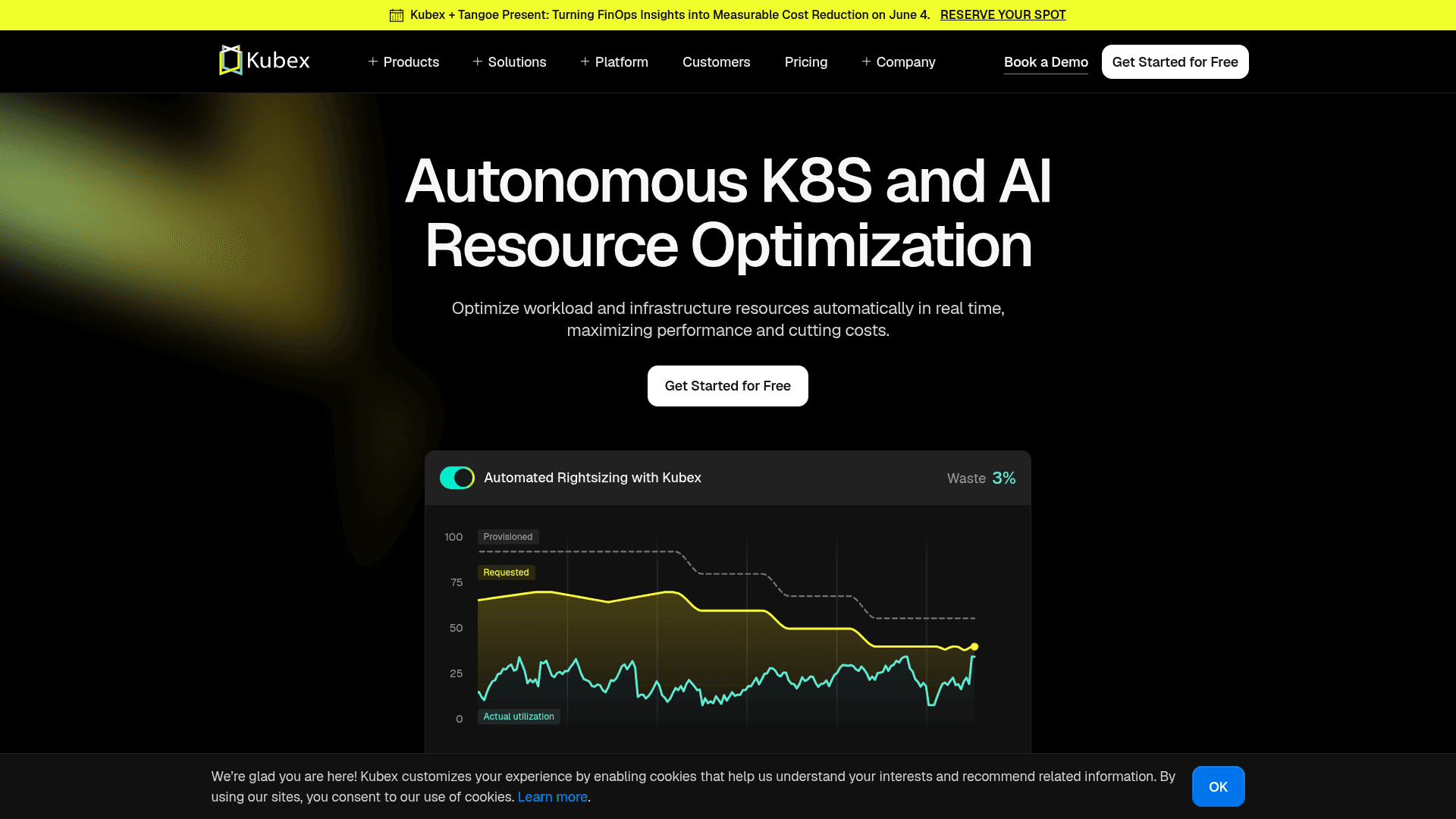
Kubex sits in the cloud resource optimization category, providing autonomous recommendations and automated execution for Kubernetes workloads and cloud infrastructure. Rather than relying on reactive autoscalers that respond to thresholds, the platform analyzes long-term usage trends to proactively set resource requests before peaks occur. The GigaOm Kubernetes Resource Optimization Solutions Report 2026 describes Kubex's core strength as predicting future resource needs based on historical data, and classifies it as an Outperformer due to its accelerated innovation roadmap and deep support for GPU optimization and Model Context Protocol (MCP).
How the Optimization Engine Works
Kubex deploys a collector (typically as a DaemonSet) into Kubernetes clusters to gather CPU, memory, and optionally disk and network I/O metrics from pods, containers, and nodes. It ingests data from Prometheus and cloud service provider instrumentation, and on the Enterprise tier also supports third-party observability metrics ingestion. The engine then:
- Identifies usage patterns, peaks, and seasonality across containers, deployments, and namespaces
- Generates optimal CPU and memory recommendations per container or pod
- Surfaces risk-categorized findings (overprovisioned, underprovisioned, anomalous)
- Executes changes autonomously via the Kubex Automation Controller, with policy guardrails that respect maintenance windows and approval workflows
GigaOm notes that this framework ensures automated changes in production are audit-compliant and risk-free.
GPU and AI Infrastructure Support
Beyond standard Kubernetes rightsizing, Kubex extends optimization to GPU workloads. The platform provides Multi-Instance GPU (MIG)-aware optimization, helping teams identify underutilized GPU slices and recommend optimal configurations. Specific capabilities include:
- Modeling NVIDIA GPU types and controlling GPU-to-memory ratios
- Tracking aggregate node-level GPU and GPU memory utilization
- Evaluating GPU slicing algorithms: time slicing, MIG, and Multi-Process Service (MPS)
- Recommending optimal GPU types based on workload requirements (GPU Model Selector)
- Planning MIG partitioning for efficient sharing (NVIDIA MIG Planner)
Platform Coverage and Integrations
Kubex supports a broad range of Kubernetes distributions and cloud providers:
- Kubernetes distributions: AKS, EKS, GKE, OKE, ECS, NKP, OpenShift, RKE2, K3S
- Cloud providers: AWS, Azure, GCP, Oracle Cloud
- On-premises deployments are also supported
- Agent interfaces: UI, CLI, and MCP (Model Context Protocol)
- Automation integrations: Helm, Terraform, Pulumi, and other IaC frameworks; GitOps pipelines; HPA, VPA, and KEDA autoscalers
- Observability: Prometheus, Datadog, CloudWatch (Enterprise tier adds third-party observability ingestion)
The platform is available on AWS Marketplace and Azure Marketplace, and Kubex is a member of the FinOps Foundation, Linux Foundation, and CNCF.
Target Audience and Enterprise Positioning
Kubex targets platform engineers, SREs, AI/ML and GPU infrastructure teams, AI factory operations, and FinOps practitioners. The GigaOm report states the platform is suited for large enterprises and platform engineering teams that require deep, audit-compliant optimization across hybrid estates, with traction in financial services, insurance, and large enterprises where governance and safety are paramount. Customer testimonials published on the Kubex website reference cost reductions in the hundreds of thousands to over a million dollars annually, attributed to eliminating overprovisioned cores and memory.
Update: GigaOm Leader Recognition and MCP Support
The GigaOm Kubernetes Resource Optimization Solutions Report 2026 ranks Kubex as a Leader in two vendor reports and classifies it as an Outperformer. The report specifically highlights Kubex's new support for GPU optimization and Model Context Protocol (MCP) as a leap forward in making optimization accessible and explainable for engineers. The product was previously known as Densify (densify.com redirects to kubex.ai), reflecting a rebranding to Kubex.
Community Discussions
Be the first to start a conversation about Kubex
Share your experience with Kubex, ask questions, or help others learn from your insights.
Pricing
Free Trial
Free access to Kubex for the first 60 days.
- Kubernetes resource optimization
- Automated Pod Scaler
- Node Optimizer
- Node Pre-Warmer
- Predictive Pod Scaler
Kubernetes Resource Optimization
Per-vCPU monthly pricing for Kubernetes and cloud infrastructure optimization. GPU features not included.
- Automated Pod Scaler
- Node Optimizer
- Node Pre-Warmer
- Predictive Pod Scaler
- Bin Packer
- HPA Optimizer
- New Container Sizer
- AI Agent
- Predictive Instance Selection
- ASG/VMSS Scaling + Family Optimization
- RDS Optimization
- IaC Framework Based Automation
- Supports AKS, EKS, GKE, OKE, ECS, NKP, OpenShift, RKE2, K3S
- Helm Deployed, SaaS Delivered
- UI, CLI, MCP agent interface
- Prometheus and CSP Instrumentation
- Email, Slack or Live support
Enterprise K8s and GPU Optimization
Enterprise plan with full GPU optimization, SSO, third-party observability ingestion, and on-prem automation policies. Contact sales for pricing.
- All Kubernetes Resource Optimization features
- GPU Resource Optimizer
- GPU Model Selector
- NVIDIA MIG Planner
- GPU Observer
- SSO integration
- On-Prem Automation Policies
- 3rd Party Observability Metrics Ingestion
- UI, CLI, MCP agent interface
- Email, Slack or Live support
Capabilities
Key Features
- Autonomous Kubernetes resource rightsizing
- GPU/AI infrastructure optimization
- Cloud instance optimization
- Automated Pod Scaler
- Node Optimizer
- Node Pre-Warmer
- Predictive Pod Scaler
- Bin Packer
- HPA Optimizer
- New Container Sizer
- AI Agent for cluster insights
- Predictive Instance Selection
- ASG/VMSS Scaling and Family Optimization
- RDS Optimization
- IaC Framework Based Automation
- GPU Resource Optimizer
- GPU Model Selector
- NVIDIA MIG Planner
- GPU Observer
- Policy guardrails and maintenance windows
- Audit-compliant automated changes
- Prometheus and CSP instrumentation data collection
- MCP (Model Context Protocol) interface
- CLI and UI agent interfaces
- Helm-deployed SaaS delivery
- On-premises automation policies
- SSO integration (Enterprise)
- Interactive dashboards and reporting