
kwant
Open-source, self-hosted team of AI bots in one binary that share chats, hand off work, and run routines on a schedule.
At a Glance
Self-hosted core under MIT OR Apache-2.0 licenses; runs on a laptop or VPS. External costs for Claude/Codex/Grok accounts or API keys are separate.
Engagement
Available On
Listed Oct 2026
About kwant
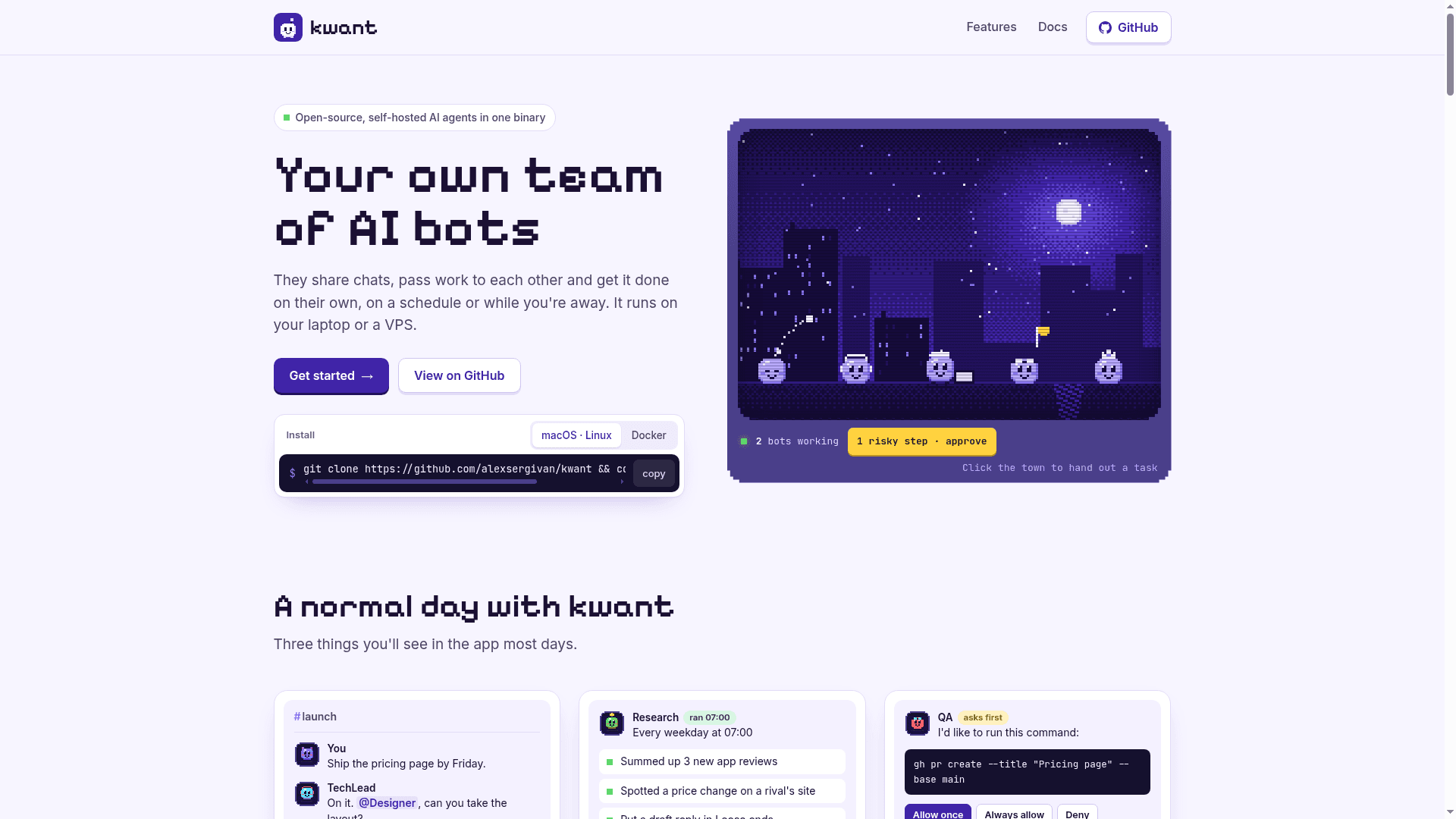
kwant is an open-source, self-hosted platform from alexsergivan that gives you a team of AI bots in a single binary. The bots share chats, hand work to each other with an @mention, and run on a schedule or while you are away. It runs on a laptop or a VPS using the Claude, Codex or Grok CLI you already use, or your own API keys.
What It Is
kwant is a multi-agent chat and automation app. Each bot has its own role, voice and model, and a team lead can run a short discussion and post a single summary. Work is organized into separate spaces, each with its own bots, teams, channels, routines and accounts. The binary bundles the web app and an SQLite database, and data lives in one local folder.
Autonomy and approvals
Ordinary work runs without interruption. In the default mode, risky steps such as a git push, a network call or a change outside the bot's folder show an approval card with the exact command, offering Allow once, Always allow or Deny. Approval modes can be set per space or per bot. Bots can create routines, channels and bots on request, each with an Undo, and imported bots arrive with no tools or keys.
Working while you're away
Routines can be set by asking for something like "every morning", or by using daily, weekly, interval or cron schedules. A While you were away page lists what is waiting, finished or failed. Loose ends finds unanswered questions and promises in chats, email and GitHub and drafts replies without sending them. Letters extracts the sender, request, deadline and amounts from a photographed bill or notice. Parallel Universe compares up to three deployment options in local sealed containers with dated price estimates.
Accounts, tools and setup
Multiple accounts per engine are supported, including Claude, Codex and Grok CLI logins, Anthropic, OpenAI and xAI keys, and OpenAI- or Anthropic-compatible servers, with failover when one runs out of usage. Any MCP server can be added, and Composio is optional for services such as Gmail, Slack and Notion. Building requires Rust and Node.js plus one AI account; it can run via make or Docker Compose, with Local or VM computer mode.
Community Discussions
Be the first to start a conversation about kwant
Share your experience with kwant, ask questions, or help others learn from your insights.
Pricing
Open Source
Self-hosted core under MIT OR Apache-2.0 licenses; runs on a laptop or VPS. External costs for Claude/Codex/Grok accounts or API keys are separate.
- Self-hosted single binary
- Team of AI bots with handoffs
- Spaces with separate bots, chats, routines and accounts
- Routines on a schedule
- Approval cards for risky steps
Capabilities
Key Features
- Teams of bots with roles, personas and @mention handoffs
- Team discussions with lead summary
- Separate spaces with own bots, routines and accounts
- Multiple accounts per engine with failover
- Approval cards with per-space and per-bot modes
- Scheduled routines including cron rules
- While you were away summary page
- Loose ends detection with draft replies
- Letters extraction from photographed documents
- Parallel Universe deployment comparison in sealed containers
- Per-bot memory and approved skills
- Import bots from Grok, ChatGPT, Claude or files
- Search across all chats in a space
- MCP server support
- Local or VM (Docker) computer mode
- Shared browser for bots
- Saved passwords with optional Bitwarden
- Laya model router
- Mobile-friendly web app