
langgraph-bigtool
A Python library for building LangGraph agents that can access and semantically search hundreds or thousands of tools using LangGraph's memory store.
At a Glance
About langgraph-bigtool
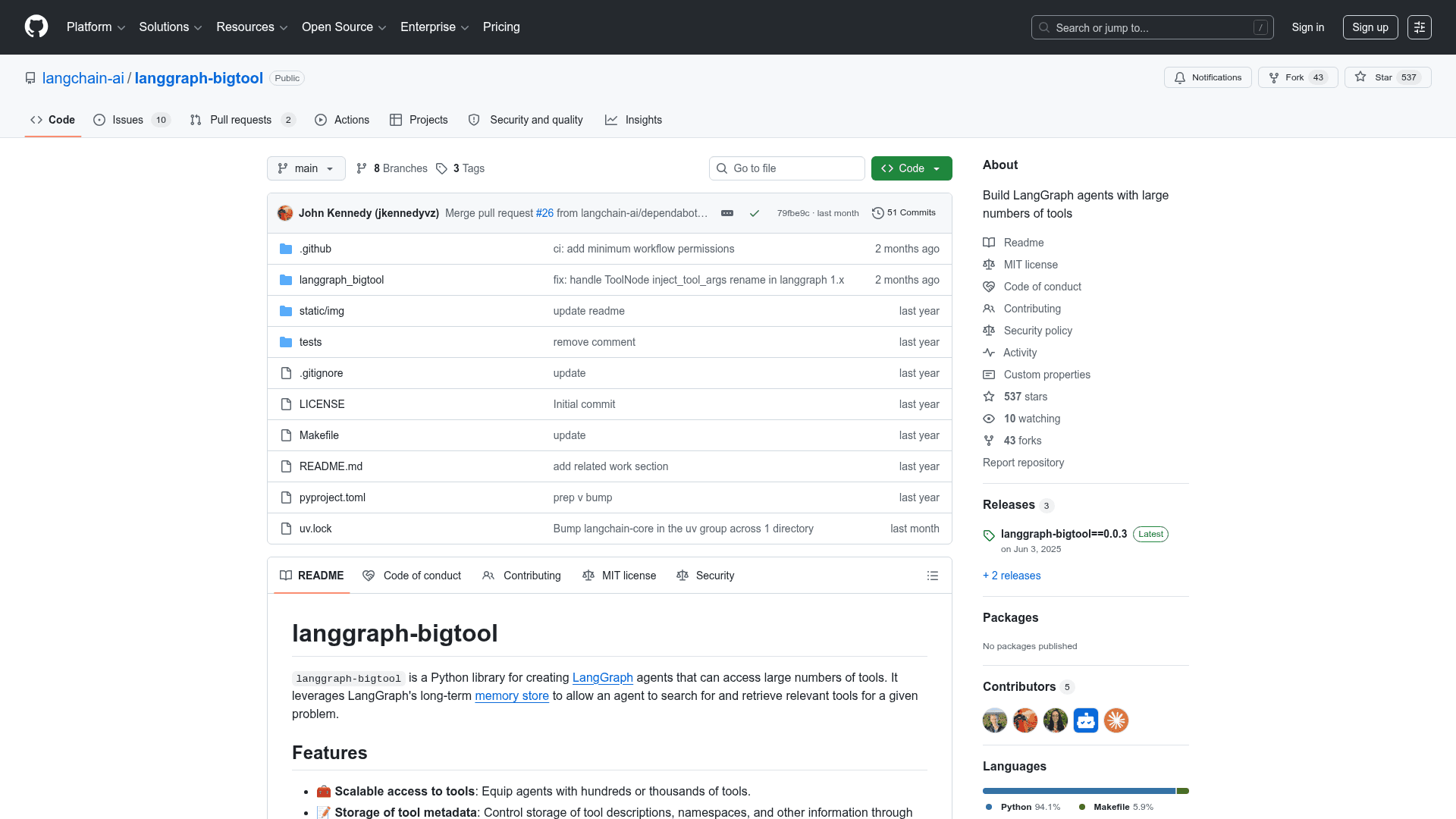
langgraph-bigtool is an open-source Python library from LangChain AI that extends LangGraph agents to handle large-scale tool registries. Rather than loading all tools into a single LLM context, it uses semantic search over LangGraph's built-in memory store to retrieve only the relevant tools for a given query. The project was created in March 2025 and has accumulated over 500 GitHub stars.
What It Is
langgraph-bigtool solves a practical scaling problem in LLM agent design: most LLMs have limits on how many tools they can handle in a single invocation. This library introduces a retrieval layer — the agent first calls a retrieve_tools function to find relevant tools from a registry, then uses those tools to answer the query. It is installed via pip install langgraph-bigtool and is built entirely on top of LangGraph.
How the Tool Retrieval Architecture Works
The core pattern involves two components: a tool registry (a dict mapping unique IDs to tool instances) and a LangGraph Store (used to index tool names and descriptions for semantic search). At runtime, the agent:
- Receives a user query
- Calls
retrieve_toolswith a search query to find relevant tool IDs - Loads and executes only those tools
The library ships with a default retrieval function using LangGraph's semantic search, but developers can pass custom retrieve_tools_function or retrieve_tools_coroutine arguments to create_agent for arbitrary retrieval logic — including category-based routing that doesn't require vector search at all.
Storage Backends and Persistence
Tool metadata (descriptions, namespaces, and other fields) is stored through LangGraph's persistence layer. The library supports:
- In-memory store (
InMemoryStore) for development and testing - Postgres backend (
PostgresStore) for production deployments
This means tool registries can persist across sessions and scale to production workloads without changes to the agent logic.
Customization and Extensibility
Developers can override the default retrieval behavior entirely. Custom retrieval functions can accept arbitrary arguments — for example, a Literal type-hinted category argument that routes the LLM to billing or service tool sets without any vector search. The library also includes a utility (convert_positional_only_function_to_tool) to handle edge cases like Python's built-in math library functions, which use positional-only arguments incompatible with standard tool wrapping.
Update: Version 0.0.3
The latest release is langgraph-bigtool==0.0.3, published on June 3, 2025. The repository was created on March 3, 2025, and last pushed to in April 2025, indicating active early development. The project references several academic papers on tool retrieval and RAG-tool fusion (including arXiv:2410.14594 and arXiv:2502.07223), signaling alignment with ongoing research in scalable agent tool use.
Related Ecosystem
langgraph-bigtool is part of the broader LangChain AI ecosystem and inherits LangGraph's built-in support for streaming, short-term and long-term memory, and human-in-the-loop workflows. It is designed to complement rather than replace standard LangGraph agent patterns, adding a retrieval layer on top of the existing framework.
Community Discussions
Be the first to start a conversation about langgraph-bigtool
Share your experience with langgraph-bigtool, ask questions, or help others learn from your insights.
Pricing
Open Source
Free and open-source under the MIT License. Install via pip and use without restrictions.
- MIT License
- Full source code access
- pip installable
- Community support via GitHub
Capabilities
Key Features
- Scalable access to hundreds or thousands of tools
- Semantic search over tool registry using LangGraph memory store
- In-memory and Postgres storage backends for tool metadata
- Customizable tool retrieval functions
- Support for streaming, short-term and long-term memory, and human-in-the-loop
- Category-based tool routing without vector search
- Utility for converting positional-only functions to tools