
Lathe
Open-source Go CLI and LLM skills that generate hands-on technical tutorials you work through yourself in a local web UI.
At a Glance
Lathe is a self-contained Go CLI and skills bundle released under the MIT License. Use, modify and distribute it free of charge.
Engagement
Available On
Alternatives
Listed Oct 2026
About Lathe
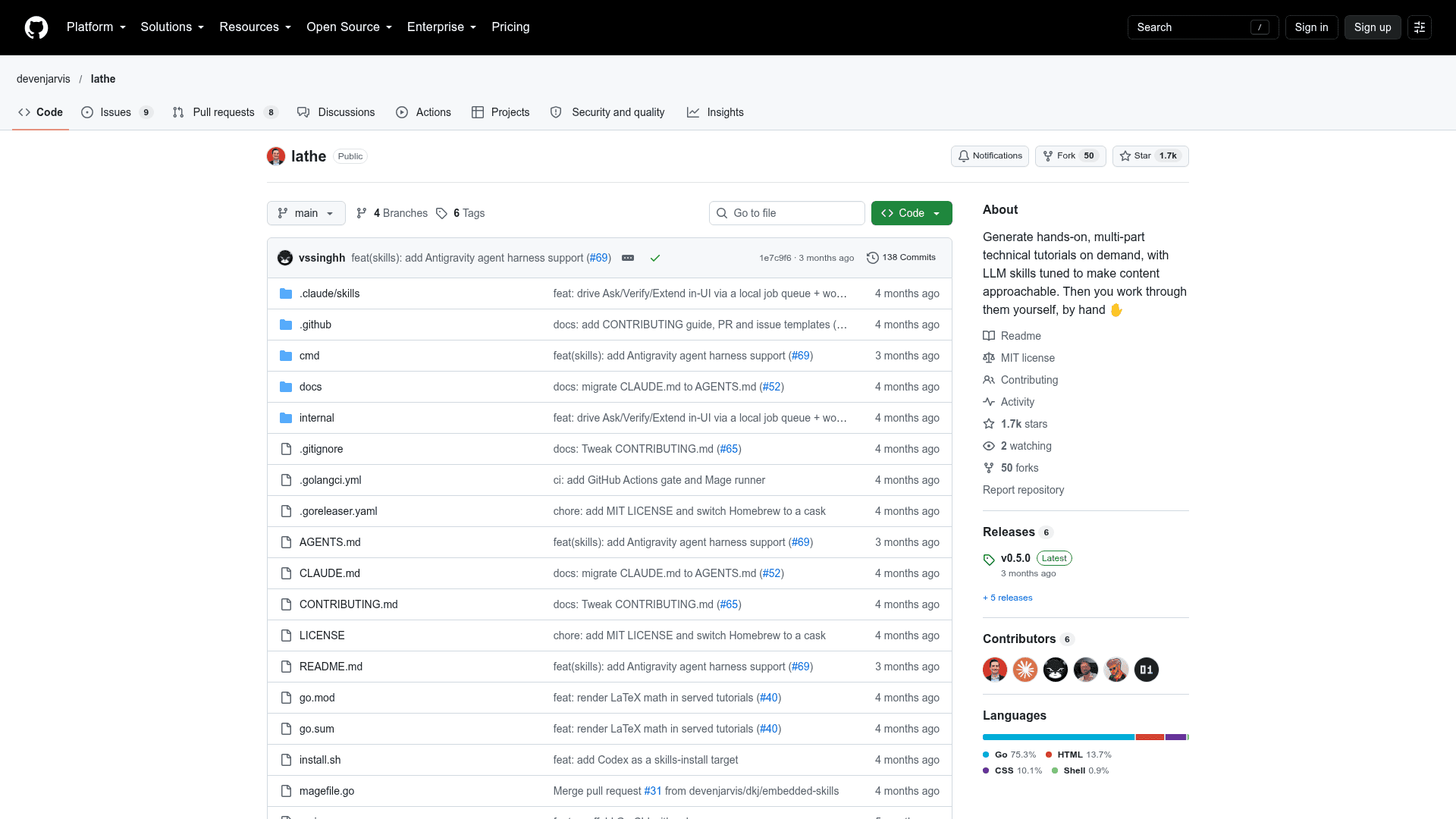
Lathe is an open-source experiment by Deven Jarvis in using LLMs to teach rather than think for you. It pairs a set of coding-agent skills with a Go CLI that stores generated tutorials and serves them in a local reader. The latest release listed is v0.5.0.
What It Is
Lathe generates hands-on, single-part or multi-part technical tutorials from any prompt, such as /lathe build a 3D Slicer in Erlang, run inside a coding agent. The README lists Claude Code, Cursor, Codex, Gemini CLI, opencode, Cline, and Windsurf as supported agents. You then read and work through the tutorial by hand in a local UI started with lathe serve, which serves at localhost:4242 by default. The binary never calls a model itself; all model work runs in your interactive agent session.
How the Workflow Runs
Skills cover the tutorial lifecycle: /lathe writes the first part, /lathe-extend adds the next part, /lathe-verify works through the steps to confirm they compile and run, /lathe-ask answers questions about a part, /lathe-tag adds search tags, and /lathe-voice creates custom voices. With /lathe-work running, the Ask, Verify, and Add a part buttons in the UI drive the agent session directly. Without it, the buttons give you the command to paste.
Reading, Library, and Provenance
The reader provides a table of contents, side-notes, and exercises at the end of each tutorial. Tutorials are stored in ~/.lathe/tutorials/ with a metadata.json recording tags, tool versions, sources, voice, and the model used. The list page offers client-side search, sorting, and filters by status, type, tag, and version. Each tutorial records the URLs consulted and shows an authorship byline.
Writing Voices and Verification
Voices change how the prose sounds without altering structure or accuracy. The plainspoken voice is the default and companion is a warmer first-person option. Verification is opt-in: it runs each step in a scratch directory and records verified, failed, or skipped, with skipped used when the required toolchain is missing. The author states that tutorials are LLM-generated and can contain errors, and that testing so far has been on Claude Code and macOS.
Setup Path
Install via Homebrew cask (macOS), an install script, go install (Go 1.25+), or from source, then run lathe skills install to place skills for your agent. Local models work by pointing your coding agent at an OpenAI-compatible endpoint.
Community Discussions
Be the first to start a conversation about Lathe
Share your experience with Lathe, ask questions, or help others learn from your insights.
Pricing
Open Source
Lathe is a self-contained Go CLI and skills bundle released under the MIT License. Use, modify and distribute it free of charge.
- MIT License (OSI-approved)
- Single self-contained binary
- Local web UI via `lathe serve`
- Skills work in Claude Code, Cursor, Codex, Gemini CLI, opencode, Cline and Windsurf
- Model/agent subscription costs are external and not sold by Lathe
Capabilities
Key Features
- Generates single-part or multi-part hands-on tutorials from a prompt
- Local web reader with table of contents, side-notes, and exercises
- Ask, verify, and extend skills for existing tutorials
- Live worker mode via /lathe-work or copy-paste fallback
- Library search, sorting, and filters by status, type, tag, and version
- Source provenance and authorship byline per tutorial
- Selectable and custom writing voices
- Opt-in verification of tutorial steps
- Light and dark mode
- Skills installable for multiple coding agents