
LayoutLens
AI-powered visual UI testing library combining deterministic WCAG accessibility audits via axe-core with optional natural-language visual checks through vision LLMs.
At a Glance
Fully free and open source under the MIT License. All features available at no cost.
Engagement
Available On
Alternatives
Listed Aug 2026
About LayoutLens
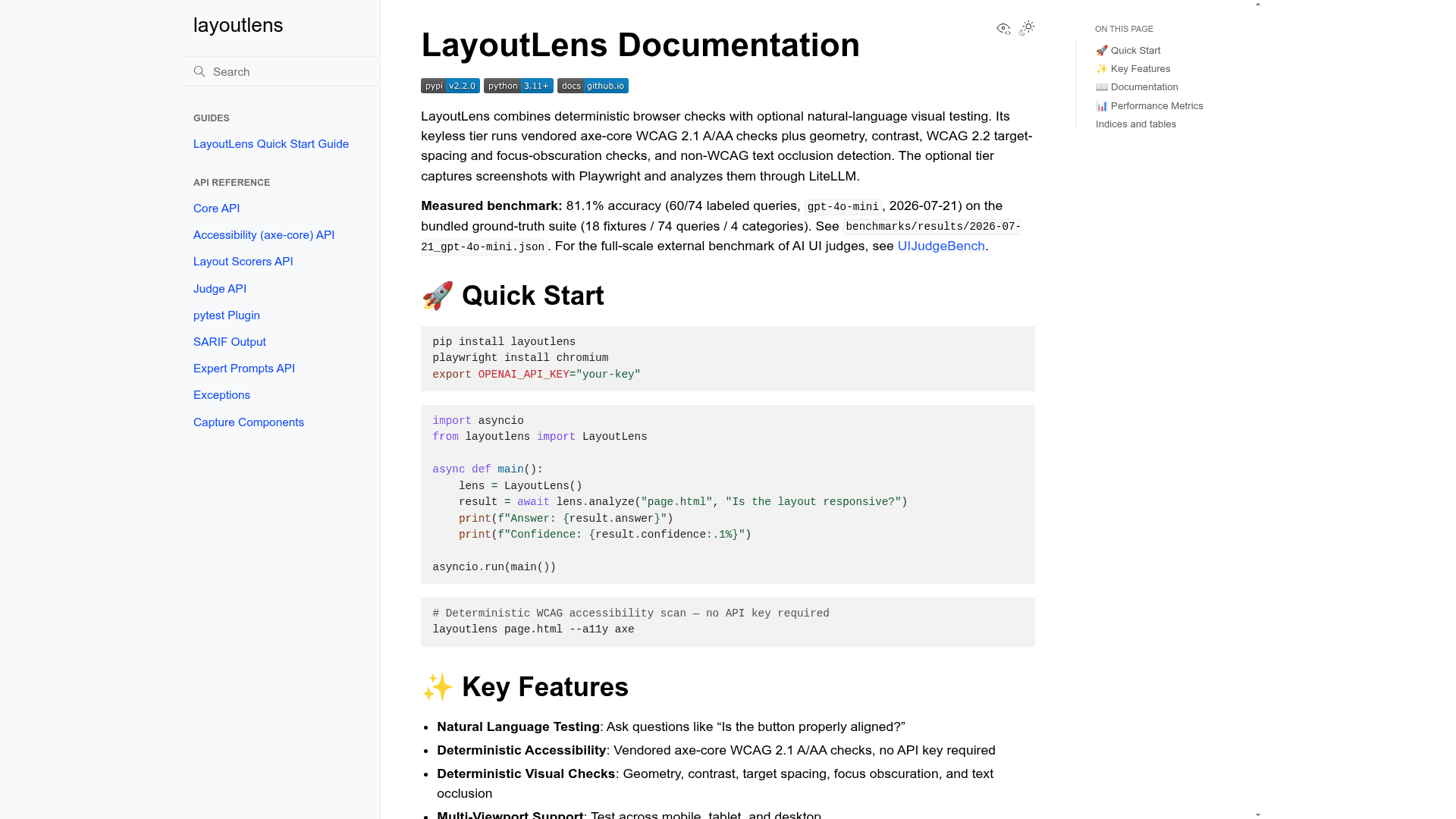
LayoutLens is an open-source Python library for AI-assisted UI testing, published under the MIT License by the gojiplus organization. It combines deterministic browser-based checks — vendored axe-core WCAG 2.1 A/AA audits, geometry scorers, contrast analysis, and text-occlusion detection — with an optional vision-LLM tier powered by LiteLLM. The library is available on PyPI and targets Python 3.11+, with Playwright used for screenshot capture.
What It Is
LayoutLens is a UI testing framework that operates across three tiers: a fully keyless deterministic tier (axe-core + geometry/contrast scorers), a hybrid tier where deterministic findings ground and can override LLM verdicts, and a pure LLM tier for natural-language visual questions. The deterministic tier requires no API key and is designed as a reliable CI gate; the LLM tier accepts any LiteLLM-compatible provider including self-hosted Ollama and vLLM endpoints. The project reports 81.1% measured accuracy on its bundled benchmark suite (60/74 labeled queries, gpt-4o-mini, measured 2026-07-21).
Architecture: Three-Tier Testing Model
The library's design separates concerns across three distinct tiers:
- Deterministic tier — vendored axe-core 4.10.3 runs WCAG 2.1 A/AA checks against a real Playwright-rendered page;
LayoutScorerdetects contrast failures, element overlap, clipping, viewport protrusion, undersized targets (WCAG 2.5.8), focus obscuration (WCAG 2.4.11), and text occlusion. No API key or network call required; confidence is always 1.0. - Hybrid tier (default for accessibility checks) — axe-core findings are injected into the LLM prompt as grounding context; any measured violation deterministically forces the verdict to "no" regardless of the model's answer.
- LLM tier — natural-language questions answered from a Playwright screenshot via any vision model; the
judge()method sends prompts verbatim for use as an external evaluation harness.
Integration Points
LayoutLens integrates across several developer workflows:
- pytest plugin — registers automatically on install;
assert_a11yandassert_layoutare keyless;assert_uiskips (never fails) without an API key or with--layoutlens-no-llm - CLI —
layoutlens page.html --a11y axefor keyless scans;--output sarifemits SARIF 2.1.0 for GitHub Code Scanning upload viagithub/codeql-action/upload-sarif - GitHub Actions — a packaged
gojiplus/layoutlens-action@v1bundles install, scan, PR annotations, a sticky results comment, and SARIF upload - MCP server —
layoutlens[mcp]exposesaudit_accessibility,scan_layout,check_ui, andcompare_uias MCP tools for Claude Code, Cursor, and compatible coding agents - LiteLLM — any provider supported by LiteLLM works, including OpenAI, Gemini, and self-hosted models via
api_base
Benchmark and Evaluation Design
The bundled benchmark covers 18 HTML fixtures and 74 labeled yes/no queries across four categories: responsive design (95.2% accuracy), layout alignment (79.2%), accessibility (76.2%), and UI components (62.5%). The evaluator scores answers deterministically — leading yes/no token vs. the answer key; ambiguous answers count as incorrect. The committed artifact benchmarks/results/2026-07-21_gpt-4o-mini.json is a real measured run. For a larger external benchmark (4,000+ machine-verified items), the README points to the companion UIJudgeBench project on GitHub and Hugging Face.
The README explicitly documents limitations: vision LLMs miss fine-grained UI differences (citing arXiv 2605.29615 showing frontier models at 47.2% overall on DiffSpot), axe-core passing is not full WCAG conformance, and the bundled benchmark is intentionally small and narrow.
Update: v2.2.0
The latest release is v2.2.0, published 2026-08-18, with the repository last pushed 2026-08-25. A notable breaking change introduced in v1.7.0 requires every YAML test-suite case to declare expected_results (an answer field and/or a contains list); cases without it now raise ValidationError at load time. The batch judging API (judge_batch) supports provider-native async Batch APIs for OpenAI, Gemini, and LiteLLM file-based backends, with content-addressed resume manifests and per-manifest locking. Manifests created before v2.1.1 fail closed with explicit migration details.
Community Discussions
Be the first to start a conversation about LayoutLens
Share your experience with LayoutLens, ask questions, or help others learn from your insights.
Pricing
Open Source
Fully free and open source under the MIT License. All features available at no cost.
- Deterministic axe-core WCAG 2.1 A/AA audits (keyless)
- Deterministic layout scorers (keyless)
- Natural-language LLM visual testing (requires own API key)
- pytest plugin
- CLI with SARIF output
Capabilities
Key Features
- Deterministic axe-core WCAG 2.1 A/AA accessibility audits (keyless)
- Deterministic layout scorers: contrast, overlap, clipping, viewport protrusion, target size, focus obscuration, text occlusion
- Natural-language visual testing via vision LLMs (LiteLLM-compatible)
- Hybrid mode: deterministic findings ground and can override LLM verdicts
- Multi-viewport support: mobile, tablet, desktop
- pytest plugin with keyless assert_a11y and assert_layout assertions
- CLI with SARIF 2.1.0 output for GitHub Code Scanning
- MCP server exposing audit_accessibility, scan_layout, check_ui, compare_ui tools
- GitHub Actions integration via gojiplus/layoutlens-action
- Batch testing with concurrent async processing
- YAML/JSON test suite support
- LLM judge API with verbatim prompt passthrough
- Batch judging with provider-native async Batch APIs (OpenAI, Gemini, LiteLLM)
- 6 built-in domain experts: accessibility, conversion, mobile, ecommerce, healthcare, finance
- Self-hosted model support via api_base (Ollama, vLLM)
- Structured JSON output with TypedDict schemas
- Bundled benchmark suite (18 fixtures / 74 labeled queries)