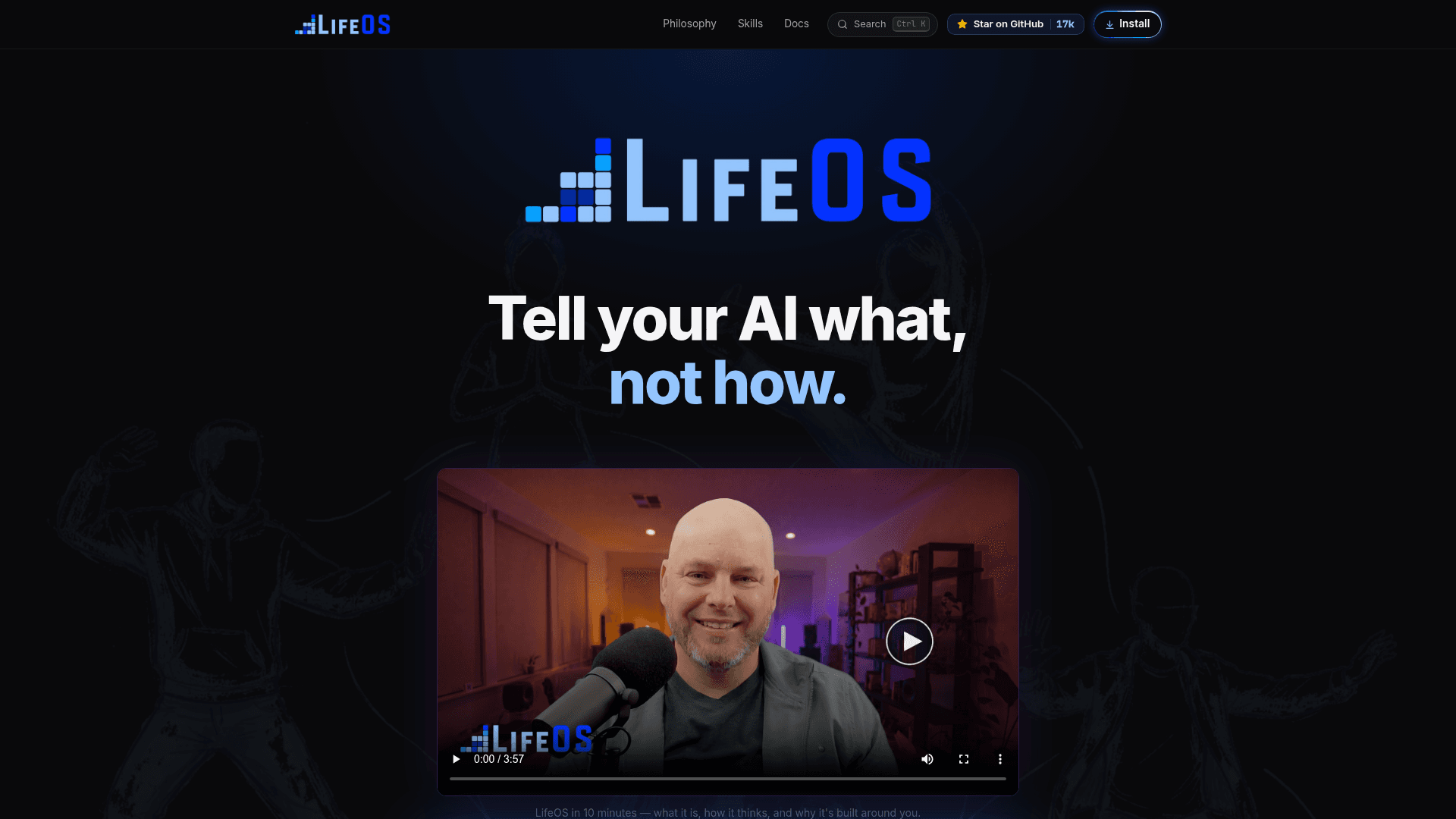
LifeOS
An open-source AI harness that captures your goals, context, and ideal state, then conveys that intent to your AI on every task to move you from current state to ideal state.
At a Glance
About LifeOS
LifeOS is an open-source, MIT-licensed AI harness created by Daniel Miessler and built primarily on TypeScript and Bun. It sits on top of AI coding agents like Claude Code, Cursor, or Codex and adds a persistent, context-aware layer that knows your goals, people, and preferences — so you stop re-explaining yourself on every task. The project reached version 7.28.3 as of August 2026 and has accumulated over 17,000 GitHub stars.
What It Is
LifeOS describes itself as an "intent engineering platform" — a layer above raw AI capability that captures what you ultimately want to achieve and conveys that intent to your AI on every task, then verifies the result against it. Where prompt engineering focuses on how to ask AI, intent engineering focuses on what you're trying to accomplish. The system is organized around one central concept: moving from your Current State to your Ideal State, with every component designed to close that gap incrementally.
Core Architecture
LifeOS ships as a single self-contained skill directory that bundles the entire library. Its named subsystems each handle a distinct concern:
- TELOS — captures your mission, goals, beliefs, and challenges via an interview; reasoned against on every task
- The Algorithm — a unified thinking loop (Observe → Think → Plan → Build → Execute → Verify → Learn) that turns a vague ask into a testable spec
- Cortex — persistent memory across sessions: hot-layer memory, a typed Knowledge Archive (People, Companies, Ideas, Research), learnings, and work history
- Synapse — the input router that catches anything, grades it, routes it, and keeps it forever
- Atlas — a live graph of everything you own, what a key unlocks, and what a single compromise would reach
- Ledger — versioned change tracking: what changed, when, and at what version
- Arbol — an execution layer of composable Unix-like units: Actions, Pipelines, and Flows
- Bunker — a universal application harness providing security, uptime, testing, and deployment from one shared chassis
- Pulse — the Life Dashboard, a live surface where you watch the system run
- Hermes Sidecar — a second front door to talk to your LifeOS as an agent from a terminal
How Installation Works
LifeOS is installed by an AI, not by a traditional package manager. You paste a single prompt into your AI coding harness — Read https://ourlifeos.ai/install and install LifeOS for me. — and the agent reads the install page and walks the full setup, asking permission before touching anything. A one-line curl shortcut is also available for Claude Code on macOS/Linux. The system requires a capable AI coding harness (Claude Code is the most-tested path) and Bun as the runtime.
Update: v7.28.3 — Cortex, Hermes, and Hardened Releases
The latest release (August 1, 2026) named and formalized several subsystems: Cortex (the memory system with hot-layer memory and a typed Knowledge Archive), Hermes (an optional second front door for agent-style terminal access), Synapse, Conduit, Feed, Atlas, and Ledger. It also added three new deterministic security gates (sanitizer-residue, licensed-font, dead-legacy-doc-pointer) and removed previously shipped commercially licensed fonts. Earlier in the v7 series, v7.0.0 ("The Bitter Pill Release") cut context size from ~88KB to ~28KB by removing reasoning choreography, self-scores, and duplicated routing — making every turn faster. v7.1.1 added a Doctor tool that reports the real state of every optional capability and a capability-aware installer.
Open-Source Model and Community
LifeOS is free and open-source under the MIT License, with the project's README stating it is "open source. Free. Forever." The public repository is generated from a private source tree, so community pull requests are ported into source with credit rather than merged directly. The project lists a roadmap including local model support (Ollama, llama.cpp), granular model routing, remote access, outbound phone calling, and external notifications via Email, Discord, Telegram, and Slack. Community discussion happens on GitHub Discussions and a Discord server.
Community Discussions
Be the first to start a conversation about LifeOS
Share your experience with LifeOS, ask questions, or help others learn from your insights.
Pricing
Open Source
Fully free and open-source under the MIT License. Free forever.
- Full LifeOS system
- All core components (TELOS, Algorithm, Cortex, Pulse, etc.)
- Complete skill library
- Community support via GitHub and Discord
- MIT License — use, modify, distribute freely
Capabilities
Key Features
- Intent engineering platform — conveys what you ultimately want to your AI on every task
- TELOS: captures mission, goals, beliefs, and challenges via interview
- The Algorithm: 7-phase thinking loop (Observe → Think → Plan → Build → Execute → Verify → Learn)
- Cortex: persistent cross-session memory with typed Knowledge Archive
- Synapse: input router that grades, routes, and stores everything
- Atlas: live graph of all assets and their relationships
- Ledger: versioned change tracking
- Arbol: composable Unix-like execution units (Actions, Pipelines, Flows)
- Bunker: universal application harness for security, uptime, testing, deployment
- Pulse: live Life Dashboard
- Hermes Sidecar: second front door for agent-style terminal access
- Voice: spoken notifications to keep you in flow
- Skill System: growing library of self-activating composable expertise units
- Hook System: code-enforced guardrails at fixed points
- ISA System: testable spec document defining what 'done' looks like
- General Hill Climbing: every goal becomes a hill, system picks the next move
- Euphoric Surprise metric: targets 9/10 responses
- Self-improvement: system modifies itself based on what it learns
- AI-native install via prompt or curl one-liner
- Harness-agnostic design (Claude Code, Cursor, Codex, etc.)
Integrations
Demo Video