
GPU rental marketplace offering per-second billed NVIDIA GPU pods via web dashboard, CLI, Python SDK, and REST API.
At a Glance
Engagement
Available On
Alternatives
Listed Oct 2026
About Lium
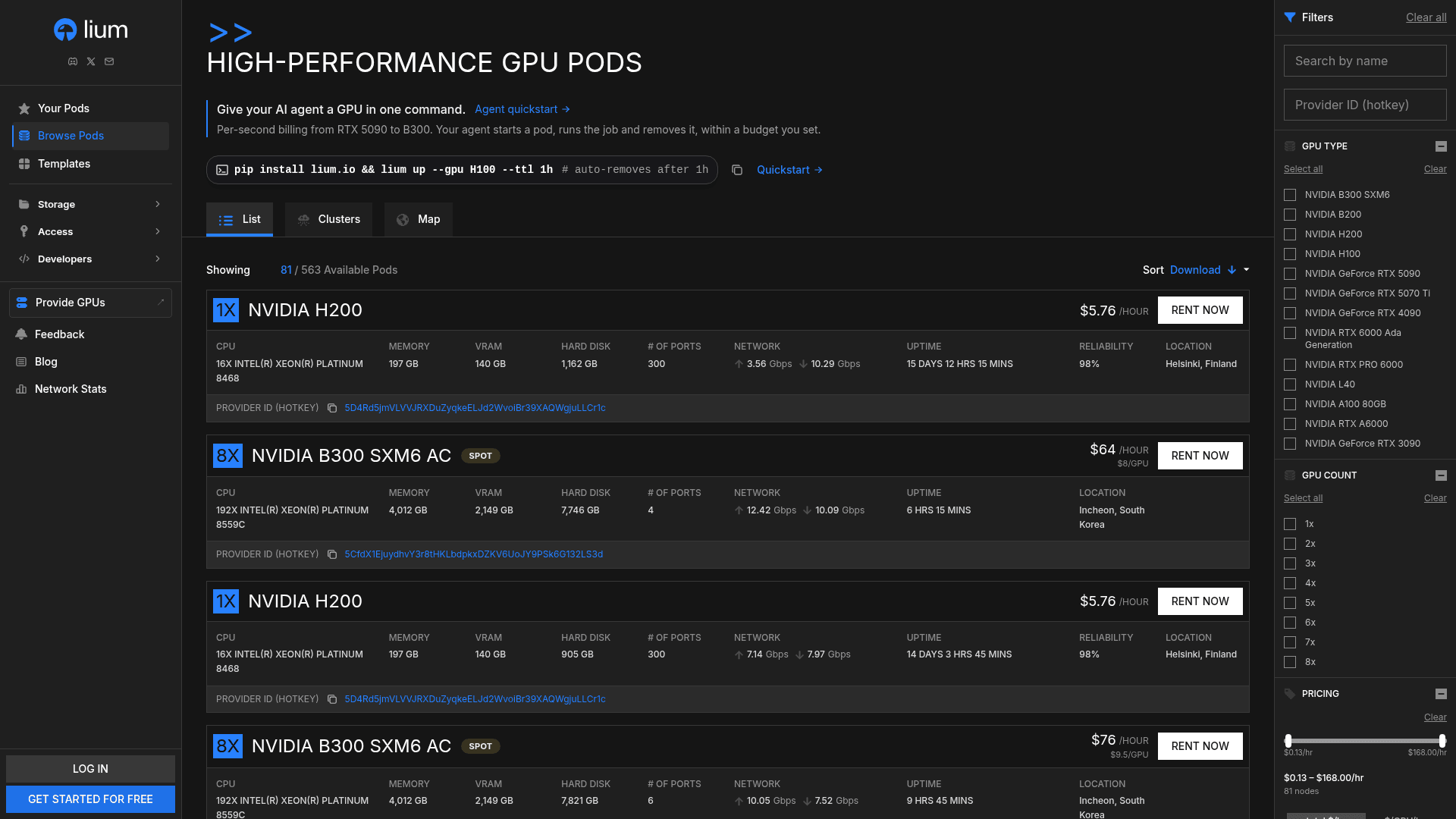
Lium is a GPU compute marketplace operated by Datura AI Corp. Renters launch containers called pods on machines supplied by independent providers, with hourly prices billed per second and no minimum rental period. Lium's homepage pitches giving an AI agent a GPU in one command, with a budget and an auto-removal timer.
What It Is
Lium connects GPU providers with renters. Providers connect their machines (nodes) and set their own price per GPU-hour, receiving 95% of the rental payment according to the Lium pricing FAQ. Renters browse live availability, filter by GPU type, count, tier (secure or spot), location, reliability, VRAM, CUDA version and more, then rent a pod. The catalog spans data center GPUs such as B300, B200, H200 and H100, professional RTX cards, and consumer cards such as the RTX 5090 and 4090.
How Renting Works
The service is prepaid: renters top up a balance by card (via Stripe) or supported cryptocurrencies, and pods draw on it per second. Starting a pod requires a balance covering 15 minutes of that pod plus 15 minutes of each pod already running. Billing stops when the pod is deleted or its scheduled end time arrives. Spot nodes are cheaper but can be reclaimed by a provider. Some nodes offer GPU splitting from a single GPU.
Tools for Developers and AI Agents
Besides the web dashboard, Lium offers a CLI (installed via a one-line script or pip), a Python SDK, and a REST API described in OpenAPI 3.1. An example command is lium up --gpu H100 --ttl 1h, which removes the pod automatically after an hour. The documentation site exposes an MCP server so agents can search and read the docs, and an agent skill for AI coding agents is published on GitHub. Machine-readable summaries are available as llms.txt and a JSON price feed.
Storage, Access and Providers
The dashboard includes volumes, backups, API keys, SSH keys and Docker credentials management, plus templates for pods. Providers manage pricing and payments in a separate Provider Portal and also earn idle pay while their GPUs are unrented. Lium states that it bans access to its compute from US-embargoed countries and sanctioned parties.
Community Discussions
Be the first to start a conversation about Lium
Share your experience with Lium, ask questions, or help others learn from your insights.
Pricing
GPU Pod Rental (B300 SXM6)
Per-second billed GPU pod rental, per GPU-hour; live asks range $7.00 – $10.50.
- Billed per second, no minimum and no reservation
- Price shown is the whole hourly price of the pod, including local disk
- Live range $7.00 – $10.50 per GPU-hour
- Persistent volume billed separately: storage per GB-hour plus data read out, at cost
- Crypto, TAO and alpha top-ups get a 2.5 % bonus
GPU Pod Rental (B200)
Per-second billed GPU pod rental, per GPU-hour; live asks range $4.00 – $7.50.
- Billed per second, no minimum and no reservation
- Live range $4.00 – $7.50 per GPU-hour
GPU Pod Rental (H200)
Per-second billed GPU pod rental, per GPU-hour; live asks range $3.39 – $5.76.
- Billed per second, no minimum and no reservation
- Live range $3.39 – $5.76 per GPU-hour
GPU Pod Rental (H100 80GB HBM3)
Per-second billed GPU pod rental, per GPU-hour; live asks range $1.31 – $3.75.
- Billed per second, no minimum and no reservation
- Live range $1.31 – $3.75 per GPU-hour
GPU Pod Rental (RTX 3090)
Per-second billed GPU pod rental, per GPU-hour; live asks range $0.20 – $0.64, the lowest starting price on the marketplace.
- Billed per second, no minimum and no reservation
- Live range $0.20 – $0.64 per GPU-hour
Capabilities
Key Features
- Per-second billing with no minimum rental period
- Live GPU marketplace with filters by GPU type, count, tier, location, reliability, VRAM and CUDA version
- Spot and secure tiers
- GPU splitting on some nodes
- CLI with auto-removal TTL for pods
- Python SDK and REST API (OpenAPI 3.1)
- MCP server for documentation
- Agent skill for AI coding agents
- Volumes, backups, SSH keys, API keys and Docker credentials management
- Pod templates
- Card and cryptocurrency top-ups
- Provider portal with idle pay and daily payouts