
LLM-as-a-Verifier
Open-source Python framework that gives fine-grained, logit-based verification scores for best-of-N selection, pairwise comparison, and progress tracking of agent trajectories.
At a Glance
LLM-as-a-Verifier Python framework released under the MIT License; free to use, copy, modify and distribute.
Engagement
Available On
Alternatives
Listed Oct 2026
About LLM-as-a-Verifier
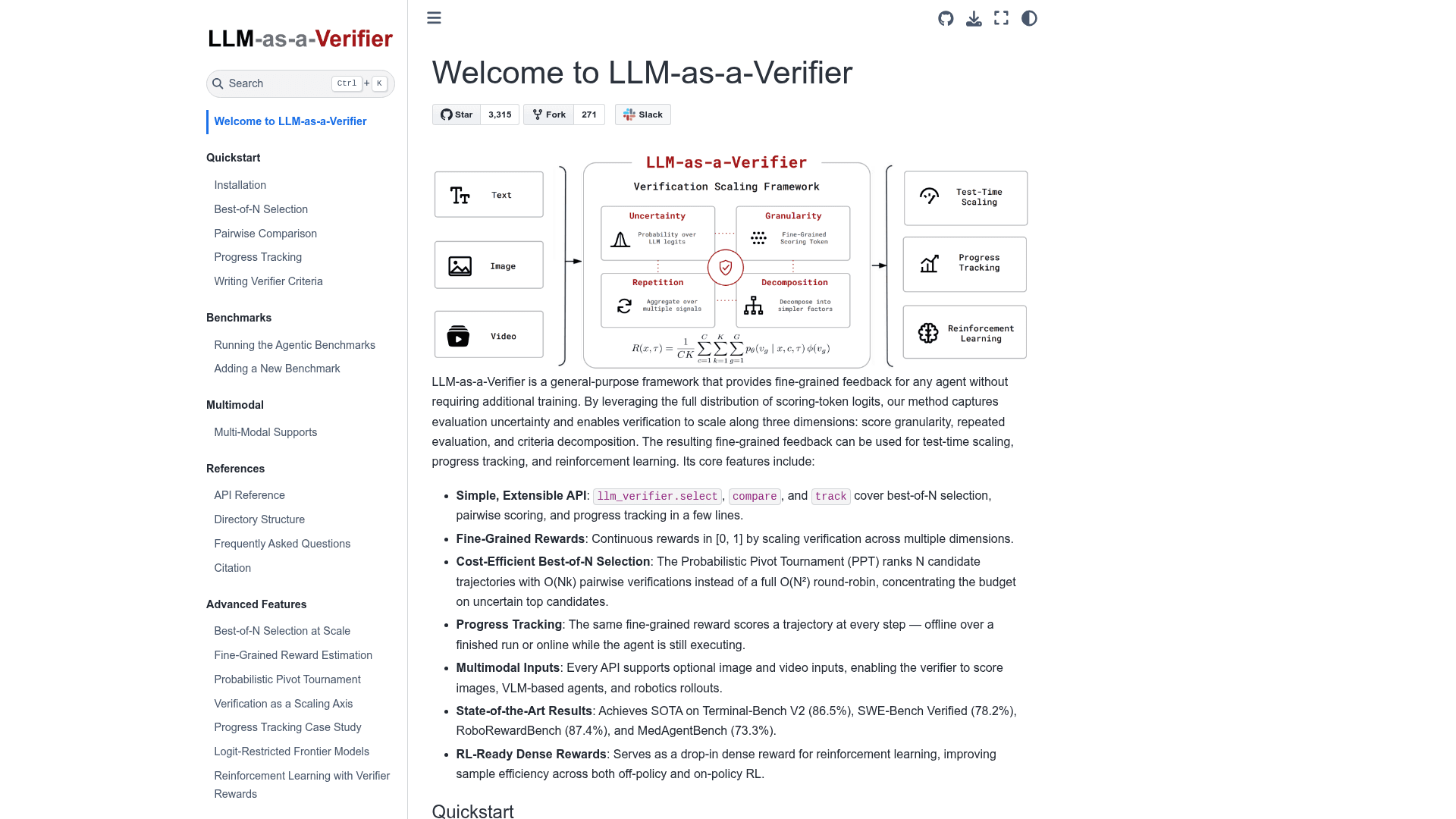
LLM-as-a-Verifier is an open-source Python framework from the LLM-as-a-Verifier team, with authors listed from Stanford, UC Berkeley and NVIDIA Research. It scores agent trajectories using the full distribution of scoring-token logits, so no additional training is needed. The scores can drive best-of-N selection, step-by-step progress tracking, and dense rewards for reinforcement learning.
What It Is
The library is installed with pip install llm-verifier and exposes three calls: select for best-of-N selection, compare for pairwise scoring, and track for progress scoring over a rollout. Instead of asking an LLM judge for a single discrete score, it takes the expectation over the logprob distribution of score tokens on a 1-20 scale. This yields continuous rewards in [0, 1] and, according to the project, avoids the ties that coarse judges produce. Verification can also be scaled by repeating evaluations and by decomposing the rubric into several criteria.
How Selection and Tracking Work
For best-of-N selection, the Probabilistic Pivot Tournament ranks candidates by comparing them against a small set of pivots. This takes O(Nk) pairwise verifications instead of a full O(N²) round-robin. A ring pass first scores adjacent pairs to cancel positional bias, and the top candidates then become pivots. For progress tracking, track scores a finished trajectory, while ProgressTracker returns a live score after each step of a running agent. Every entry point accepts optional images, which supports VLM agents and robotics rollouts.
Benchmarks and Reproduction
The repository ships agent trajectories and scripts to reproduce results on Terminal-Bench, SWE-Bench Verified and MedAgentBench. The project reports 86.5% on Terminal-Bench V2, 78.2% on SWE-Bench Verified, 73.3% on MedAgentBench and 87.4% on RoboRewardBench. It also reports improved sample efficiency when the verifier is used as a dense reward for SAC and GRPO. Users can add their own benchmark through criteria files and a documented workflow.
Setup Path
A verifier backend is needed: a DeepSeek or Vertex API key in .env, or an OpenAI-compatible server that returns logprobs, such as vLLM. A companion Claude Code plugin, TurboAgent, runs as an LLM API proxy that generates multiple candidate responses and selects the best one. Version 0.3.0 adds a Terminal-Bench 4.0 benchmark, task-agnostic criteria and an updated DeepSeek backend.
Community Discussions
Be the first to start a conversation about LLM-as-a-Verifier
Share your experience with LLM-as-a-Verifier, ask questions, or help others learn from your insights.
Pricing
Open Source (MIT)
LLM-as-a-Verifier Python framework released under the MIT License; free to use, copy, modify and distribute.
- MIT License
- Install via pip install llm-verifier
- Best-of-N selection, pairwise comparison and progress tracking APIs
- Requires your own model backend or API key (e.g. DeepSeek, Vertex, or an OpenAI-compatible server), which is an external cost
Capabilities
Key Features
- Best-of-N selection with llm_verifier.select
- Pairwise comparison with llm_verifier.compare
- Progress tracking with track and online ProgressTracker
- Fine-grained continuous rewards from score-token logprobs
- Probabilistic Pivot Tournament with O(Nk) comparisons
- Criteria decomposition and repeated evaluation
- Multimodal image and video inputs
- Dense reward signals for reinforcement learning
- Benchmark reproduction scripts and custom benchmark support
- Token usage accounting and prefix-cache optimization