
LLM Wiki
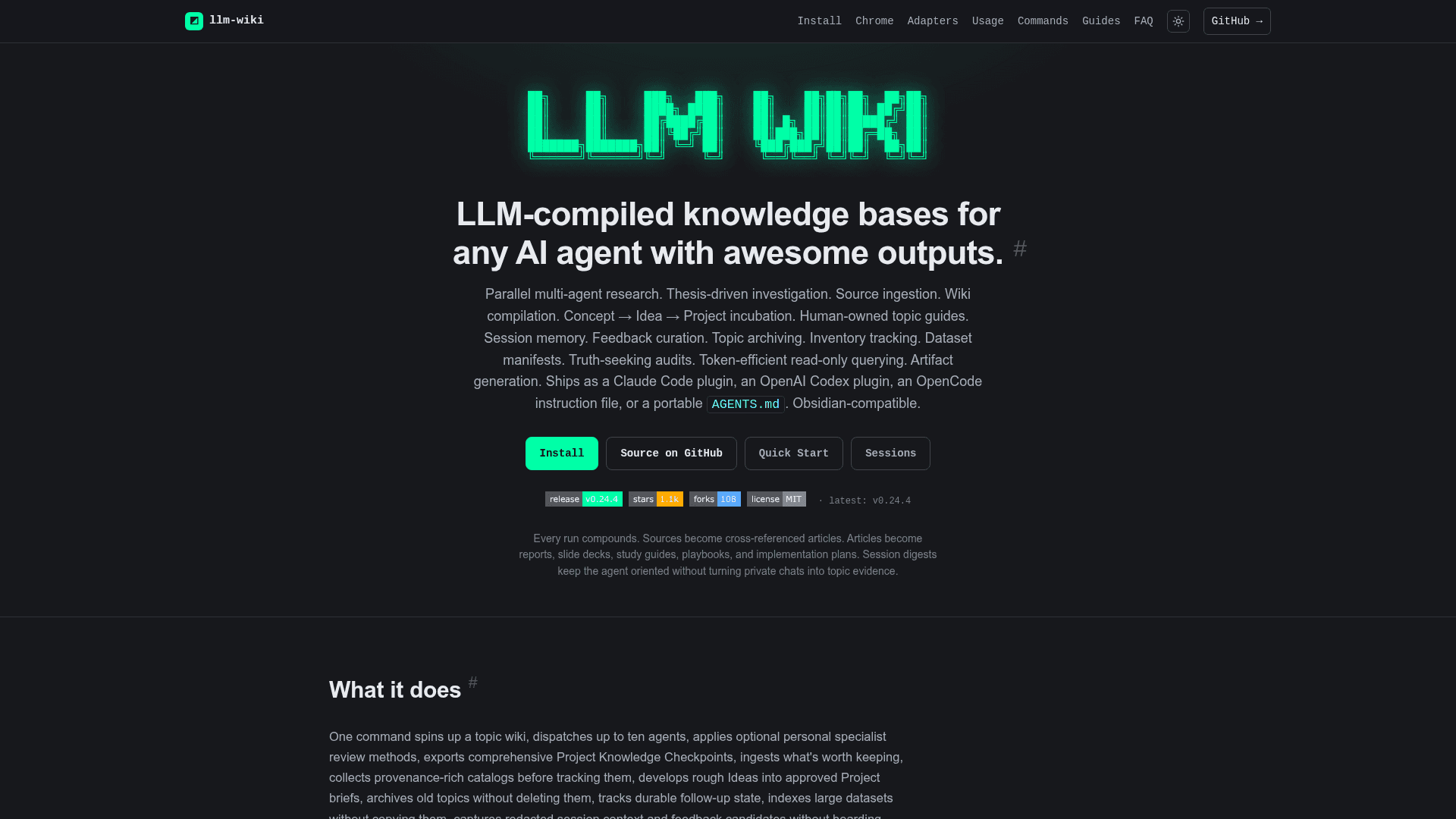
LLM-compiled knowledge bases for any AI agent, with parallel multi-agent research, thesis-driven investigation, source ingestion, wiki compilation, and artifact generation.
At a Glance
Fully free and open-source under the MIT License. Install as a Claude Code plugin, Codex marketplace plugin, OpenCode instruction file, or portable AGENTS.md.
Engagement
Available On
Listed Aug 2026
About LLM Wiki
LLM Wiki is an MIT-licensed, open-source tool that turns any LLM agent into a parallel research engine and an append-only, Markdown-native knowledge base. Created by developer nvk and inspired by Andrej Karpathy's LLM wiki concept, it ships as a Claude Code native plugin, an OpenAI Codex marketplace plugin, an OpenCode instruction file, and a portable AGENTS.md for any other LLM agent. All data is stored as plain Markdown files you own, with zero runtime dependencies.
What It Is
LLM Wiki is a command-driven knowledge management system that orchestrates multiple LLM agents to research topics in parallel, ingest and synthesize sources, and compile structured wiki articles. It sits between a research assistant and a personal knowledge base: agents search the web from different angles (academic, technical, applied, news, contrarian), ingest the best sources into an immutable raw/ layer, and compile synthesized articles with cross-references and confidence scores into a wiki/ layer. The result is a portable, Obsidian-compatible Markdown vault you can query, audit, and build deliverables from.
Research and Investigation Modes
LLM Wiki offers three research intensities and a dedicated thesis mode:
- Standard (5 agents): academic, technical, applied, news, and contrarian angles
- Deep (
--deep, 8 agents): adds historical, adjacent-field, and data/stats agents - Retardmax (
--retardmax, 10 agents): skip planning, cast the widest net, ingest aggressively, compile fast - Thesis mode (
--mode thesis): starts from a specific claim, splits agents across supporting, opposing, mechanistic, meta/review, and adjacent angles, and delivers a verdict (supported / partially supported / contradicted / insufficient evidence / mixed) rather than a summary. With--min-time, round two automatically focuses on the weaker side of the evidence to counter confirmation bias.
The --plan flag decomposes a broad topic into 3–5 parallel research paths, confirms with the user, then dispatches all paths simultaneously. The --min-time flag keeps research running in rounds—each round drilling into gaps the previous one found—for durations like 1h or 2h.
Architecture and Storage Model
The hub (~/wiki/) is a lightweight registry with no content. All content lives in isolated topic sub-wikis under topics/. Each topic wiki contains:
raw/— immutable ingested sources (URLs, files, PDFs, Git repos, MediaWiki dumps, Wayback CDX snapshots)wiki/concepts/,wiki/topics/,wiki/references/— compiled, synthesized articlesinventory/— durable operational state: items, source candidates, corpora, open questions, next actionsinventory/ideas/— rough proposals being researched and shaped before promotion to Projectsdatasets/— manifests for large or external data that stays outside the wikioutput/— generated artifacts (reports, slides, plans, glossaries)schema.md— human-owned topic guide for local vocabulary and conventions.obsidian/— Obsidian vault config for graph view and backlinks
Every directory has an _index.md; agents read indexes first and never scan blindly. Cross-references use dual-link format ([[wikilink]] plus standard Markdown) so the wiki works in Obsidian, Claude Code, GitHub, and plain text editors alike.
Session Memory and Feedback Curation
LLM Wiki includes a default-on session memory layer under HUB/.sessions/. Trusted hooks from Claude Code, Codex, OpenCode, and Gemini-style adapters write redacted checkpoints, compact Markdown digests, per-session state JSON, and feedback candidates—without storing full transcripts. The /wiki:session rehydrate command returns a compact context block so a future turn can pick up where the previous one left off. Feedback candidates (corrections, preferences, approvals, plan acceptance) accumulate under .sessions/feedback/ and are promoted into topic raw/notes/ only by explicit user action. Users can opt out entirely with /wiki:session disable.
Update: v0.24.4 — Adapter CLI Compatibility
The latest release is v0.24.4, published 2026-08-27. It adds llm-wiki adapter show <id> --json as an explicit alias for the command's existing JSON output, removing a fresh-session failure mode when an agent follows the adapter workflow using the common --json form. The deterministic CLI is synchronized across the Claude, Codex, and OpenCode packages. Notable recent milestones in the changelog include:
- v0.24.0 — Project Knowledge Checkpoints Export: comprehensive cross-topic handoffs with dry-run-first create, deterministic privacy sealing, and read-only verification
- v0.23.0 — Personal specialist framework: user-owned, instruction-only
SKILL.mdreview methods underHUB/.skills/with explicit per-topic allowlists - v0.22.0 — Declarative private-adapter routing with provider-neutral intent and exact-URL routes
- v0.18.0 — Hub-wide portfolio view across active topic wikis
The repository reports 1,127 stars and 108 forks as of the last crawl, per GitHub metadata.
Community Discussions
Be the first to start a conversation about LLM Wiki
Share your experience with LLM Wiki, ask questions, or help others learn from your insights.
Pricing
Open Source
Fully free and open-source under the MIT License. Install as a Claude Code plugin, Codex marketplace plugin, OpenCode instruction file, or portable AGENTS.md.
- Parallel multi-agent research
- Thesis-driven investigation
- Source ingestion and wiki compilation
- Session memory and feedback curation
- Project Knowledge Checkpoints Export
Capabilities
Key Features
- Parallel multi-agent research (5, 8, or 10 agents)
- Thesis-driven investigation with verdict output
- Source ingestion (URLs, files, PDFs, Git repos, MediaWiki dumps, Wayback CDX snapshots)
- Wiki compilation with cross-references and confidence scores
- Token-efficient read-only query mode
- Session memory with redacted checkpoints and rehydration
- Feedback curation and explicit promotion
- Project Knowledge Checkpoints Export with privacy sealing
- Personal specialist framework (instruction-only SKILL.md methods)
- Private adapter protocol with scoped resources and plan-bound approval
- Collector catalogs for media, memes, tools, and entities
- Inventory tracking for items, candidates, corpora, and next actions
- Dataset manifests for large external data
- Idea incubation and explicit Project promotion
- Hub-wide portfolio view
- Archive and restore topic wikis
- Artifact generation (reports, slides, study guides, plans, glossaries)
- Obsidian-compatible dual-link format
- Zero runtime dependencies
- Audit and truth-seeking across wiki, outputs, and provenance
- Librarian staleness and quality scoring
- Lint and auto-repair structural issues
- Chrome extension for bounded tab control via MCP tools